|
| Fig 1 From Hollar's Ornatus |
In the first
half of the seventeenth century the main linen headwear for women was the coif.
The coif came in several forms but most were close fitting. Hoods were around
from the beginning of the century and, from the 1640s to the 1680s, they slowly,
but never completely, replaced the coif both as a fashion item and among the
lower classes.
Another name
for a hood can be chaperon, and this is the term Cunnington (1972) uses to refer to
them. Cotgrave draws the term very wide, defining it thus ‘Chaperon, a hood, or
French hood (for a woman); also any hood, bonnet, or lettice cap.” (Cotgrave,
1611)
The OED has several references to chaperons from the first half of the 17th
century including, most explicitly, this from 1623 “Their White Hoods or
Chapperons.” (OED, 2016)
These earlier
hoods may be different to the later ones. There are a few of survivals of early
hoods, two in the V&A have been dated to 1600-1625, and 1600-1630,
both have scrolling blackwork embroidery, as did some of the coifs of
that period. Another hood in the V&A collection is dated to 1610-1620 and is of linen with insertion work
at the seams and a bobbin lace edging, a detailed examination and pattern has
been produced for this. (Lucas, 2011) There are also two hoods,
that Janet Arnold took patterns from, in the Gallery of Costume at Manchester,
they are dated between 1610 and 1625, one is of linen (accession no. 2003.73) and the other of fustian (accession no. 2003.74. (Arnold, 2008) In wear these might well look like the hood
won in Vermeer’s painting the Procuress, 1656, they have no gathering at the
back but are simply worn loose. There is also a hood in the Metropolitan Museum in New York, this they date to c.1640 and, it is very
fine, almost transparent, cotton with a bobbin lace edging. There is very
little further information on it, but the photograph of the back view gives an
indication of the construction, which is very unlike that of the earlier hoods.
The hood, like
the coif, comes in various types, in later examples it is usually gathered at
the back. Some early depictions show this style as dark and worn with winter
wear. There are two like this in Hollar’s 1640 work Ornatus
Muliebris, or the Habits
of Englishwomen. One depicts a lady in full winter mode with a face mask, cape or shawl and a
muff as well as her hood, in the second example the lady has a muff, and her hood appears to have very
large ties at the front.(Fig. 1) Hollar’s series of the Four seasons which date from
1644 show, in the full length versions, both Autumn and Winter wearing hoods, the Winter appearing
to have a light coloured lining to the hood and a lighter hood/coif being worn
underneath. The three quarter length seasons also show Autumn and Winter with hoods. Hollar’s two works from
later in the 1640s, his Theatrum Mulierum and Aula Veneris, which depict dress of women across
Europe, Hollar was very good at picking up regional differences in clothing,
have only three women with hoods. Two of these are English, a noble woman and a gentlewoman. The third, which gives a good rear
view of a hood is dated 1648 and is a lady from Brabant, and here it looks as though a veil
maybe being worn over it.
All the above
are dark fabrics, being worn as outerwear, presumably instead of a hat. In
English images this dark fabric type may be seen in Marmion’s Smell in his Four Senses series
of c.1653 , and being
worn two women on the servants’ side of the 1671 painting of the Titchborne Dole, while the servant in front of them
wears a white coif, and the ladies of the family have no head covering. Another
is the portrait of Elizabeth Cromwell, mother of Oliver, who died in 1654,
it is difficult to see in the image whether her widow’s peak is worn as part of
a coif under the hood, or as part of a veil over the hood.
However hoods
were also worn in light fabrics, and the earliest English depiction of this may
be William Dobson’s portrait of his second wife Judith, which is dated to 1635-40. There is
a later enamel portrait of Barbara Palmer, Lady Castlemaine in a hood, it has a broad lace edging
and the fastening bow is obviously fixed to the linen rather than the lace, so
that the lace goes all the way around the face, this has to have been heavily
starched or wired to keep its shape. Even young girls wore these hoods, and in
the c.1670 portrait of the Mason children the girls appear to be wearing some
form of biggin or coif underneath.
By 1688 hoods
seem to have overtaken coifs as headwear. Laroon’s wonderful Cries of London
published in that year has 28 illustrations of women from the lowest classes in
London, of these 18 are wearing hoods, and only 3 obvious coifs. (Shesgreen,
1990)
There are 6 where it is difficult to determine whether a coif or hood is being
worn, and there is one headwrap. To pick up on the dark/light question 9 of the
hoods in Laroon are dark and 9 are light. However by the time hoods had reached
the lowest classes, fashion in headwear among the elite had moved on to top
knots, the commode, the tour, the fontange, etc. (McShane & Backhouse, 2010), as shown in the
super cap of the doll Lady Clapham from the 1690s. The hood, where it
survived, had mostly morphed into a cap with the ties becoming long lappets as
in this example from c1690 in the Metropolitan Museum, there is something similar in the
Bowes Museum but unfortunately there is no detailed image online.
Where the
hoods in Hollar are outdoor wear, they may be worn over a coif. When you get to
Larroon, 4 of the dark hoods and 2 of the light hoods are being worn with a hat
over the top, and not necessarily in winter as two are wearing a straw hat over a hood. Likewise John Michael Wright’s 1676
painting of Mrs Salesbury with her grandchildren depicts her wearing a high “sugar loaf”
style hat over a dark hood, and an unknown artist’s depiction of Catherine Davenant in the 1660s shows her wearing
something similar.
 |
| Fig 2. Detail from Steen's 1658 painting |
In accounts it
can be difficult to work out the difference between the terms hood and coif.
There is an assumption that the coif will be white linen, while the hood will
be a sturdy fabric in a range of colours, this is not always the case. The 1641-2 household accounts of the Marquis
of Hertford shows the daughters of the family receiving hoods, Lady Jane got 2
white sarcenet hoods at 3s 6d each, and Lady Francis 2 black taffeta hoods also
at 3s 6d each, they also received hoods with no material listed, which were cheaper
at 2s 4d each. (Morgan, 1945) These upper class hoods were obviously
of silk, but there were cheaper ones around. Richard Riddings, a chapman, had in
1680 a dozen calico hoods for children at 2d each, he also had in stock three
black serge coifs at 8d each. (Spufford, 1984) The black serge coifs sound as though they
might be hoods rather than coifs, having said that a Dutch survival in the museum at Antwerp is much more coif like in design,
than hood like. Another chapman Wlliam Mackerell in 1642 had large blue coifs
at 5½d each and smaller blue coifs for 3d each, perhaps these were more like
the Antwerp coif.
 |
| Fig 3 - Detail from Laroon's Merry Song |
When looking
at the possible construction of these later hoods, lacking a survival we need
to look at illustrations. Most of the English illustrations of hoods are linked
above, however the best source of middle and lower class illustrations of mid
to late 17th century hoods are in Dutch genre paintings. Below are a
series of links, organised by date from c1650 to c1678. This is by no means a
comprehensive listing. On the construction, those with a rear view as in de
Hooch’s 1658 painting (Fig. 2) and Hollar’s lady of Brabant, show the gathering at the
back. This gathering can also be seen in two sideways views, Metsu’s 1658painting and Roestraten’s 1678 painting. The ties at the front of the hoods
range in size from narrow ribbons, to huge things that look as though the whole
side of the hood extends down. In Lady Castlemaine’s portrait there are narrow
red ribbon ties, similar red ribbons are used on the white hood in Ter Borch’spainting the Letter (1660-5), and Metsu’s 1662-3 painting. In several of Laroon’s
drawings such as Old Satin, Crab, merry new, song (detail right), poor Jack
etc., the ties are large. It is often difficult to tell if the hoods with large
ties are shaped hoods, or just a fabric scarf knotted under the chin.
The decline
in the hood as a fashion item can be seen through the fashion engravings that were
published in France between 1675 and 1700, and a discussion of their usefulness
can in found in Davis (2014). The hood can still be seen the Jean LePautre
engraving Dame en habit d’ete of 1676-8, but by the 1680s it has become
more like a large scarf covering the tall fashionable headdress underneath,
as in the 1689 Femme de qualite allant incognito par la ville, and this 1682-6 French fashion plate by Nicholas Bonnart, La Belle Plaideuse.
Dutch genre
painting with hoods
Woman peeling an apple (c.1650) by Gerard Ter Borch
(1617-81) An almost transparent hood worn with a shoulder cape/rail
The procuress (1656) by Johannes Vermeer (1632-75)
Very loose, ungathered hood, like the earlier English survivals.
The doctor’s visit (1658-62) by Jan Steen c.1625-1679.
There are lots of different versions of paintings with this title by Jan Steen.
This one is chosen because the patient is obviously wearing something like a
forehead cloth under the hood. The English author Fynes Moryson commented in
1617, “...such crosse-clothes or forehead clothes as our women use when they
are sick.” It is interesting to note that this tight cloth across the forehead
also appears in van Hoogstraten’s painting of a doctor’s visit – link below,
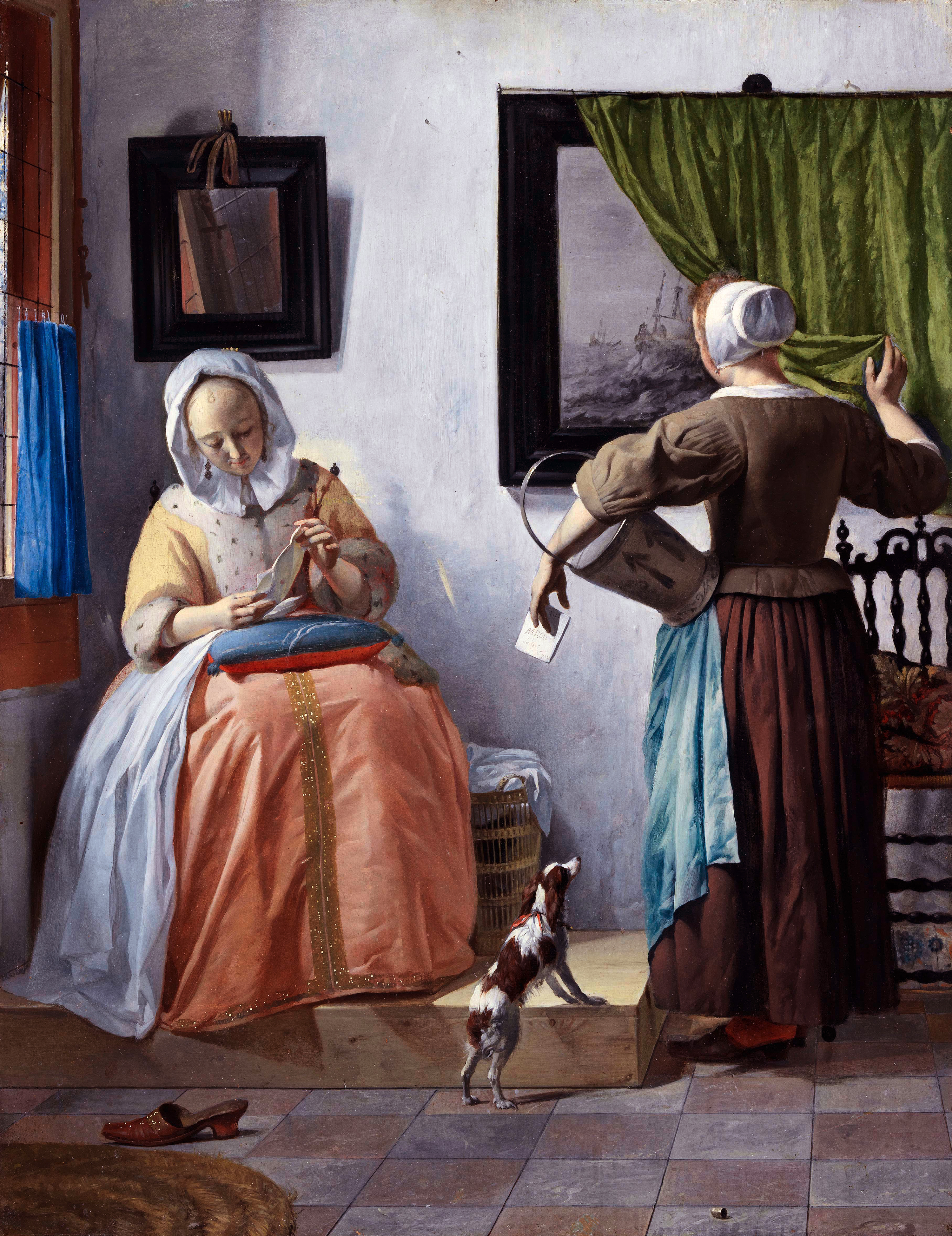
A Girl Receiving a Letter, (c.1658) by Gabriel Metsu, 1629-1667. A sideways on
view. The way the front of the hood is rolled, and the gathering at the back
can be seen. She also has a little linen shoulder rail/cape.
Musical Party (1659) by Gabriel Metsu, 1629-1667.
This lady’s hood appears to be falling off the back of her head.
The letter (1660-5) by Gerard Ter Borch
(1617-81) You have to use the zoom to see a loose dark hood over tied light
hood.
The doctor’s visit (1660s) by Gabriel Metsu, 1629-1667.
As in the Steen and the Hoogstraten paintings of a doctor’s visit, the patient
has some form of forehead cloth.
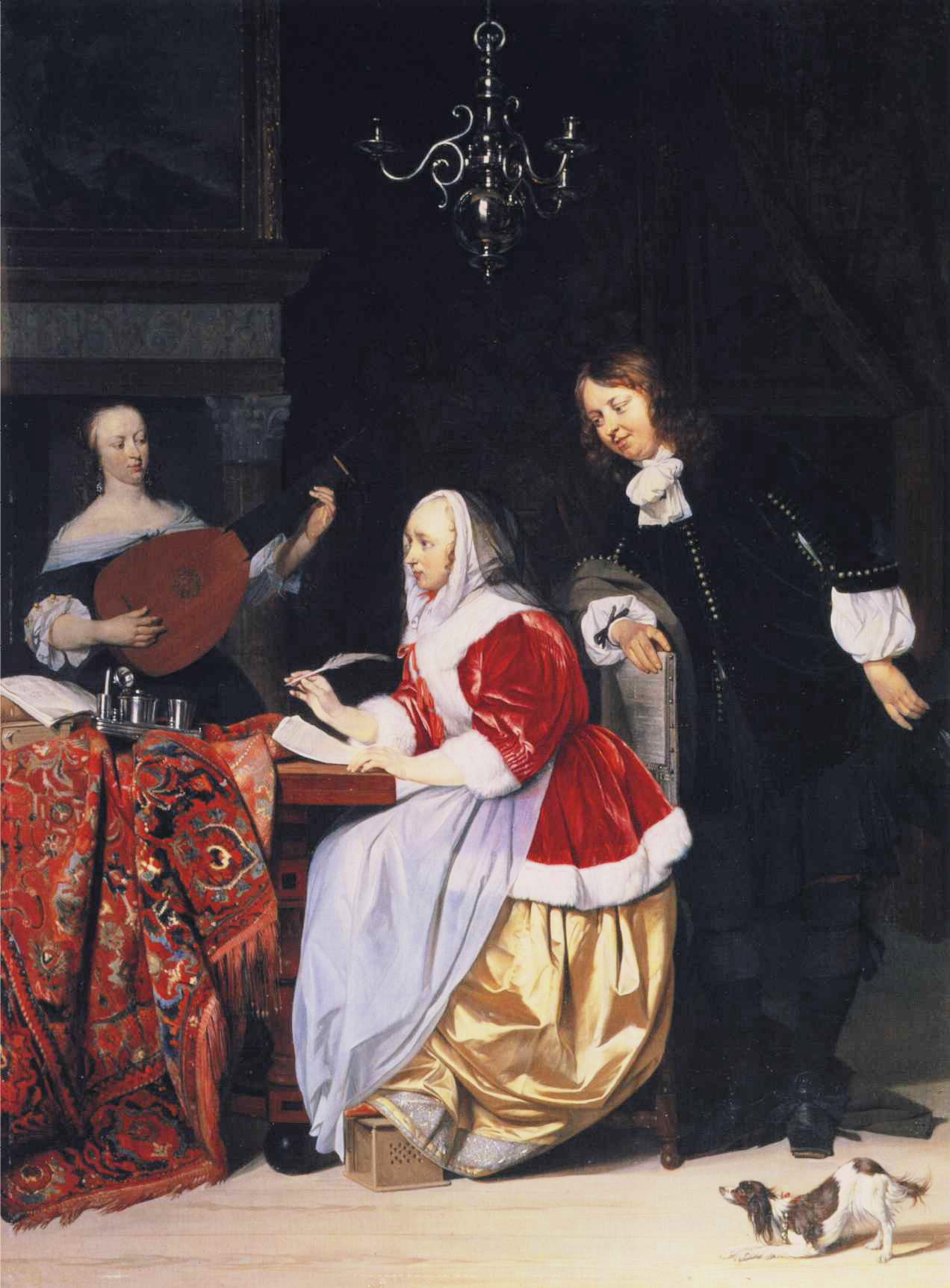
Young woman composing music. (1662-3) by Gabriel Metsu,
1629-1667. There is a dark veil on the back of the head, worn over a white
hood. The hood appears to be fastened with a red ribbon.
The Life of Man (c1665) by Jan Steen c.1625-1679. The woman in the
middle wears an untied hood.
Woman reading letter (c. 1665) by Gabriel Metsu 1629-1667.
The lady wears a close hood, while her maid wears a coif
The proposal (1665-70) by Gerritsz van Roestraten
(1630–1700) Large ties to the hood.
Girl peeling apple. (pre 1667) by Gabriel Metsu 1629-1667.
The hood is left loose and untied, the length of what in later headwear will
turn into lappets can be seen.
Feast of St Nicholas (1665-8) by Jan Steen c.1625-1679.
Here as well as the fabric at the front of the hood being rolled back, the
excess fabric at the side appears to form a roll.
The doctor’s visit (c.1667), by Samuel van Hoogstraten
1627–1678. see note under Steen’s Doctor’s visit above
Two women by a cradle (c1670) by Samuel van Hoogstraten
1627–1678. The painting shows the mother of the newborn in what can best be
described as a dressing gown, her hood is untied, while her visiting friend
appears to have several layers of hood and coif.
Woman making pancakes 1678 by Gerritsz van Roestraten
(1630–1700) A side view of a hood, use the zoom for the detail, you can see
that it is gathered at the back
Bibliography
Arnold,
J., 2008. Patterns of Fashion 4 : the cut and construction of linen shirts,
smocks, neckwear, headwear and accessories for men and women. London:
Macmillan.
Cotgrave, R., 1611. A Dictionarie of the French and
English tongues. London: Islip.
Cunnington, C. W. & Cunnington, P., 1972. Handbook of
English costume in the seventeenth century. 3rd ed.. London: Faber.
Davis, E.,
2014. Habite de qualite: seventeenth century French fashion prints as sources
for dress history. Dress, 40(2)
pp.117-44
Lucas, A., 2011. Linen Hood , London: V&A Publishing,
2011, pp.120-123. In: Seventeenth-Century Women’s Dress Patterns, vol.1. London:
: V&A Publishing pp.120-123.
McShane, A. & Backhouse, C., 2010. Top knots and lower
sorts:print and promiscuous consumption in the 1690s. In: M. Hunter, ed. Printed
Images in Early Modern Britain: Essays in Interpretation. Farnham: Ashgate,
pp. 337-58.
Morgan, F. C., 1945. Private purse accounts of the Marquis of
Hertford, Michaelmas 1641-2. Antiquaries Journal, 25 pp.12-42.
OED, 2016. "chaperon, n.". OED Online. December
2015. Oxford University Press.. [Online] Available at: http://www.oed.com/view/Entry/30576?rskey=Uawe9x&result=1&isAdvanced=false [Accessed 15 January 2016].
Shesgreen, S., 1990. The criers and hawkers of London,
engravings and drawings by Marcellus Laroon. Aldershot: Scholar Press.
Spufford, M., 1984. The great reclothing of rural England:
petty chapmen and their wares in the seventeenth century. London: Hambledon
Press.
 This recently opened exhibition
at the Fashion Museum Bath is on until the 1st January 2018, and includes considerably more
than one hundred objects. This is because the cases of accessories are not
included in the total, so for example the first case contains several 16th
and 17th century gloves from the Spence Collection.
As can been seen from the photograph the light levels are very low because of
the fragility of the fabric displayed.
This recently opened exhibition
at the Fashion Museum Bath is on until the 1st January 2018, and includes considerably more
than one hundred objects. This is because the cases of accessories are not
included in the total, so for example the first case contains several 16th
and 17th century gloves from the Spence Collection.
As can been seen from the photograph the light levels are very low because of
the fragility of the fabric displayed.  The first case of large garments contains the wonderful late
16th/early 17th century embroidered jacket, which appears
in the centre of the advertising for the exhibition. It is followed by a rare
1690s crewel embroidered petticoat, which shows how English embroiderers were
copying the designs of the painted calicoes that were coming into the country
in even increasing numbers at that time. The next garment is a lady’s sleeveless
waistcoat, worn underneath for warmth; it is embroidered with a stunning design
of crane-like birds. It can be seen in greater detail in the image
gallery on the museum’s website, which has images of 36 items in the
exhibition. The c1700 man’s sleeved waistcoat, which is displayed behind these
two garments, is rather too far way to be seen in detail.
The first case of large garments contains the wonderful late
16th/early 17th century embroidered jacket, which appears
in the centre of the advertising for the exhibition. It is followed by a rare
1690s crewel embroidered petticoat, which shows how English embroiderers were
copying the designs of the painted calicoes that were coming into the country
in even increasing numbers at that time. The next garment is a lady’s sleeveless
waistcoat, worn underneath for warmth; it is embroidered with a stunning design
of crane-like birds. It can be seen in greater detail in the image
gallery on the museum’s website, which has images of 36 items in the
exhibition. The c1700 man’s sleeved waistcoat, which is displayed behind these
two garments, is rather too far way to be seen in detail. 




.jpg)