Wednesday, 30 March 2016

A waistcoat, a nightcap and a pair of slippers from the 1640s.


 Provenance
The collector Sir William Burrell (1861-1958) purchased these three items in 1937. They, with his collection, were gifted by Sir William and his wife to the City of Glasgow. The Burrell Purchase Book states that these were purchased from a direct descendant of Colonel Thomas Veel (1591-c1663) of Alverstone near Bristol. The comment is that Charles left them, perhaps as a gift or memento, after he had stayed with the Colonel in 1645. At that time Charles had travelled from Oxford as head of the Western Association, and it is known that the army stopped at both Bridgewater and Bristol. Whether they actually belonged to Charles is not provable. They are described by the curator as “relatively small for a man. However, Charles was only 15 in 1645.” (Quinton, 2013)
 
The waistcoat
The waistcoat is a vibrant pink/red silk satin with an interlining of wool and linen, and was lined with a tabby weave pink/red silk, of which little remains except around the buttonholes. I have not seen the interior, thought the plain linen interlining can be seen inside the sleeves at the wrist. It is edged, and the seams are covered, with a narrow silk braid. It looks as though the buttons, which are somewhat flat, are covered with the same silk braid. It is quilted with zig zag lines worked in running stitch.


The Burrell’s online description http://collections.glasgowmuseums.com/starobject.html?oid=36161 says that the lack of a waist seam is unusual at this date, but it is certainly not unknown. The back and front panel of a 1630s doublet in the Victoria and Albert Museum, doesn’t have a waist seam, the pattern for this is diagram VIII in Waugh (1964). Also the 1644 burial doublet of Pfalzgraf Johann Friedrich has the front and back panels cut in one piece. (Stolleis, 1977) The suggestion made by the museum is that it was perhaps made to be worn under a buff coat. There is a cream worsted waistcoat/coat of a similar date (1630-1650) in the V&A, but the museum’s online description is not very helpful. The sleeves of the waistcoat are cut with a curve, and fasten with four buttons at the wrist. There are 25 buttons down the front of the waistcoat.

The nightcap and slippers
The nightcap and its matching backless slippers are made in pink silk satin. They are embroidered with a design which has been identified as a pineapple. (Quinton, 2013)

The nightcap
The nightcap is made from eight panels and has no brim. This brimless style is similar to others of the middle decades of the seventeenth century. Another also in the Glasgow collection  is reputed to have belonged to Major Hugh Buntine, who was part of Leslie’s army in the Civil War.  The embroidery on the nightcap involves couched loops of silver and silver-gilt thread, and spangles. It is lined with a tabby weave yellow silk.
 
The slippers
The slippers are backless, and heeled, a fairly common style in the mid 17th century. There is another, but plain, pair in the V&A, that were originally salmon pink. Later pairs, like these in the Museum of London, have a squarer toe. Other pairs of slippers exist from the seventeenth century, for example the pair owned by Sir Francis Verney that are at Claydon House. 

References
Quinton, R., 2013. Glasgow Museums: Seventeenth Century Costume. Glasgow: Glasgow Museums.
Stolleis, K., 1977. Die Gewänder aus der Lauinger Fürstengruft. Munchen: Deutscher Kunstverlag.
Waugh, N., 1964. The cut of men's clothes 1600-1900.. London: Faber.

Friday, 29 January 2016

Women’s Hoods 1600-1690


Fig 1 From Hollar's Ornatus
In the first half of the seventeenth century the main linen headwear for women was the coif. The coif came in several forms but most were close fitting. Hoods were around from the beginning of the century and, from the 1640s to the 1680s, they slowly, but never completely, replaced the coif both as a fashion item and among the lower classes. 

Another name for a hood can be chaperon, and this is the term Cunnington (1972) uses to refer to them. Cotgrave draws the term very wide, defining it thus ‘Chaperon, a hood, or French hood (for a woman); also any hood, bonnet, or lettice cap.” (Cotgrave, 1611) The OED has several references to chaperons from the first half of the 17th century including, most explicitly, this from 1623 “Their White Hoods or Chapperons.” (OED, 2016)

These earlier hoods may be different to the later ones. There are a few of survivals of early hoods, two in the V&A have been dated to 1600-1625, and 1600-1630,  both have scrolling blackwork embroidery, as did some of the coifs of that period. Another hood in the V&A collection is dated to 1610-1620 and is of linen with insertion work at the seams and a bobbin lace edging, a detailed examination and pattern has been produced for this. (Lucas, 2011) There are also two hoods, that Janet Arnold took patterns from, in the Gallery of Costume at Manchester, they are dated between 1610 and 1625, one is of linen (accession no. 2003.73) and the other of fustian (accession no. 2003.74. (Arnold, 2008)  In wear these might well look like the hood won in Vermeer’s painting the Procuress, 1656, they have no gathering at the back but are simply worn loose. There is also a hood in the Metropolitan Museum in New York, this they date to c.1640 and, it is very fine, almost transparent, cotton with a bobbin lace edging. There is very little further information on it, but the photograph of the back view gives an indication of the construction, which is very unlike that of the earlier hoods. 

The hood, like the coif, comes in various types, in later examples it is usually gathered at the back. Some early depictions show this style as dark and worn with winter wear. There are two like this in Hollar’s 1640 work Ornatus Muliebris, or the Habits of Englishwomen. One depicts a lady in full winter mode with a face mask, cape or shawl and a muff as well as her hood, in the second example the lady has a muff, and her hood appears to have very large ties at the front.(Fig. 1) Hollar’s series of the Four seasons which date from 1644 show, in the full length versions, both Autumn and Winter wearing hoods, the Winter appearing to have a light coloured lining to the hood and a lighter hood/coif being worn underneath. The three quarter length seasons also show Autumn and Winter with hoods. Hollar’s two works from later in the 1640s, his Theatrum Mulierum and Aula Veneris, which depict dress of women across Europe, Hollar was very good at picking up regional differences in clothing, have only three women with hoods. Two of these are English, a noble woman and a gentlewoman. The third, which gives a good rear view of a hood is dated 1648 and is a lady from Brabant, and here it looks as though a veil maybe being worn over it.

All the above are dark fabrics, being worn as outerwear, presumably instead of a hat. In English images this dark fabric type may be seen in Marmion’s Smell in his Four Senses series of c.1653 , and being worn two women on the servants’ side of the 1671 painting of the Titchborne Dole, while the servant in front of them wears a white coif, and the ladies of the family have no head covering. Another is the portrait of Elizabeth Cromwell, mother of Oliver, who died in 1654, it is difficult to see in the image whether her widow’s peak is worn as part of a coif under the hood, or as part of a veil over the hood.  

However hoods were also worn in light fabrics, and the earliest English depiction of this may be William Dobson’s portrait of his second wife Judith, which is dated to 1635-40. There is a later enamel portrait of Barbara Palmer, Lady Castlemaine in a hood, it has a broad lace edging and the fastening bow is obviously fixed to the linen rather than the lace, so that the lace goes all the way around the face, this has to have been heavily starched or wired to keep its shape. Even young girls wore these hoods, and in the c.1670 portrait of the Mason children the girls appear to be wearing some form of biggin or coif underneath. 

By 1688 hoods seem to have overtaken coifs as headwear. Laroon’s wonderful Cries of London published in that year has 28 illustrations of women from the lowest classes in London, of these 18 are wearing hoods, and only 3 obvious coifs. (Shesgreen, 1990) There are 6 where it is difficult to determine whether a coif or hood is being worn, and there is one headwrap. To pick up on the dark/light question 9 of the hoods in Laroon are dark and 9 are light. However by the time hoods had reached the lowest classes, fashion in headwear among the elite had moved on to top knots, the commode, the tour, the fontange, etc. (McShane & Backhouse, 2010), as shown in the super cap of the doll Lady Clapham from the 1690s. The hood, where it survived, had mostly morphed into a cap with the ties becoming long lappets as in this example from c1690 in the Metropolitan Museum, there is something similar in the Bowes Museum but unfortunately there is no detailed image online. 
Where the hoods in Hollar are outdoor wear, they may be worn over a coif. When you get to Larroon, 4 of the dark hoods and 2 of the light hoods are being worn with a hat over the top, and not necessarily in winter as two are wearing a straw hat over a hood. Likewise John Michael Wright’s 1676 painting of Mrs Salesbury with her grandchildren depicts her wearing a high “sugar loaf” style hat over a dark hood, and an unknown artist’s depiction of Catherine Davenant in the 1660s shows her wearing something similar.

Fig 2. Detail from Steen's 1658 painting
In accounts it can be difficult to work out the difference between the terms hood and coif. There is an assumption that the coif will be white linen, while the hood will be a sturdy fabric in a range of colours, this is not always the case.  The 1641-2 household accounts of the Marquis of Hertford shows the daughters of the family receiving hoods, Lady Jane got 2 white sarcenet hoods at 3s 6d each, and Lady Francis 2 black taffeta hoods also at 3s 6d each, they also received hoods with no material listed, which were cheaper at 2s 4d each. (Morgan, 1945) These upper class hoods were obviously of silk, but there were cheaper ones around. Richard Riddings, a chapman, had in 1680 a dozen calico hoods for children at 2d each, he also had in stock three black serge coifs at 8d each. (Spufford, 1984)  The black serge coifs sound as though they might be hoods rather than coifs, having said that a Dutch survival in the museum at Antwerp is much more coif like in design, than hood like. Another chapman Wlliam Mackerell in 1642 had large blue coifs at 5½d each and smaller blue coifs for 3d each, perhaps these were more like the Antwerp coif.  

Fig 3 - Detail from Laroon's Merry Song
When looking at the possible construction of these later hoods, lacking a survival we need to look at illustrations. Most of the English illustrations of hoods are linked above, however the best source of middle and lower class illustrations of mid to late 17th century hoods are in Dutch genre paintings. Below are a series of links, organised by date from c1650 to c1678. This is by no means a comprehensive listing. On the construction, those with a rear view as in de Hooch’s 1658 painting (Fig. 2) and Hollar’s lady of Brabant, show the gathering at the back.  This gathering can also be seen in two sideways views, Metsu’s 1658painting and Roestraten’s 1678 painting. The ties at the front of the hoods range in size from narrow ribbons, to huge things that look as though the whole side of the hood extends down. In Lady Castlemaine’s portrait there are narrow red ribbon ties, similar red ribbons are used on the white hood in Ter Borch’spainting the Letter (1660-5), and Metsu’s 1662-3 painting. In several of Laroon’s drawings such as Old Satin, Crab, merry new, song (detail right), poor Jack etc., the ties are large. It is often difficult to tell if the hoods with large ties are shaped hoods, or just a fabric scarf knotted under the chin.

The decline in the hood as a fashion item can be seen through the fashion engravings that were published in France between 1675 and 1700, and a discussion of their usefulness can in found in Davis (2014). The hood can still be seen the Jean LePautre engraving Dame en habit d’ete of 1676-8, but by the 1680s  it has become more like a large scarf covering the tall fashionable headdress underneath, as in the 1689 Femme de qualite allant incognito par la ville, and this 1682-6  French fashion plate  by Nicholas Bonnart, La Belle Plaideuse.

Dutch genre painting with hoods
Woman peeling an apple (c.1650) by Gerard Ter Borch (1617-81) An almost transparent hood worn with a shoulder cape/rail
The procuress (1656) by Johannes Vermeer (1632-75) Very loose, ungathered hood, like the earlier English survivals.
Girl drinking with men 1658 by Pieter de Hooch 1629-84. A good rear view of the hood showing the gathers.
The doctor’s visit (1658-62) by Jan Steen c.1625-1679. There are lots of different versions of paintings with this title by Jan Steen. This one is chosen because the patient is obviously wearing something like a forehead cloth under the hood. The English author Fynes Moryson commented in 1617, “...such crosse-clothes or forehead clothes as our women use when they are sick.” It is interesting to note that this tight cloth across the forehead also appears in van Hoogstraten’s painting of a doctor’s visit – link below,
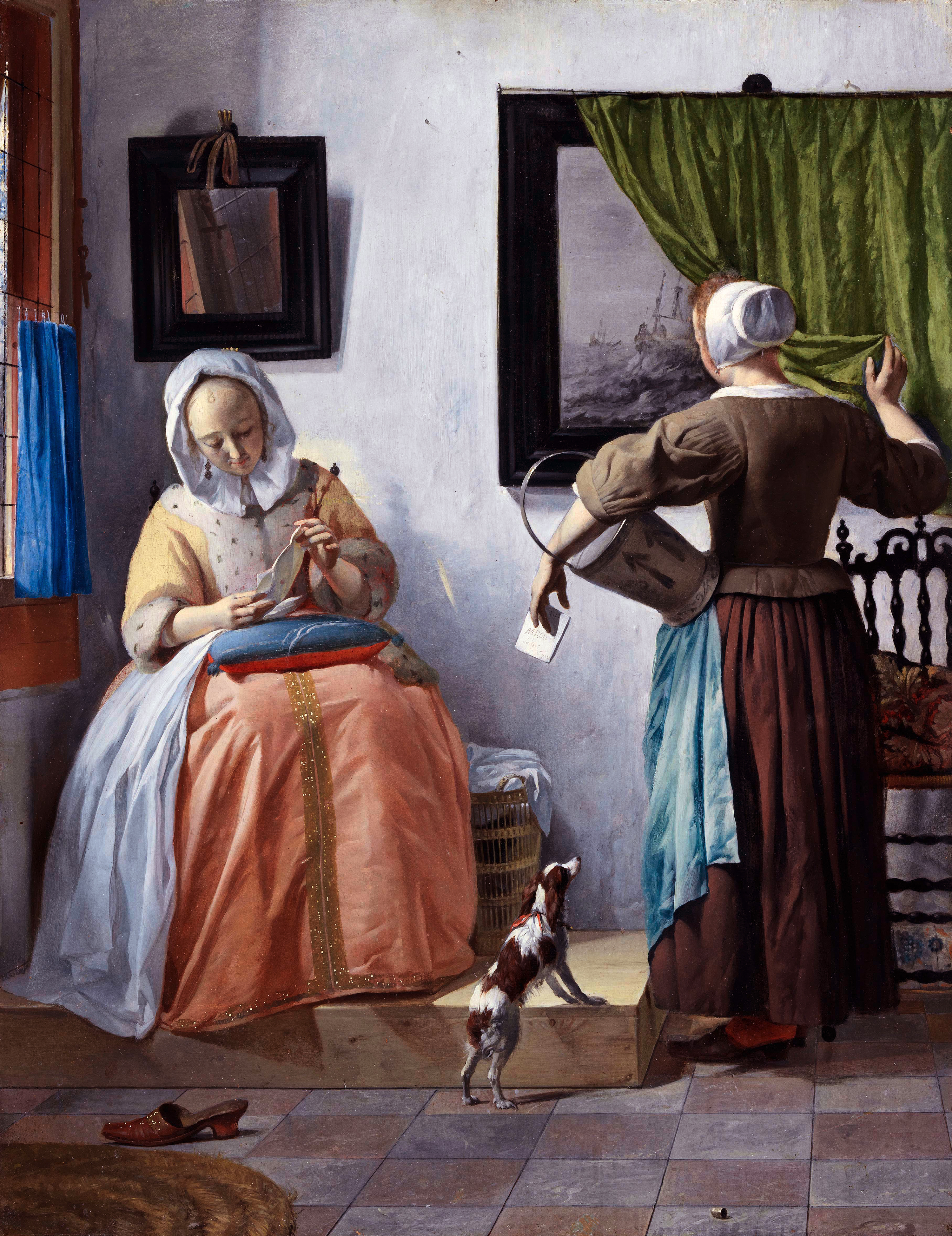
A Girl Receiving a Letter, (c.1658)  by Gabriel Metsu, 1629-1667. A sideways on view. The way the front of the hood is rolled, and the gathering at the back can be seen. She also has a little linen shoulder rail/cape.
Musical Party (1659) by Gabriel Metsu, 1629-1667. This lady’s hood appears to be falling off the back of her head.
The letter (1660-5) by Gerard Ter Borch (1617-81) You have to use the zoom to see a loose dark hood over tied light hood.
The doctor’s visit (1660s) by Gabriel Metsu, 1629-1667. As in the Steen and the Hoogstraten paintings of a doctor’s visit, the patient has some form of forehead cloth.
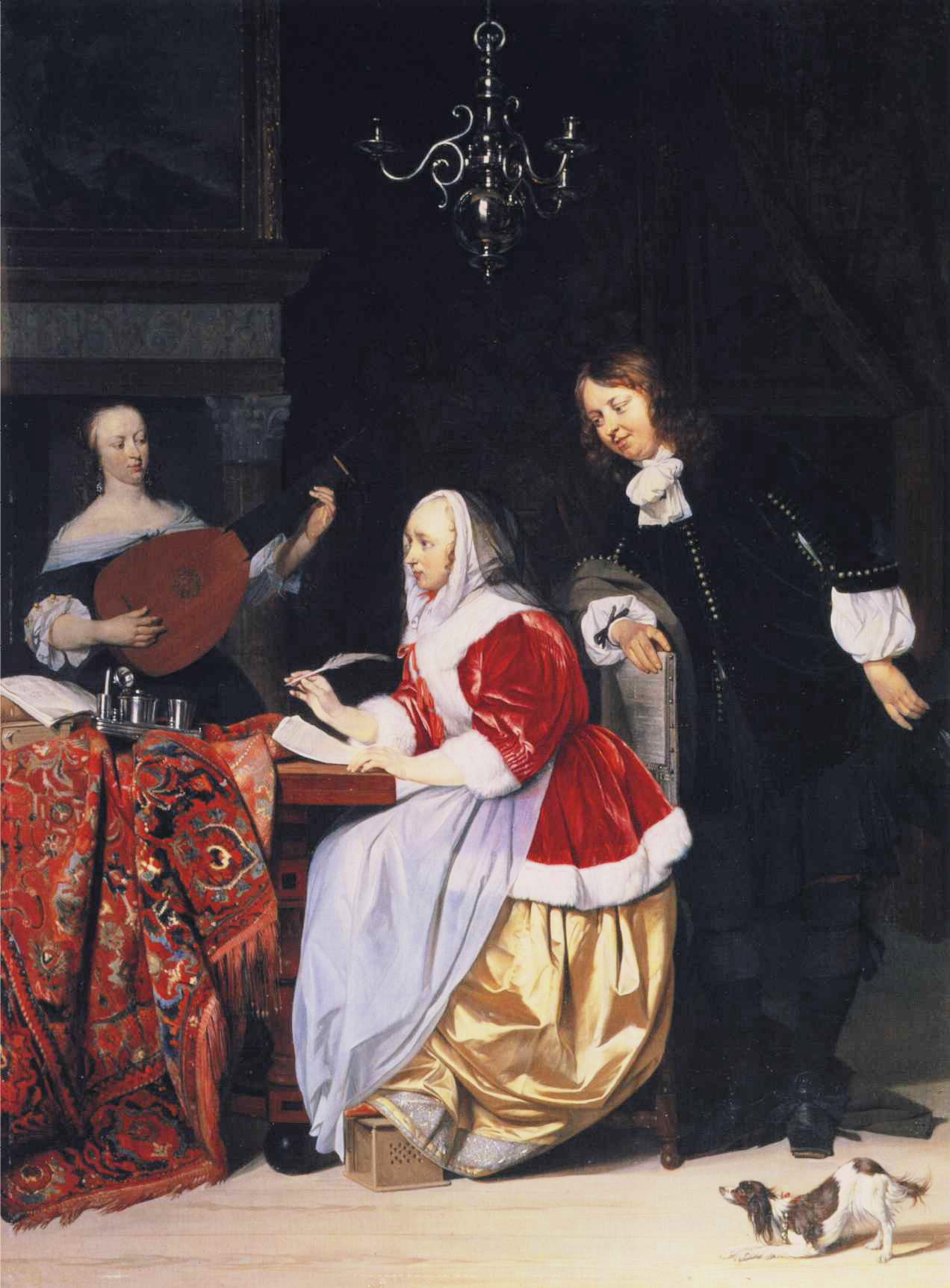
Young woman composing music. (1662-3) by Gabriel Metsu, 1629-1667. There is a dark veil on the back of the head, worn over a white hood. The hood appears to be fastened with a red ribbon.
Effects of intemperance (1663-5) by Jan Steen c.1625-1679. A tied hood
The Life of Man (c1665)  by Jan Steen c.1625-1679. The woman in the middle wears an untied hood.
Woman reading letter (c. 1665) by Gabriel Metsu 1629-1667. The lady wears a close hood, while her maid wears a coif
The proposal (1665-70) by Gerritsz van Roestraten (1630–1700) Large ties to the hood.
Girl peeling apple. (pre 1667) by Gabriel Metsu 1629-1667. The hood is left loose and untied, the length of what in later headwear will turn into lappets can be seen.
Feast of St Nicholas (1665-8) by Jan Steen c.1625-1679. Here as well as the fabric at the front of the hood being rolled back, the excess fabric at the side appears to form a roll.
The doctor’s visit (c.1667), by Samuel van Hoogstraten 1627–1678. see note under Steen’s Doctor’s visit above
Baptism “Soo de ouden soungen, so pypen de jongen” (1669) by Jan Steen c.1625-1679. In the three women by the cradle there are 3 types of headwear,  the woman in the middle wears a hood.
Two women by a cradle (c1670) by Samuel van Hoogstraten 1627–1678. The painting shows the mother of the newborn in what can best be described as a dressing gown, her hood is untied, while her visiting friend appears to have several layers of hood and coif.
Woman making pancakes 1678 by Gerritsz van Roestraten (1630–1700) A side view of a hood, use the zoom for the detail, you can see that it is gathered at the back 

Bibliography
Arnold, J., 2008. Patterns of Fashion 4 : the cut and construction of linen shirts, smocks, neckwear, headwear and accessories for men and women. London: Macmillan.
Cotgrave, R., 1611. A Dictionarie of the French and English tongues. London: Islip.
Cunnington, C. W. & Cunnington, P., 1972. Handbook of English costume in the seventeenth century. 3rd ed.. London: Faber.
Davis, E., 2014. Habite de qualite: seventeenth century French fashion prints as sources for dress history. Dress, 40(2) pp.117-44
Lucas, A., 2011. Linen Hood , London: V&A Publishing, 2011, pp.120-123. In: Seventeenth-Century Women’s Dress Patterns, vol.1. London: : V&A Publishing pp.120-123.
McShane, A. & Backhouse, C., 2010. Top knots and lower sorts:print and promiscuous consumption in the 1690s. In: M. Hunter, ed. Printed Images in Early Modern Britain: Essays in Interpretation. Farnham: Ashgate, pp. 337-58.
Morgan, F. C., 1945. Private purse accounts of the Marquis of Hertford, Michaelmas 1641-2. Antiquaries Journal, 25 pp.12-42.
OED, 2016. "chaperon, n.". OED Online. December 2015. Oxford University Press.. [Online] Available at: http://www.oed.com/view/Entry/30576?rskey=Uawe9x&result=1&isAdvanced=false [Accessed 15 January 2016].
Shesgreen, S., 1990. The criers and hawkers of London, engravings and drawings by Marcellus Laroon. Aldershot: Scholar Press.
Spufford, M., 1984. The great reclothing of rural England: petty chapmen and their wares in the seventeenth century. London: Hambledon Press.

Friday, 15 January 2016

The decline and fall of frieze and russet?


Frieze and russet appear to be two of the main fabrics for the outer clothing of the generality of lower classes in the sixteenth century. Peachey’s (2014) table of wool fabrics covering the period 1558-1660 shows frieze as 37% and russet as 38% of the fabrics used. This would seem to indicate 75% of clothing for the lower classes was frieze or russet. Peachey’s figures are obtained mainly from wills and probate inventories and are for fabrics used for the outer layer of a garment, for those he describes as common civilians. One problem with his figures is that they cover an entire century and he does not show how this usage changed over time.

What were these two fabrics?
Re-enactors, and I’m one so I can be rude, often want things nailed down. Garment x was made with fabric y, and fabric y was made to the following rules and cost z. Unfortunately it doesn’t work like that, firstly because it is very, very rare to find a piece of fabric with a contemporary label attached saying I am a piece of Devonshire dozen or Manchester cotton, then because fabric terminology changes over time, and also because the same word can be used to describe quite different fabrics.

Frieze
Mikhaila and Malcolm-Davies (2006) describe frieze as, “very thick, heavy, plain weave, well-fulled cloth, with raised hairy surface on one or both sides. Made from cheaper fleeces, unfit for finer cloth.” Fuller (1660) speaks of it as a coarse kind of cloth manufactured in Wales, "than which none warmer to be worn in winter, and the finest sort thereof very fashionable and gentile. Prince Henry (1594-1612) had a friese sute out of it.” 

Frieze is sometimes regulated by law. An Act of 1551, speaking like Fuller of Welsh friezes, gives them as being a minimum of 30 yards long, three quarters (27 inches) wide and “being so fullie wrought shalle waye ev'ye” (love the spelling of heavy). A whole piece, that is the 30 yards, to weigh 48 pounds at the least. 

However not all frieze was the same. Spufford (2003) examining the prices of fabrics has a table showing the price of frieze ranged from 7d to 5s 8d a yard in the period 1560-1610, and 2s to 6s in the period 1610-1660. She has no examples of frieze in her table for the period after 1660. 

Russet
Mikhaila and Malcolm-Davies (2006) describe russet as “a coarse narrow wool, undyed and unfinished; broad russet, better quality, might be dyed; London russet as wide and costly as broadcloth.” Both Delaney in hisThomas of Reading from 1612, and Hall in his Satires of 1598 describe russet as the wear of country folk. 

Spufford (2003) shows that russet, like frieze and other fabrics, could vary enormously in price for “a yard of [any] fabric with the same name at the same date throughout our period (1560-1705).” Russet varies from 5d to 4s 5d a yard in 1560-1610, and 1s 6d to 3s 10d in 1610-1660. Like frieze she has no examples of russet after 1660.

Part of the problem with describing russet is that the term was being used not only for a fabric, but also for a colour from before the beginning of the sixteenth century. The colour russet is described in 1573 as, “If you will mingle a litle portion of white with a good quantitie of redde, you may make thereof a Russet, or a sadde Browne, at your discretion.” 

Probate accounts
As pointed out above Spufford’s (2003) paper shows no frieze or russet, in the accounts she examined, after 1660. Spufford was looking at probate accounts, these were produced by the administrator or the executor of a will, often the widow. When there was a child orphaned the accounts can show, among other things, the provision of clothes for the orphaned child/ren until they were, apprenticed or 21 in the case of boys, and married or 18 in the case of girls. These are often more detailed in the final year when the accounts are being wound up.  Spufford analysed 820 accounts from which she extracted 8,974 garments. These accounts are not from the very rich, they reflect, she says “the lives and clothes of labourers, husbandmen and yeomen below the gentry level.”

Cloth
Cloth is a very general term usually referring to a fabric made of wool. In the probate accounts it is the most used fabric for making doublets, jerkins, waistcoats and breeches for boys, and waistcoats and petticoats for girls. However it is also listed as providing a large number of the shirts and smocks, which might indicate that it may be being used just as a general term for any type of fabric, wool or linen. Spufford refers to it as “the ambiguous and universal” cloth, and it is interesting that in his list Peachey does not mention it at all, maybe because of its ambiguity.

The changing use of cloth types
As well as dividing what was provided by garment and gender, Spufford also split her results by 40-45 year time periods; 1560-1610, 1610-1660 and 1660-1705, this enables us to infer that perhaps certain fabrics were declining in use, while others were rising. The declining fabrics would appear to be russets, friezes and cottons: 90% of russets, 82% of cottons (wool) and 76% of friezes are pre 1610. Other declining fabrics that appear pre 1660, but rarely post 1660, are fustians and canvas: 64% of fustians are pre 1610 with 36% in the 1610-1660 period and none post 1660; with canvas this is 74% pre 1610, 24% 1610-1660 and only 2% post 1660. Other fabrics go along in a more or less steady state, like cloth, stuff and kersey, and among the linens, lockeram. 

Remember that these are clothes provided for young adults and children, by comparison the garments appearing in wills belong to older people. It would be interesting to compare an analysis of the fabric of garments in both early and late seventeenth century wills and probate inventories, with those in the probate accounts. We could then see whether this would show the same change in fabric use, but perhaps coming through later. Certainly John Dale, a yeoman, still had one gray frieze coat in his 1682 probate inventory, to go with his serge, cloth, and two worsted camlet coats. (Williams and Thompson, 2007)

Social status and the fabric used
The obvious thing to say is that the poorer, coarser cloths are worn by the poorer classes, and yet there is this enormous difference in price for fabrics of the same name. While friezes have been identified as being worn by the poor, they are also, as shown by John Dale and Prince Henry, being worn by the middle and upper classes.

Spufford’s (2003) analysis appears to bear this out. She points out that the heavyweight and cheap canvas appears across all her income groupings for doublets, though the owners of canvas breeches are predominantly in the poorest group. On the other hand four of her poorest boys had doublets of the supposedly expensive broadcloth. With the girls more of the poorest were wearing russet waistcoats and petticoats, whereas none of the richest group did so. The richest group’s waistcoats and petticoats were mainly of cloth, kersey, mockado [a fake velvet style of cloth] or fustian.

How much was spent
In Gregory King’s 1688 calculations, variation in the amounts spent by families on their clothing range from, ‘almost £3’ a year for  the lowest income groups to, ‘about £1000’ for those with the highest of incomes. (Spufford 2000)   If you think this is any different from today consider that you can buy a pair of cheap jeans for £5 in a supermarket, while an “off the peg” top of the range pair of Gucci jeans cost over £2000. 

Spufford (2003) produced a table showing how the cost of a basic wardrobe changed over the period. For a boy the wardrobe she uses consists of a shirt, jerkin/doublet, breeches, coat, stockings, shoes and a hat, the median for 1610-1660 was £1 3s 3d. For girls her wardrobe is a smock, waistcoat, petticoat, stockings, shoes and headwear (she did not include a gown although she had records for 137 of them, as most were in her top income group); for 1610-1660 the cost of this wardrobe was 14s 9d. She did not unfortunately do a cost by time period analysis of the gowns.

Bibliography
Anon. 1573. A very proper treatise, wherein is briefly sett for thethe art of limming, 1573. The 1596 edition is available at https://archive.org/details/verypropertreati00impr
Fuller. T. 1660 The history of the worthies of England, Volume 3. London:Tegg, 1840 edition.
Mikhaila, N. and Malcolm-Davies, J. 2006. The Tudor tailor. London: Batsford.
Peachey, S. (ed.) 2014. Clothes of the common people in Elizabethan and early Stuart England. 1558-1660: the user’s manual. Bristol: Stuart Press.
Spufford, M. 2000. The cost of apparel in seventeenth-century England, and the accuracy of Gregory King.  Economic history review, 53 (4) 677-705
Spufford, M. 2003. Fabric for seventeenth-century children and adolescents’ clothes. Textile History, 34 (1), 47–63
Williams, L. and Thompson, S. eds. 2007. Marlborough probate inventories 1591-1775. Wiltshire Record Society, vol 59, 165-6

Monday, 21 December 2015

The Gunnister Man Project


 From the Shetland Museums leaflet (3)

Last month I attended the Knitting History Forum conference, and one of the speakers was Dr. Carol Christiansen, Textile Curator at the Shetland Museum and Archives, she spoke on the re-construction of the Gunnister Man clothing. The project to re-construct the clothing was a joint venture involving, among others, Carol Christiansen, Martin Ciszuk, of the School of Textiles, University of Borås, Sweden, and Lena Hammarlund, craftsperson and textile researcher, from Göteborg, Sweden, and was completed in 2009. Some of this was reported at NESAT XI (1) and some at the European Textile Forum. (2)   Also the Shetland museum service has produced a leaflet, which shows the re-created clothing, complete with mends, patches, etc. (3)

Background
A lone burial containing the body of a man, or to be more precise the clothing of a man the body having disappeared, was found at Gunnister in Shetland in 1951. As Carol said most of the report written at that time by Henshall and Maxwell (4) still stands. The body probably dates to the very end of the 17th century, early 18th century. The purse he was carrying contains three coins, one Swedish dated 1683, and two Dutch from 1681 and 1690. Gunnister Voe, itself was one of a number of extremely small ports operating at the end of the Hanseatic League period. It is about two miles distant from the burial, and it traded with Dutch, Swedish and German merchants. The site at Gunnister Voe has been excavated, but very little was found there. (5, 6)

The burial
The bulk of what survived in the burial is the woollen clothing, which is very heavily patched, so that there are 20 different fabrics represented. The non-clothing items were a wooden stick, a small wooden bucket (16.25 cm diameter by 14.5 cm high), two other small pieces of wood, a wooden knife handle, a horn spoon and another piece of horn, a quill (analysis showed that it had ink on it), and the coins.  Non fabric items of clothing were, four pieces of a leather belt with a brass buckle, and a very few fragments where rivlin type shoes would have been.

The clothing
The clothing is with the National Museums of Scotland, but was returned to Shetland for the period of the project and the exhibition that followed. They are now back with the NMS.The garments were all closely examined in order to decide what wools to use, and various wools were tested including Shetland, Herdwick and Gammelnorsk (an old Scandinavian breed). A dye analysis proved inconclusive. One conclusion was that the clothing had been obtained over a considerable period of time, and from many different places. As has already been mentioned the clothing was heavily patched and the feet on the stockings had been completely replaced.
For the reconstruction of the clothing Lena worked on the spinning and weaving of yarn and cloth. Martin worked on the cutting and sewing of the woven items, and Carol and Lena worked on reproducing the knitted items. As Carol was talking mainly about the knitted items some garments were hardly mentioned, however I have linked to the SCRAN – the National Museums of Scotland – database entries for each garment below:

The shirt
This was not mentioned by Carol in her talk. It is of wool and fastens from the waist to neck with ten buttons of wool covered in cloth. (4) All the buttons on the Gunnister clothing were wool covered with cloth.

The jacket and coat
The shorter jacket was being worn over the longer coat. The low decorative pocket slits on the coat were sewn shut, and the turn back cuffs on the coat were rolled down. Carol also mentioned that the stockings appeared to have been sewn to the bottom edge of the coat. She conjectured that these alterations may have been against the cold, and pointed out that the 1690s saw some very bad weather.

The breeches
The breeches had had pocket bags on either side, which had disappeared and therefore were probably made of linen or leather. The waist had been altered by taking in 5 inches. The breeches had a fly front, fastened with only one button at the waist.

The stockings
As mentioned before the stockings appear to have been attached to the lower edge of the coat with thick two ply wool. The stockings had been mended at the knees, but more obviously the feet had been replaced, in one case with the leg of another, finer knit, stocking. Carol said that the knitting on the main stocking legs was 2.9 to 3.2 stitches to the cm, and 4 to 5 rows to the cm. They had a decorative false seam at the back, and the calf shaping was worked every four rows.

The cap with a brim
This was the cap he was wearing. This was white and, according to Carol, the pattern in Henshall is incorrect. The cap was 56 cm in circumference and 17 cm from crown to edge. It was knitted at 3.5 stitches to the cm and 3.75 to 4.5 rows to the cm.

The cap without a brim.
This was the cap that was in a breast pocket of the coat. The shaping, which produces a sort of cross at the crown, is similar to that of a Svabald example. The cap has a boucle effect inside. Testing produced the same boucle effect when a Shetland wool was mixed with primitive Scandinavia wool, and then fulled. This cap was knitted at 3 to 3.25 stitches and 4 to 4.5 rows to the cm.

The purse

The purse is grey-brown with a pattern in white and red. It is 10cm by 13.5cm and was knitted in the round with the bottom being knit together. It has 4.5 stitches and 6 rows to the cm. There is a cast on row, then a knit row, before the 13 loops that carry the drawstring. My attempt at the Gunnister purse, done before I attended the talk, is shown right.

The gloves
The gauge given in Henshall for knitting the gloves is incorrect The gloves were knitted at 3 stitches and 4.5 rows per cm in white wool. They have a decorative design of three lines on the back of the hand. The gauntlet has a decorative design involving rows of garter stitch, stocking stitch and purl stitch. Henshall gives this as “6 rows of garter stitch, 5 of stocking stitch, 5 of garter stitch, 6 of stocking stitch, 3 purl rows separated by 2 plain rows, 8 of stocking stitch, 5 of garter stitch, with decreases along the outer side.”


Bibliography

1.  North European Symposium for Archaeological Textiles, 10-13 May 2011, Esslingen am Neckar, Germany. Carol’s abstract is available from;   http://www.nesat.de/nesat_11_esslingen/abstracts/lecture_christiansen.pdf

2. Ciszuk, M and Hammarlund, L. 2013. Tracing Production Processes and Craft Culture: the reconstruction of the Gunnister Man costume. In: Ancient textiles, modern science : re-creating techniques through experiment : proceedings of the First and Second European Textile Forum 2009 and 2010;  edited by Heather Hopkins. Oxford: Oxbow

3..Shetland Museums and Archives. 2009. Gunnister Man A life reconstructed. (Watch it, because it is designed to fold into a leaflet the first bit is upside down.)

4.  Henshall, A. S. and Maxwell, S.  1952. Clothing and other articles from a late
17th-century grave at Gunnister, Shetland.  Proceedings of the Society of Antiquaries of Scotland, 1951-52, 30-42. Available from: http://archaeologydataservice.ac.uk/archiveDS/archiveDownload?t=arch-352-1/dissemination/pdf/vol_086/86_030_042.pdf link)

5. Queen’s University Belfast. 2010. Gunnister: excavations of a German trading site at Gunnister Voe, Shetland. Available from:

6. Gardiner, M. and Mehler, N. 2010. The Hanseatic trading site at Gunnister Voe, Shetland
Post Medieval Archaeology, 44 (2) 347-349. Available from: https://www.academia.edu/690244/Excavations_at_the_hanseatic_trading_site_at_Gunnister_Shetland._Post-Medieval_Archaeology_44_2_2010_347-349