Tuesday, 3 November 2015

A 1623 tailor and seven other Marlborough tailors 1592-1691


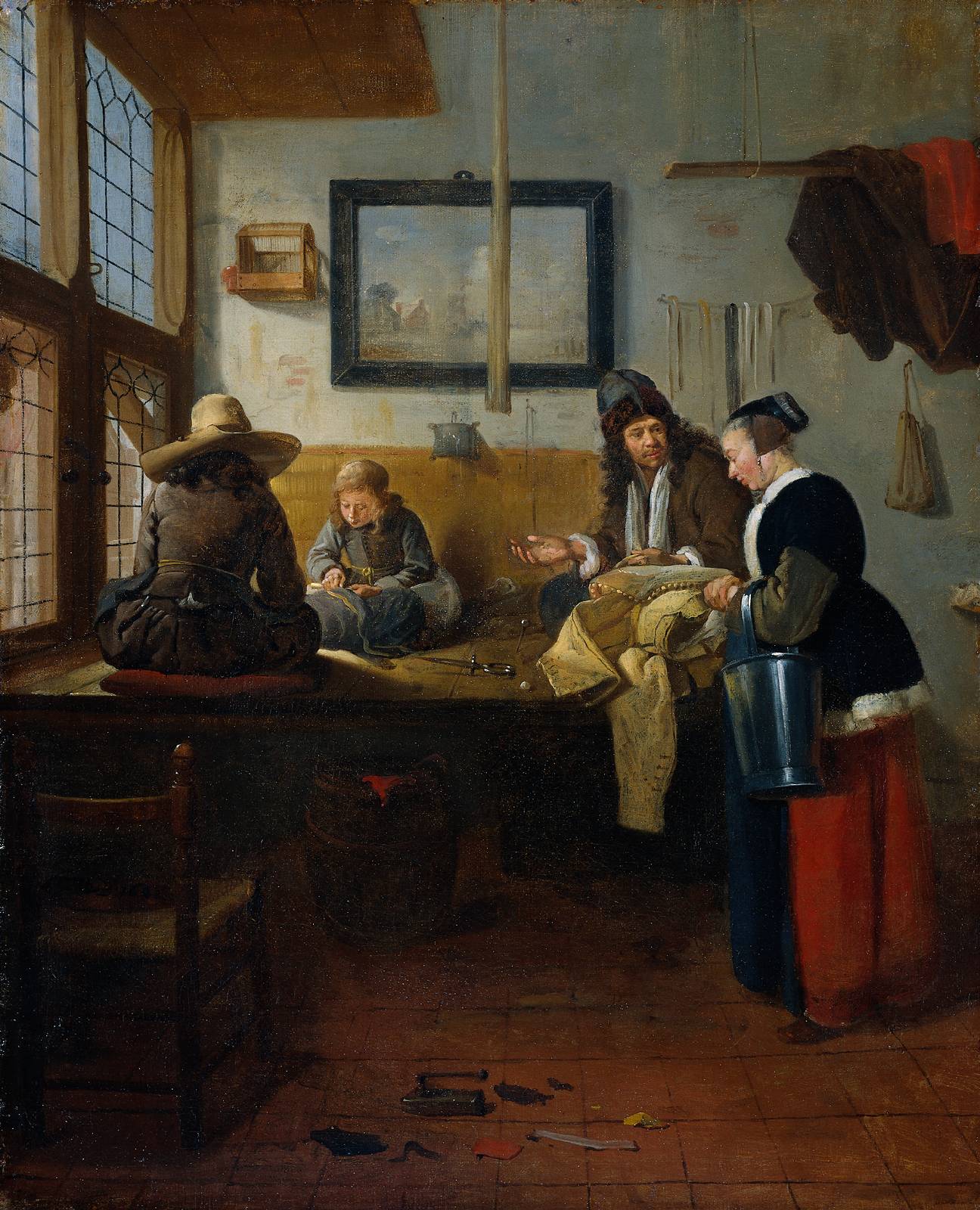
Quirijn van Brekelenkam - Tailor's workshop c.1661
This post looks particularly at the 1623 probate inventory of the tailor Ambrose Pontin of  Marlborough, in the county of Wiltshire, and at the seven other Marlborough tailors with probate inventories made between 1592 and 1691.(1) Pontin’s inventory is perhaps unusual in that it gives an idea of his equipment, and also shows the wares of an early craftsman retailer. There hasn’t been a vast amount of research done on how ordinary people purchased clothing at this time, but he may well be typical as a supplier. In market towns such as Marlborough the population, of about a thousand people, would be swollen on weekly market days, and it has been suggested that by 1660 the market places were surrounded by retail and craft shops. (2)

 
Relative values

Looking at the other, non farming, men of Marlborough who had inventories taken in the period 1620-1642, Pontin, with a total worth given as £90-18s-2d is near, but by no means at the top, of the range. John Cole, a 1626 tanner, was worth considerably more, £143-10s-4d, and two men worth a lot more were William Brewtie, a 1640 innholder, £279-8s-0d and Walter Jeffrys, a 1641 baker, £225-13s-0d. Pontin’s worth is similar to that of Anthony Gunther, a 1624 glover, £89-2s-6d, and John Heath, a 1637 innholder, £95-0s-7d. Below these with values of more than £50 are a barber, shoemaker, haberdasher and baker. With values between £30 and £50 are a dyer, a parchment maker, a glover and a barber. Those with values between £10 and £30 are two weavers, a cooper, a tanner, a heelmaker, mercer, butcher, carpenter, glazier, and shoemaker. Right at the bottom end,with values under £10, are a buttonmaker, baker, tailor and carpenter. This shows that tailors could run from the poorest to the richest of tradesmen. 

In the century from 1591 to 1691 there are eight Marlborough tailors listed in the inventories. Thomas Cockye 1592, Ambrose Pontin 1623, William Dawnce 1632, Robert Millington 1678, William Cornish 1685, Thomas Have 1689, John Mundy 1691 and Francis Smith 1691. Their values range from the £4-2s of Dawnce to £94-14s-6d for Millington. The total worth given is not necessarily an indication of how rich or otherwise they were, or how successful as tailors. 

Robert Millington 1678 for example, is the richest at £94-14s-6d, however £80 of this is in “debts due to the deceased.” William Cornish 1685, is another high value tailor worth £87-7s-0d, however although described as a tailor he is obviously functioning as a farmer, as he has harrows and ploughs and £31 of his worth is “corne upon the ground,” that is a crop in the fields. Francis Smith in 1691 appears to be doubling as brewer, he has his own brewhouse and cellar and owns eleven keevors (mash tubs), a furnace, boiler, 9 vessels and 3 horses for beer (in this sense it is a  horse as a frame, as in a saw-horse or a clothes horse).

Cloth

Pontin is the only one who lists any cloth in stock, and he kept a considerable amount having, 104 yards of ordinary woollen cloth (£13), 357 yards of coarse woollen cloth (£26- 5s), 13 yards of fustian (13s), 40 yards of broad list (in this sense list is a strip of fabric, or a edge of cloth, or an edging fabric (OED)) (2s), and 5 yards of linen cloth (6s). The amount of coarse cloth he had would seem to indicate that he is making for the ordinary working man. He purchases his cloth in the city of Salisbury, just over 25 miles away, as he owes £6 4s for cloth bought there.

Tools of the trade and point of sale

Most tailors use chests for storage. Pontin appears to store his cloth in chests as he had “nine coffers 10s” Thomas Cockye 1592, also has, “In the shoppe 2 great chests £1 13s 4d”, even Dawnce the poorest tailor had “one chest, three coffers, one box.” Thomas Have, another poor tailor has “1 chest, 1 truncke, cofer and 4 boxes.”  From Cockye’s inventory we gather he has a shop, Francis Smith also has a shop, but we do not know what was in it, as the appraisers value only what is in the “chamber over the shop.”

From the Nuremberg House Books (4)
Pontin, in another part of his building, and unfortunately with this inventory the appraisers do not specify rooms, has a chest, a shopboard, 2 irons and 3 pairs of shears, together worth 7s. The OED has two definitions for shopboard, either or both of which might be applicable here. Firstly “A counter or table upon which a tradesman's business is transacted or upon which his goods are exposed for sale,” and secondly “A table or raised platform upon which tailors sit when sewing.” Three other tailors, Cockye, Dawne and Have, also own shopboards, while irons and shears appear in the inventories of both Cockye and Dawnce, Dawnce’s being specified as a pressing iron. 

Then Pontin has the odds and ends, not worth enough for a full listing; “girdles, laces, gartering and pinnes” worth 5s-8d. There are “silke lase and remnants of taffety” worth another 5s, another “little box, a remnant of cotton, 1 paire of stokins (stockings) and 4 yards to measure cloth” totalling 1s.  He has 11 yards of loom work, which may well be what we would call braid, and “more in little remnants of woollen cloth, 4s.” 

To get around Pontin has a horse, and with it two pack saddles and one riding saddle. The only other tailor to own as horse is William Cornish, but I think his horses, he has five, are for his farming, not his tailoring.

Ready to wear

Pontin is the only one who has sale items of clothing in stock, “20 sale dubletts, £5,” “12 pair sale breeches £3” and “6 sale jerkins 17s,” but it was not just woollen items, which these would have been. He also had “10 dozen and 10 falling sale bands” worth £3 5s., that is 130 falling bands at 6d per band. These prices are very similar to those in the 1628 inventory of the chapman John Uttinge of Great Yarmouth.(3) Uttinge had laced falling bands at 8d each, plain bands at 7d each and 27 bands for men at 3d each.  Pontin also has “2 dozen and a half of small made wear, 8s,” we don’t know what these are.

The tailors’ own clothes

For most of the tailors a simple figure is given for their wearing apparel, and often this includes other items. Millington, the richest has wearing apparel worth £2 as does Cornish, Pontin’s clothes are worth £1, while poor Dawnce has clothes worth only 1s. Have’s wearing clothes are lumped in with the money in his pocket at £2 10s. Smith’s wearing apparel is lumped together with his books and is worth £5. Mundy has wearing apparel and linen listed as worth £7, often wearing apparel relates only to the woollen clothing, and wearing linens are either not listed or are listed separately. The earliest tailor,Thomas Cockye 1592, is the only one whose apparel is listed, he has; “2 dubletes, 2 pare of hose, a cloke, a felt hatt, a pare of shooes and a jirkin £1”

Bibliography

1. Williams, Lorelei and Thomson, Sally. Marlborough probate inventories 1591-1775. Chippenham : Wiltshire Record Society, 2007.
2. Cox, N. and Dannehl, K. Perceptions of retailing in early modern England. Farnham : Ashgate, 2007.
3. Spufford, M. The great reclothing of rural England: petty chapmen and their wares in the seventeenth century. London : Hambledon Press, 1984.
4.  Die Hausbücher der Nürnberger Zwölfbrüderstiftungen. The illustration of a tailor in his workshop is taken from the House books of the "Twelve Brothers" an almshouse in Nuremberg, each man entering the almshouse was painted starting with its foundation in the middle ages and ending in 1806. The complete set has been digitised and is available at http://www.nuernberger-hausbuecher.de/

Thursday, 1 October 2015

Historic Clothing Day at the Weald & Downland Museum


The gridshell building at Weald & Downland

On Sunday I attended the Weald and Downland Museum’s Historic Clothing Day held in the site’s incredible Gridshell building, see right. For those who do not know the Weald and Downland Museum, it is an open air museum with more than 40 buildings that were in danger of destruction, and which have been rebuilt on a 40 acre site. The buildings run from a 14th century flint cottage, reconstructed from archaeological evidence, to an early 20th century “tin” church. In many of these buildings the museum has costumed interpreters and volunteers, and the project that clothed these people was the subject of the last presentation of the day.

The day started with a presentation on Henry VIII’s clothing from Maria Hayward author of, among other works, Dress at the Court of King Henry VIII (2007), Rich Apparel: Clothing and the Law in Henry VIII's England (2009), and The 1547 Inventory of King Henry VIII: Volume 2: Textiles and Dress (2012). I am still coming to terms with the proposition that it is possible, to an extent, to “let out” a suit of armour when your waist grows. Although this was done for some of Henry’s armour he had many sets and they show his increase in size from a 34 inch waist as a young man to a 51 inch waist in this last years. Maria showed items other than armour associated with Henry including a hawking glove now in the Ashmolean, and clothes similar to those he would have worn, such as the splendid outfit that belonged to Maurice of Saxony. She noted that by the end of his reign he owned many pairs of glasses. 

The second presentation was from Danae Tankard on Fashionable clothing in late seventeenth century Sussex. Danae looked at the clothing choices and purchases of several middling people in Sussex including Samuel Jeake and his wife of Rye. Jeake was a merchant and a dissenter and his correspondence from London to his wife in the provinces, includes fashion comments, for example on a mantua that was to be drawn with India sprigs, presumably indicating that it was to have a pattern drawn on it for her to embroider. Another person was Edward May (1663-86), his father dying when he was young, the payments for his clothes were made by a trustee Walter Roberts, and there are letters between Roberts and a tailor John Heath. 

After a break Grace Evans, curator of the Chertsey Museum, gave a presentation on 18th and early 19th century items from the Olive Matthews bequest that are now in the museum. Grace discussed how Olive Matthews started as a collector of historical dress as young as aged twelve, using her allowance to purchase from the Caledonian Road Market before the Second World War. Grace showed some of the highlights of the collection including an embroidered man’s night cap of c1600-20, and a 1690s collar of point de neige lace. There was also an open robe of 1734-4 silk that had been remake sometime in the 1750s with the addition of two other silks. Frugal indeed.

There was long break for lunch where we could go around the buildings and see some of the demonstrations as in the photograph to the left where the process of creating linen from flax was being presented by a costumed interpreter.

After lunch Vivienne Richmond author of Clothing the poor in 19th century England, spoke on the subject. She talked about the problems of assessing evidence, she regards the painting that is used for the cover of her book as a romanticised image, and queried to what extent photographs of the ragged children of the time might have been sent up by the photographer. She spoke of the concept of Sunday best (something I remember from my own childhood), and quoted from someone reminiscing that, because they did not have Sunday best clothing, their pious mother had taken them to a church some distance from where they lived so they would not be seen attending church in ragged clothes.

The final presentation of the day came from Barbara Painter, who was the clothing consultant for, and heavily
involved in, the
Historic Clothing Project at Weald and Downland. We were treated to a catwalk display of some the garments worn by the interpreters. The garments are matched to the buildings in which they are to be worn, so the Tudor period clothing is worn in the Bayleaf Farmstead which is displayed as it would have been around 1540. Similarly the West Wittering School is presented as it would have been around 1890.

Wednesday, 9 September 2015

A Visit to South Devon


I recently visited south Devon and some museums and costume collections in the area. 

Part of the Corsets and Crinolines Exhibition at Totnes
The museum is housed opposite the market square in Totnes. It has the Devonshire Collection of Period Costume. There are three rooms upstairs which have an exhibition that changes every year. The exhibition for 2015 is Corsets and Crinolines; it ends on the 2nd October. The display shows on one mannequin an outfit, and on the next mannequin what would be worn underneath to produce that shape. The earliest garments in the exhibition are mid 18th century. Unfortunately the museum is not open at weekends; you can tell when the museum is open by the “dancing” puppets in the window, if they are moving the museum is open.


Although not a costume museum the Elizabethan House, built c.1575, just down the road does have some clothing in its exhibits, including this “window” display shown left of Thomas and Company who were local tailors. The theme garden outside has a bed of plants used as dyes.

The F word at Killerton
Killerton is an 18th century house with large gardens that has been owned by the National Trust since the middle of the 20th century. The fashion collections held there include the Paulise de Bush costume collection. The upstairs has an exhibition of clothing which changes every year, this year’s exhibition 'The F-word: The changing language of fashion' explores how revolutionary innovations in fabric, cut and fastenings have changed the shape of fashion. The items on display run from the 18th century through to the 1990s. There are some fascinating film clips showing on a loop including a 1940s film showing how zip fasteners were made and a 1920s clip showing how early plastic buttons were made. For more information about the exhibition have a look at the article on the website. The photograph above shows one of the cases.

Thursday, 6 August 2015

Clothes for the Bridlington Poor 1637.


Detail of the poor. Tichborne Dole 1671

With many thanks to Paul Leask who passed the information to me. 

The information we have on clothing provided to the poor in the mid seventeenth century has increased considerably over the years. Spufford noted the Beccles overseers’ accounts for 1636-7 and 1645-69.(1) Saunders worked on the churchwarden accounts for several London parishes covering the period 1630-1680,(2) and Tankard used a variety of sources for her work on the clothing of the poor in Sussex. (3) The accounts for Bridlington give us provision in a small Yorkshire town for just one year 1637.(4) 

Bridlington
Bridlington is a small town on the Yorkshire coast. The manor of Bridlington was sold by its owner Sir George Ramsey, to thirteen men from the town who purchased it on behalf of all the tenants. In 1636 these men became the feofees (trustees) of the manor, and the record of the giving of clothing to the poor comes from the following year. (5) In 1643 Henrietta Maria landed there with troops to support her husband.

The costs
The record commences with a statement of the costs involved, or at least some of the costs. The fabrics themselves are given as “Bestowed in cloath for the poor of Bridlington cum Key the summe of £4 15s 6d,” a man called Atken, presumably a tailor, is then paid 6s 0d for “making the poore cloathes.” (4) This relationship between the cost of cloth and the making is similar to that in other places. In Rothfield, Sussex in 1663 four and three quarter ells of lockram plus thread  cost 4s 10d but the cost of making was only 8d, while in 1667 the provision of a coat involved three yards of kersey at 6s, but  only 1s 6d for the making and the buttons. (3)

The quantities
Twenty six gifts were made to twenty five people, eighteen women and six men, plus two gifts of hose to Julian Clarke, whose sex is unclear. Six of the women are described with the prefix Uxor, which means wife, rather than a Christian name. Only two items are for children.

The fabrics
Unfortunately the quote is “Bestowed in cloath.” There is no indication what type or types of cloth, or price per yard, and no indication of the length, so it is uncertain whether it made just these items or if there was fabric left over. Provision for the poor usually involved cheap cloth, the Trustees of an almshouse in Greenwich in 1615 decreed the warden should “make this purchase of cloth in the best season of the yeare when and where he may have yt the best cheape.” (6) However it was not all of the cheapest, fabrics mentioned by those providing poor Londoners with clothes in the 17th century include for wools: broadcloth, cottons, and flannel, and for flax: buckram, canvas, and linen.(2) 

The only material mentioned in the accounts is for William Bower who is given a “dublet and breeches of calves lether with lineinge of hardin” Harden is a coarse flax fabric described by Markham in 1615 as “That which comes from the flaxe being a little towed again in a paire of wool cards, will make a course harding.” (7) Clothing made of leather was relatively common and did not necessarily come from the tailor, a glover’s widow in 1682 had nineteen pairs of leather breeches in stock. (8)

Clothes for men
George Whiteinge described as “a prentice” is given two new shirts. There is no indication as to whether he is a child supported by the parish who is being indentured, or just a very poor apprentice. It was common for parish overseers who were paying for pauper children’s indentures to also provide clothing. In London Saunders noted that the richer parishes provided better clothes. In 1630 St. Botolph Aldgate paid, “for clothing a child put to prentice 15s 4d”, while in 1658/9 the richer St Dunstan in the West paid £1 14s 11d for  “John Dunstan an apprentice.”(2)

Three men, John Ulyet, Edward ffoster, and Richard Sampson are given coats, as is Nan Denie, though her coat is described as fully lined. They are given coats rather than doublets, one man William Bower, mentioned above and described as “the ideote” was given, a “dublet and breeches of calves lether with lineinge of hardin.” The choice of leather may be because it is harder wearing.

Matthew Man is given a safeguard, but whether this is for him or a female member of his family we don’t know.  

Clothes for women
The clothes for women are of two types and here we have terminology questions. Women are given, upper bodies and safeguards. There are six “upper body and sleeves,” while one is just an upper body. There are nine safeguards, including the one for Matthew Man. Fairly obviously these are a main garment for the upper body and a main garment for the lower body, but elsewhere in the country these are usually referred to a waistcoats and petticoats, however sometimes a distinction is made. In 1633 Elizabeth Reynes probate has her owning, among other garments, “a payre of bodice, ... two wastcoates and two old wastcoates more.”(8) Sometimes you get references to petticoats and safeguards, indicating that they are different garments, Buck records Annis Smith in Bedfordshire in 1618, having a wardrobe that consisted of three gowns, five petticoats, three waistcoats, two hats, a safeguard and a cloak, (9) while Tankard quotes a coroner’s inquest, into the suicide of Joan Hawkins in 1606, as noting that her clothing included a petticoat, a russet petticoat and a safeguard. (3) 

The “upper body and sleeves,” is this a boned or an unboned garment? No one can say definitively, but since the payment is just for cloth probably not. When bodies were provided by the Beccles overseers in 1630 they were of canvas.(1) This fits with the London bylaw that for maid servants bodies were to have no stiffening “saving canvas or buckram only.”(10)  Arnold gives a definition of bodies that, “In the second half of the sixteenth century this term refers to both the stiffened inner garment, and the upper part of a woman’s gown fitted close to the body, what we would now describe as a bodice.”(11) Randle Holme describes waistcoats as “an habit or garment generally worn by the middle and lower sort of women, having goared skirts, and some wear them with stomachers.” (12) One wonders if perhaps a waistcoat could be made by a non- professional, a woman at home, while bodies implies that it is made by a tailor, Elizabeth Coulstocke, on trial for theft in 1651 stated that she had intended to make a linsey-woolsey waistcoat from the disputed fabric. (3) Other options are that, for bodies sleeves were an optional extra, hence one woman who received a body without sleeves, or that bodies would be worn with something over them, whereas waistcoats would not.  So although there may be some distinction between the two garments, it is impossible to say what it might be.

The term safeguard, which was common at the time, would also seem to be different in some way from a petticoat. Over the years safeguard has become associated with travelling, however Minsheu in 1617 gives the meaning simply as, “a saveguard for a woman, because it guards the other clothes from soiling.”(13) Phillips dictionary also gives this meaning, “A kind of Dust-gown, or upper Garment worn by Women, commonly called a Safe-Guard”(14) Arnold gives a 1585 description of a safeguard as, “a kind of array or attire reaching from the navel down to the feet,” which implies a skirt.(11)  Holme describes it as part of a riding habit, “put about the middle and so doth secure the feet from cold and dirt.”(12) In the context of Bridlington, it appears to be simply a skirt of some sort.

Clothes for children
Two items are given for children, in both cases apparently to the mother.  One woman, Jane Browne, is given “a paire of breeches for a boy,” presumably her son. The breeches would imply that the child was over the age for breeching, so older than five or six years. Francis Story is given a “childe coate,” children’s coats were probably ankle length with a centre front fastening to the waist. (15) A coat may well indicate that it is for a younger child., but this style survived for many centuries in the uniforms of schools founded in the 16th and 17th centuries such as the various blue coat schools. The coat for poor scholars at Dulwich in 1619 was to be “of good cloth of sad colour, the bodice lined with canvas and the skirts with white cotton. (6)

Bibliography
1. Spufford, M. 1984. The Great Reclothing of Rural England: Petty Chapmen and Their Wares in the Seventeenth Century. London: Hambledon Press
2. Saunders, A. S. 2006. Provision of Apparel for the Poor in London, 1630–1680. Costume, 40, 21-27
3. Tankard, D. 2012. 'A Pair of Grass-Green Woollen Stockings': The Clothing of the Rural Poor in Seventeenth-Century Sussex. Textile History, 43 (1), 5-22.
4. Purvis, J.S. 1926.  Bridlington Charters, Court Rolls and Papers, XVI - XIX Century. Being a selection of Documents Illustrating the History of Bridlington Under the Rule of the Lords Feoffees. London: Brown.
5. Sheahan, J. J. and Whellan, T. 1856. History and Topography of the City of York and the Ainsty Wapentake and the East Riding of Yorkshire, vol 2. Beverley:  Green.
6.  Cunnington, P. and Lucas, C. 1978. Charity costumes of children, scholars, almsfolk, pensioners. London: Black
7. Markham, G. 1615. Countrey Contentments: The Engish Huse-wife. I.B. for R. Jackson,)
8. Williams, L. And Thomson, S. Eds. 2007. Marlborough Probate Inventories 1591-1775. Chippenham: Wiltshire Record Society.
9. Buck, A. 2000. Clothing and textiles in Bedfordshire Inventories 1617-1620. Costume, 34, 25-38
10. Cunnington, P. and Lucas, C. 1967. Occupational costume in England. London: Black
11. Arnold, J. 1988. Queen Elizabeth’s Wardrobe Unlock’d. Leeds: Maney
12. Holme, R. 1688. Academie of Armourie. s.l.:s.n.
13. Minsheu, J. 1617. The guide into tongues.
14. Phillips, E. And Kersey, J. 1706. New World of Words. London: Phillips
15. Buck, A. 1996. Clothes and the child. Bedford: Ruth Bean