Friday, 20 December 2019

Printed fan leaves of the 1630s by Abraham Bosse


The famous engraving by Abraham Bosse (1602-1676) of people shopping in the Galerie Royale shows three booths. On the left a bookshop, on the right a booth selling collars, neckerchiefs and lace, and in the centre a booth selling gloves and fans. In the centre foreground a gentleman, a lady and her maid servant are admiring a fan. Behind them in the booth a server is taking down a box labelled Eventails du Bosse [fans by Bosse]. 

Bosse is know to have engraved at least two series of leaves for folding fans, and some for fixed fans. One series shows scenes from classical mythology. A leaf dated 1638 in the Museum of Fine Arts Boston has a central cartouche showing the Birth of Adonis, with Daphne as a tree giving birth, surrounded by four winged figures and Venus. The smaller cartouches either side show Venus, Adonis, and Cupid on one side and Venus with a sleeping Adonis, Cupid and a chariot in clouds. The rest of the leaf includes swags holding floral emblems surrounded by cupids. Another Bosse fan leaf depicted in Helene Alexander’s book Fans (Costume Accessories Series) and dated 1637, has a central cartouche representing the Judgement of Paris. 

Seventeenth century life appears in another series by Bosse. One leaf also dated 1638 and also in the Museum of Fine Arts, Boston, shows the Four Ages of Man. On the left a woman looks into a very grand cradle, while a group of children are shown behind her including one playing a drum. Next there is a courting couple with a cupid. The centre of the leaf shows a grand house in the distance. Centre right the couple are now a family with two children, and far right an elderly couple sit on chairs. The figures on this fan leaf seem to follow from a series of engravings Bosse did on the Ages of Man in 1636, so the courting couple echo the engraving of Adolescence, while the cradle is similar to the one in his engraving of Childhood.  The elderly couple sitting by a fireplace seem to be almost a reverse image of the pair in his engraving of Death. 
 

These fan leaves would have been painted and mounted on sticks, so that the leaf in use would appear similar to this detail from Cornelius Johnson’s 1638 portrait of Diana Cecil, Countessof Elgin, shown left


Tuesday, 5 November 2019

The stockings from the Texel Wreck


A selection of the reconstructed stockings
I recently attended the Knitting History Symposium in Leiden. What follows is taken from my notes and therefore may not accurately reflect what was said.

Much of the time was spent looking at the work done by Chrystel Brandenburgh and her group on the Texel stocking finds. There was a lot about the Texel wreck in the newspapers back in 2015-6 when it was discovered. The wreck is off the island of Texel in the Wadden Sea and is designated number BZN17. There was a lot of conjecture at the time about the ship and its contents, and who they belonged to. It now thought to have been an armed Dutch merchant vessel, which sank around 1645-1660.

The project that Chrystel spoke about aimed to use volunteer knitters to produce reconstructions of the silk stockings. So far 27 of these reconstructions have been produced, using different silks, needles and techniques to try and match the originals. 

The wooden board the stockings were stretched on
The original stockings were examined using a high definition microscope. It was discovered that the silk is reeled, not spun. They were knitted in the round with an intricate clock. The knitter participants started off by making test swatches using two sizes of needles, 0.7 mm and 1.0 mm. Three types of silk were used, two of these still had the gum (sericin) attached. The gauge was 83 wales and 100 courses per 10 cm. The stocking was 63 cm long and the foot length is 24 cm.

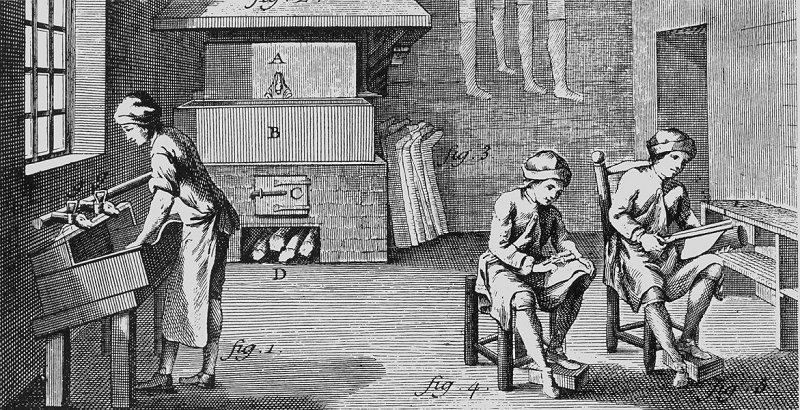
It was discovered that the gummed silk was easier to work than the degummed silk. Degumming involved boiling in salt water. When degummed the stocking was then stretched over a wooden board, this technique existed in the seventeenth century, and they can be seen here in the background of Diderot's entry on stocking knitters, in his Encyclopedie. The degummed knitting then appeared more regular. 

The first reconstruction took around 360 hours to knit a stocking. Experience halved the time taken to knit the stockings, but this was still between 120 and 150 hours work per stocking. A pattern has been produced and is available from Ravelry for €9 at https://www.ravelry.com/patterns/library/17th-century-silk-stockings There also a blog posting from one of the participants at https://www.ravelry.com/projects/buitendijkm/17th-century-silk-stockings

Later on in the day Geeske Krusman talked about wearing the reconstructions. She and another person (Suzanna?, sorry her name is not in my notes) each wore a pair of the reconstructed stockings with reproduction 17th century shoes, one pair with heels and one pair flat. They also used four pairs of garters. One pair of stockings were worn for 139 hours and show no traces of wear, the other pair were washed on three occasions with no damage. Geeske has an Academia page and usually puts up her talks on that. https://independent.academia.edu/GeesKrus

Some of the dyed stockings
Since the stockings were knitted undyed there was also a paper by Art Proaño Gaibor on reproducing seventeenth century dye recipes, particularly black, from the Burgundian-Hapsburg Netherlands. These were then tested on some of the reconstructed stockings.