Friday, 15 January 2016

The decline and fall of frieze and russet?


Frieze and russet appear to be two of the main fabrics for the outer clothing of the generality of lower classes in the sixteenth century. Peachey’s (2014) table of wool fabrics covering the period 1558-1660 shows frieze as 37% and russet as 38% of the fabrics used. This would seem to indicate 75% of clothing for the lower classes was frieze or russet. Peachey’s figures are obtained mainly from wills and probate inventories and are for fabrics used for the outer layer of a garment, for those he describes as common civilians. One problem with his figures is that they cover an entire century and he does not show how this usage changed over time.

What were these two fabrics?
Re-enactors, and I’m one so I can be rude, often want things nailed down. Garment x was made with fabric y, and fabric y was made to the following rules and cost z. Unfortunately it doesn’t work like that, firstly because it is very, very rare to find a piece of fabric with a contemporary label attached saying I am a piece of Devonshire dozen or Manchester cotton, then because fabric terminology changes over time, and also because the same word can be used to describe quite different fabrics.

Frieze
Mikhaila and Malcolm-Davies (2006) describe frieze as, “very thick, heavy, plain weave, well-fulled cloth, with raised hairy surface on one or both sides. Made from cheaper fleeces, unfit for finer cloth.” Fuller (1660) speaks of it as a coarse kind of cloth manufactured in Wales, "than which none warmer to be worn in winter, and the finest sort thereof very fashionable and gentile. Prince Henry (1594-1612) had a friese sute out of it.” 

Frieze is sometimes regulated by law. An Act of 1551, speaking like Fuller of Welsh friezes, gives them as being a minimum of 30 yards long, three quarters (27 inches) wide and “being so fullie wrought shalle waye ev'ye” (love the spelling of heavy). A whole piece, that is the 30 yards, to weigh 48 pounds at the least. 

However not all frieze was the same. Spufford (2003) examining the prices of fabrics has a table showing the price of frieze ranged from 7d to 5s 8d a yard in the period 1560-1610, and 2s to 6s in the period 1610-1660. She has no examples of frieze in her table for the period after 1660. 

Russet
Mikhaila and Malcolm-Davies (2006) describe russet as “a coarse narrow wool, undyed and unfinished; broad russet, better quality, might be dyed; London russet as wide and costly as broadcloth.” Both Delaney in hisThomas of Reading from 1612, and Hall in his Satires of 1598 describe russet as the wear of country folk. 

Spufford (2003) shows that russet, like frieze and other fabrics, could vary enormously in price for “a yard of [any] fabric with the same name at the same date throughout our period (1560-1705).” Russet varies from 5d to 4s 5d a yard in 1560-1610, and 1s 6d to 3s 10d in 1610-1660. Like frieze she has no examples of russet after 1660.

Part of the problem with describing russet is that the term was being used not only for a fabric, but also for a colour from before the beginning of the sixteenth century. The colour russet is described in 1573 as, “If you will mingle a litle portion of white with a good quantitie of redde, you may make thereof a Russet, or a sadde Browne, at your discretion.” 

Probate accounts
As pointed out above Spufford’s (2003) paper shows no frieze or russet, in the accounts she examined, after 1660. Spufford was looking at probate accounts, these were produced by the administrator or the executor of a will, often the widow. When there was a child orphaned the accounts can show, among other things, the provision of clothes for the orphaned child/ren until they were, apprenticed or 21 in the case of boys, and married or 18 in the case of girls. These are often more detailed in the final year when the accounts are being wound up.  Spufford analysed 820 accounts from which she extracted 8,974 garments. These accounts are not from the very rich, they reflect, she says “the lives and clothes of labourers, husbandmen and yeomen below the gentry level.”

Cloth
Cloth is a very general term usually referring to a fabric made of wool. In the probate accounts it is the most used fabric for making doublets, jerkins, waistcoats and breeches for boys, and waistcoats and petticoats for girls. However it is also listed as providing a large number of the shirts and smocks, which might indicate that it may be being used just as a general term for any type of fabric, wool or linen. Spufford refers to it as “the ambiguous and universal” cloth, and it is interesting that in his list Peachey does not mention it at all, maybe because of its ambiguity.

The changing use of cloth types
As well as dividing what was provided by garment and gender, Spufford also split her results by 40-45 year time periods; 1560-1610, 1610-1660 and 1660-1705, this enables us to infer that perhaps certain fabrics were declining in use, while others were rising. The declining fabrics would appear to be russets, friezes and cottons: 90% of russets, 82% of cottons (wool) and 76% of friezes are pre 1610. Other declining fabrics that appear pre 1660, but rarely post 1660, are fustians and canvas: 64% of fustians are pre 1610 with 36% in the 1610-1660 period and none post 1660; with canvas this is 74% pre 1610, 24% 1610-1660 and only 2% post 1660. Other fabrics go along in a more or less steady state, like cloth, stuff and kersey, and among the linens, lockeram. 

Remember that these are clothes provided for young adults and children, by comparison the garments appearing in wills belong to older people. It would be interesting to compare an analysis of the fabric of garments in both early and late seventeenth century wills and probate inventories, with those in the probate accounts. We could then see whether this would show the same change in fabric use, but perhaps coming through later. Certainly John Dale, a yeoman, still had one gray frieze coat in his 1682 probate inventory, to go with his serge, cloth, and two worsted camlet coats. (Williams and Thompson, 2007)

Social status and the fabric used
The obvious thing to say is that the poorer, coarser cloths are worn by the poorer classes, and yet there is this enormous difference in price for fabrics of the same name. While friezes have been identified as being worn by the poor, they are also, as shown by John Dale and Prince Henry, being worn by the middle and upper classes.

Spufford’s (2003) analysis appears to bear this out. She points out that the heavyweight and cheap canvas appears across all her income groupings for doublets, though the owners of canvas breeches are predominantly in the poorest group. On the other hand four of her poorest boys had doublets of the supposedly expensive broadcloth. With the girls more of the poorest were wearing russet waistcoats and petticoats, whereas none of the richest group did so. The richest group’s waistcoats and petticoats were mainly of cloth, kersey, mockado [a fake velvet style of cloth] or fustian.

How much was spent
In Gregory King’s 1688 calculations, variation in the amounts spent by families on their clothing range from, ‘almost £3’ a year for  the lowest income groups to, ‘about £1000’ for those with the highest of incomes. (Spufford 2000)   If you think this is any different from today consider that you can buy a pair of cheap jeans for £5 in a supermarket, while an “off the peg” top of the range pair of Gucci jeans cost over £2000. 

Spufford (2003) produced a table showing how the cost of a basic wardrobe changed over the period. For a boy the wardrobe she uses consists of a shirt, jerkin/doublet, breeches, coat, stockings, shoes and a hat, the median for 1610-1660 was £1 3s 3d. For girls her wardrobe is a smock, waistcoat, petticoat, stockings, shoes and headwear (she did not include a gown although she had records for 137 of them, as most were in her top income group); for 1610-1660 the cost of this wardrobe was 14s 9d. She did not unfortunately do a cost by time period analysis of the gowns.

Bibliography
Anon. 1573. A very proper treatise, wherein is briefly sett for thethe art of limming, 1573. The 1596 edition is available at https://archive.org/details/verypropertreati00impr
Fuller. T. 1660 The history of the worthies of England, Volume 3. London:Tegg, 1840 edition.
Mikhaila, N. and Malcolm-Davies, J. 2006. The Tudor tailor. London: Batsford.
Peachey, S. (ed.) 2014. Clothes of the common people in Elizabethan and early Stuart England. 1558-1660: the user’s manual. Bristol: Stuart Press.
Spufford, M. 2000. The cost of apparel in seventeenth-century England, and the accuracy of Gregory King.  Economic history review, 53 (4) 677-705
Spufford, M. 2003. Fabric for seventeenth-century children and adolescents’ clothes. Textile History, 34 (1), 47–63
Williams, L. and Thompson, S. eds. 2007. Marlborough probate inventories 1591-1775. Wiltshire Record Society, vol 59, 165-6

Monday, 21 December 2015

The Gunnister Man Project


 From the Shetland Museums leaflet (3)

Last month I attended the Knitting History Forum conference, and one of the speakers was Dr. Carol Christiansen, Textile Curator at the Shetland Museum and Archives, she spoke on the re-construction of the Gunnister Man clothing. The project to re-construct the clothing was a joint venture involving, among others, Carol Christiansen, Martin Ciszuk, of the School of Textiles, University of BorÃ¥s, Sweden, and Lena Hammarlund, craftsperson and textile researcher, from Göteborg, Sweden, and was completed in 2009. Some of this was reported at NESAT XI (1) and some at the European Textile Forum. (2)   Also the Shetland museum service has produced a leaflet, which shows the re-created clothing, complete with mends, patches, etc. (3)

Background
A lone burial containing the body of a man, or to be more precise the clothing of a man the body having disappeared, was found at Gunnister in Shetland in 1951. As Carol said most of the report written at that time by Henshall and Maxwell (4) still stands. The body probably dates to the very end of the 17th century, early 18th century. The purse he was carrying contains three coins, one Swedish dated 1683, and two Dutch from 1681 and 1690. Gunnister Voe, itself was one of a number of extremely small ports operating at the end of the Hanseatic League period. It is about two miles distant from the burial, and it traded with Dutch, Swedish and German merchants. The site at Gunnister Voe has been excavated, but very little was found there. (5, 6)

The burial
The bulk of what survived in the burial is the woollen clothing, which is very heavily patched, so that there are 20 different fabrics represented. The non-clothing items were a wooden stick, a small wooden bucket (16.25 cm diameter by 14.5 cm high), two other small pieces of wood, a wooden knife handle, a horn spoon and another piece of horn, a quill (analysis showed that it had ink on it), and the coins.  Non fabric items of clothing were, four pieces of a leather belt with a brass buckle, and a very few fragments where rivlin type shoes would have been.

The clothing
The clothing is with the National Museums of Scotland, but was returned to Shetland for the period of the project and the exhibition that followed. They are now back with the NMS.The garments were all closely examined in order to decide what wools to use, and various wools were tested including Shetland, Herdwick and Gammelnorsk (an old Scandinavian breed). A dye analysis proved inconclusive. One conclusion was that the clothing had been obtained over a considerable period of time, and from many different places. As has already been mentioned the clothing was heavily patched and the feet on the stockings had been completely replaced.
For the reconstruction of the clothing Lena worked on the spinning and weaving of yarn and cloth. Martin worked on the cutting and sewing of the woven items, and Carol and Lena worked on reproducing the knitted items. As Carol was talking mainly about the knitted items some garments were hardly mentioned, however I have linked to the SCRAN – the National Museums of Scotland – database entries for each garment below:

The shirt
This was not mentioned by Carol in her talk. It is of wool and fastens from the waist to neck with ten buttons of wool covered in cloth. (4) All the buttons on the Gunnister clothing were wool covered with cloth.

The jacket and coat
The shorter jacket was being worn over the longer coat. The low decorative pocket slits on the coat were sewn shut, and the turn back cuffs on the coat were rolled down. Carol also mentioned that the stockings appeared to have been sewn to the bottom edge of the coat. She conjectured that these alterations may have been against the cold, and pointed out that the 1690s saw some very bad weather.

The breeches
The breeches had had pocket bags on either side, which had disappeared and therefore were probably made of linen or leather. The waist had been altered by taking in 5 inches. The breeches had a fly front, fastened with only one button at the waist.

The stockings
As mentioned before the stockings appear to have been attached to the lower edge of the coat with thick two ply wool. The stockings had been mended at the knees, but more obviously the feet had been replaced, in one case with the leg of another, finer knit, stocking. Carol said that the knitting on the main stocking legs was 2.9 to 3.2 stitches to the cm, and 4 to 5 rows to the cm. They had a decorative false seam at the back, and the calf shaping was worked every four rows.

The cap with a brim
This was the cap he was wearing. This was white and, according to Carol, the pattern in Henshall is incorrect. The cap was 56 cm in circumference and 17 cm from crown to edge. It was knitted at 3.5 stitches to the cm and 3.75 to 4.5 rows to the cm.

The cap without a brim.
This was the cap that was in a breast pocket of the coat. The shaping, which produces a sort of cross at the crown, is similar to that of a Svabald example. The cap has a boucle effect inside. Testing produced the same boucle effect when a Shetland wool was mixed with primitive Scandinavia wool, and then fulled. This cap was knitted at 3 to 3.25 stitches and 4 to 4.5 rows to the cm.

The purse

The purse is grey-brown with a pattern in white and red. It is 10cm by 13.5cm and was knitted in the round with the bottom being knit together. It has 4.5 stitches and 6 rows to the cm. There is a cast on row, then a knit row, before the 13 loops that carry the drawstring. My attempt at the Gunnister purse, done before I attended the talk, is shown right.

The gloves
The gauge given in Henshall for knitting the gloves is incorrect The gloves were knitted at 3 stitches and 4.5 rows per cm in white wool. They have a decorative design of three lines on the back of the hand. The gauntlet has a decorative design involving rows of garter stitch, stocking stitch and purl stitch. Henshall gives this as “6 rows of garter stitch, 5 of stocking stitch, 5 of garter stitch, 6 of stocking stitch, 3 purl rows separated by 2 plain rows, 8 of stocking stitch, 5 of garter stitch, with decreases along the outer side.”


Bibliography

1.  North European Symposium for Archaeological Textiles, 10-13 May 2011, Esslingen am Neckar, Germany. Carol’s abstract is available from;   http://www.nesat.de/nesat_11_esslingen/abstracts/lecture_christiansen.pdf

2. Ciszuk, M and Hammarlund, L. 2013. Tracing Production Processes and Craft Culture: the reconstruction of the Gunnister Man costume. In: Ancient textiles, modern science : re-creating techniques through experiment : proceedings of the First and Second European Textile Forum 2009 and 2010;  edited by Heather Hopkins. Oxford: Oxbow

3..Shetland Museums and Archives. 2009. Gunnister Man A life reconstructed. (Watch it, because it is designed to fold into a leaflet the first bit is upside down.)

4.  Henshall, A. S. and Maxwell, S.  1952. Clothing and other articles from a late
17th-century grave at Gunnister, Shetland.  Proceedings of the Society of Antiquaries of Scotland, 1951-52, 30-42. Available from: http://archaeologydataservice.ac.uk/archiveDS/archiveDownload?t=arch-352-1/dissemination/pdf/vol_086/86_030_042.pdf link)

5. Queen’s University Belfast. 2010. Gunnister: excavations of a German trading site at Gunnister Voe, Shetland. Available from:

6. Gardiner, M. and Mehler, N. 2010. The Hanseatic trading site at Gunnister Voe, Shetland
Post Medieval Archaeology, 44 (2) 347-349. Available from: https://www.academia.edu/690244/Excavations_at_the_hanseatic_trading_site_at_Gunnister_Shetland._Post-Medieval_Archaeology_44_2_2010_347-349

Tuesday, 3 November 2015

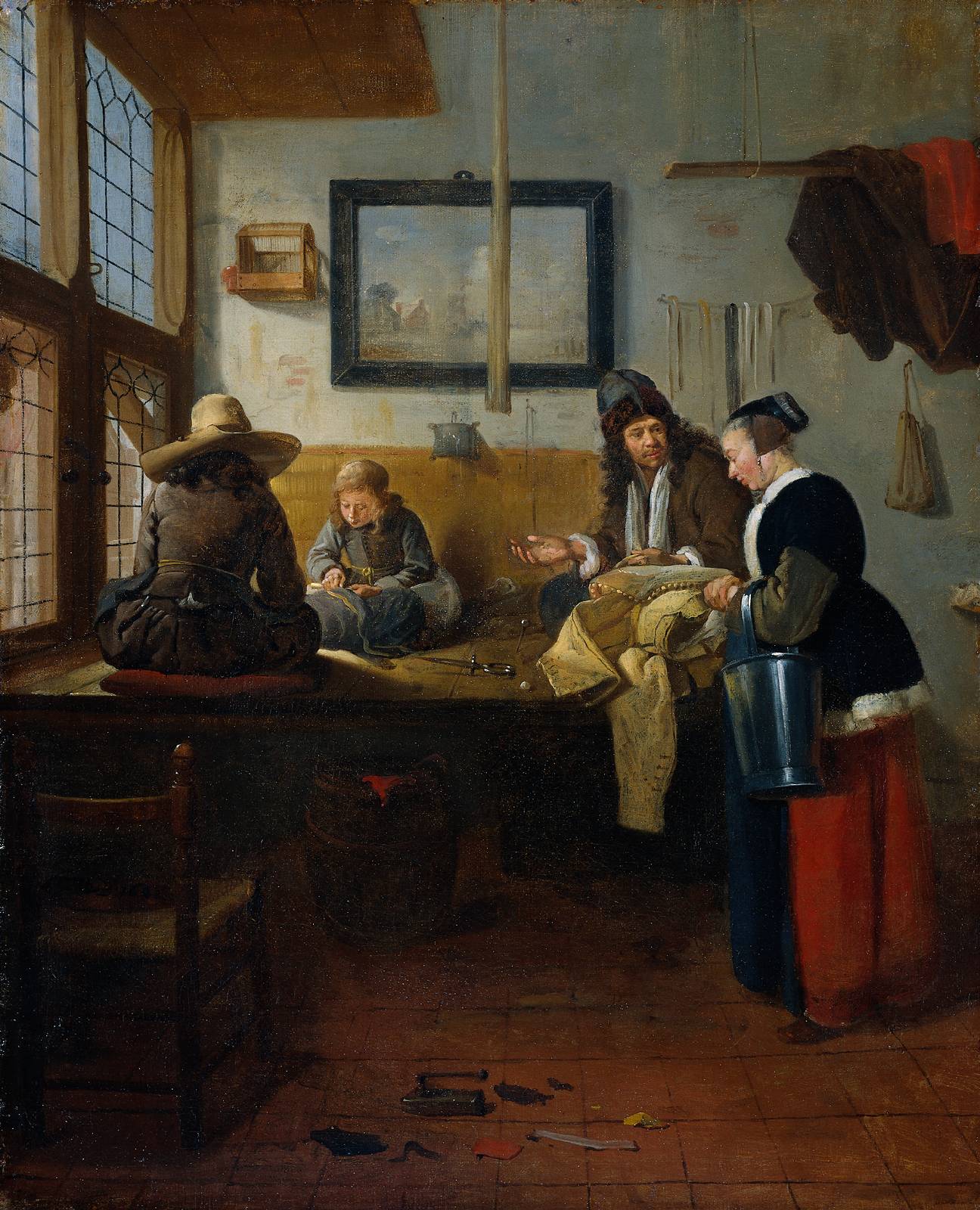
A 1623 tailor and seven other Marlborough tailors 1592-1691


Quirijn van Brekelenkam - Tailor's workshop c.1661
This post looks particularly at the 1623 probate inventory of the tailor Ambrose Pontin of  Marlborough, in the county of Wiltshire, and at the seven other Marlborough tailors with probate inventories made between 1592 and 1691.(1) Pontin’s inventory is perhaps unusual in that it gives an idea of his equipment, and also shows the wares of an early craftsman retailer. There hasn’t been a vast amount of research done on how ordinary people purchased clothing at this time, but he may well be typical as a supplier. In market towns such as Marlborough the population, of about a thousand people, would be swollen on weekly market days, and it has been suggested that by 1660 the market places were surrounded by retail and craft shops. (2)

 
Relative values

Looking at the other, non farming, men of Marlborough who had inventories taken in the period 1620-1642, Pontin, with a total worth given as £90-18s-2d is near, but by no means at the top, of the range. John Cole, a 1626 tanner, was worth considerably more, £143-10s-4d, and two men worth a lot more were William Brewtie, a 1640 innholder, £279-8s-0d and Walter Jeffrys, a 1641 baker, £225-13s-0d. Pontin’s worth is similar to that of Anthony Gunther, a 1624 glover, £89-2s-6d, and John Heath, a 1637 innholder, £95-0s-7d. Below these with values of more than £50 are a barber, shoemaker, haberdasher and baker. With values between £30 and £50 are a dyer, a parchment maker, a glover and a barber. Those with values between £10 and £30 are two weavers, a cooper, a tanner, a heelmaker, mercer, butcher, carpenter, glazier, and shoemaker. Right at the bottom end,with values under £10, are a buttonmaker, baker, tailor and carpenter. This shows that tailors could run from the poorest to the richest of tradesmen. 

In the century from 1591 to 1691 there are eight Marlborough tailors listed in the inventories. Thomas Cockye 1592, Ambrose Pontin 1623, William Dawnce 1632, Robert Millington 1678, William Cornish 1685, Thomas Have 1689, John Mundy 1691 and Francis Smith 1691. Their values range from the £4-2s of Dawnce to £94-14s-6d for Millington. The total worth given is not necessarily an indication of how rich or otherwise they were, or how successful as tailors. 

Robert Millington 1678 for example, is the richest at £94-14s-6d, however £80 of this is in “debts due to the deceased.” William Cornish 1685, is another high value tailor worth £87-7s-0d, however although described as a tailor he is obviously functioning as a farmer, as he has harrows and ploughs and £31 of his worth is “corne upon the ground,” that is a crop in the fields. Francis Smith in 1691 appears to be doubling as brewer, he has his own brewhouse and cellar and owns eleven keevors (mash tubs), a furnace, boiler, 9 vessels and 3 horses for beer (in this sense it is a  horse as a frame, as in a saw-horse or a clothes horse).

Cloth

Pontin is the only one who lists any cloth in stock, and he kept a considerable amount having, 104 yards of ordinary woollen cloth (£13), 357 yards of coarse woollen cloth (£26- 5s), 13 yards of fustian (13s), 40 yards of broad list (in this sense list is a strip of fabric, or a edge of cloth, or an edging fabric (OED)) (2s), and 5 yards of linen cloth (6s). The amount of coarse cloth he had would seem to indicate that he is making for the ordinary working man. He purchases his cloth in the city of Salisbury, just over 25 miles away, as he owes £6 4s for cloth bought there.

Tools of the trade and point of sale

Most tailors use chests for storage. Pontin appears to store his cloth in chests as he had “nine coffers 10s” Thomas Cockye 1592, also has, “In the shoppe 2 great chests £1 13s 4d”, even Dawnce the poorest tailor had “one chest, three coffers, one box.” Thomas Have, another poor tailor has “1 chest, 1 truncke, cofer and 4 boxes.”  From Cockye’s inventory we gather he has a shop, Francis Smith also has a shop, but we do not know what was in it, as the appraisers value only what is in the “chamber over the shop.”

From the Nuremberg House Books (4)
Pontin, in another part of his building, and unfortunately with this inventory the appraisers do not specify rooms, has a chest, a shopboard, 2 irons and 3 pairs of shears, together worth 7s. The OED has two definitions for shopboard, either or both of which might be applicable here. Firstly “A counter or table upon which a tradesman's business is transacted or upon which his goods are exposed for sale,” and secondly “A table or raised platform upon which tailors sit when sewing.” Three other tailors, Cockye, Dawne and Have, also own shopboards, while irons and shears appear in the inventories of both Cockye and Dawnce, Dawnce’s being specified as a pressing iron. 

Then Pontin has the odds and ends, not worth enough for a full listing; “girdles, laces, gartering and pinnes” worth 5s-8d. There are “silke lase and remnants of taffety” worth another 5s, another “little box, a remnant of cotton, 1 paire of stokins (stockings) and 4 yards to measure cloth” totalling 1s.  He has 11 yards of loom work, which may well be what we would call braid, and “more in little remnants of woollen cloth, 4s.” 

To get around Pontin has a horse, and with it two pack saddles and one riding saddle. The only other tailor to own as horse is William Cornish, but I think his horses, he has five, are for his farming, not his tailoring.

Ready to wear

Pontin is the only one who has sale items of clothing in stock, “20 sale dubletts, £5,” “12 pair sale breeches £3” and “6 sale jerkins 17s,” but it was not just woollen items, which these would have been. He also had “10 dozen and 10 falling sale bands” worth £3 5s., that is 130 falling bands at 6d per band. These prices are very similar to those in the 1628 inventory of the chapman John Uttinge of Great Yarmouth.(3) Uttinge had laced falling bands at 8d each, plain bands at 7d each and 27 bands for men at 3d each.  Pontin also has “2 dozen and a half of small made wear, 8s,” we don’t know what these are.

The tailors’ own clothes

For most of the tailors a simple figure is given for their wearing apparel, and often this includes other items. Millington, the richest has wearing apparel worth £2 as does Cornish, Pontin’s clothes are worth £1, while poor Dawnce has clothes worth only 1s. Have’s wearing clothes are lumped in with the money in his pocket at £2 10s. Smith’s wearing apparel is lumped together with his books and is worth £5. Mundy has wearing apparel and linen listed as worth £7, often wearing apparel relates only to the woollen clothing, and wearing linens are either not listed or are listed separately. The earliest tailor,Thomas Cockye 1592, is the only one whose apparel is listed, he has; “2 dubletes, 2 pare of hose, a cloke, a felt hatt, a pare of shooes and a jirkin £1”

Bibliography

1. Williams, Lorelei and Thomson, Sally. Marlborough probate inventories 1591-1775. Chippenham : Wiltshire Record Society, 2007.
2. Cox, N. and Dannehl, K. Perceptions of retailing in early modern England. Farnham : Ashgate, 2007.
3. Spufford, M. The great reclothing of rural England: petty chapmen and their wares in the seventeenth century. London : Hambledon Press, 1984.
4.  Die Hausbücher der Nürnberger Zwölfbrüderstiftungen. The illustration of a tailor in his workshop is taken from the House books of the "Twelve Brothers" an almshouse in Nuremberg, each man entering the almshouse was painted starting with its foundation in the middle ages and ending in 1806. The complete set has been digitised and is available at http://www.nuernberger-hausbuecher.de/

Thursday, 1 October 2015

Historic Clothing Day at the Weald & Downland Museum


The gridshell building at Weald & Downland

On Sunday I attended the Weald and Downland Museum’s Historic Clothing Day held in the site’s incredible Gridshell building, see right. For those who do not know the Weald and Downland Museum, it is an open air museum with more than 40 buildings that were in danger of destruction, and which have been rebuilt on a 40 acre site. The buildings run from a 14th century flint cottage, reconstructed from archaeological evidence, to an early 20th century “tin” church. In many of these buildings the museum has costumed interpreters and volunteers, and the project that clothed these people was the subject of the last presentation of the day.

The day started with a presentation on Henry VIII’s clothing from Maria Hayward author of, among other works, Dress at the Court of King Henry VIII (2007), Rich Apparel: Clothing and the Law in Henry VIII's England (2009), and The 1547 Inventory of King Henry VIII: Volume 2: Textiles and Dress (2012). I am still coming to terms with the proposition that it is possible, to an extent, to “let out” a suit of armour when your waist grows. Although this was done for some of Henry’s armour he had many sets and they show his increase in size from a 34 inch waist as a young man to a 51 inch waist in this last years. Maria showed items other than armour associated with Henry including a hawking glove now in the Ashmolean, and clothes similar to those he would have worn, such as the splendid outfit that belonged to Maurice of Saxony. She noted that by the end of his reign he owned many pairs of glasses. 

The second presentation was from Danae Tankard on Fashionable clothing in late seventeenth century Sussex. Danae looked at the clothing choices and purchases of several middling people in Sussex including Samuel Jeake and his wife of Rye. Jeake was a merchant and a dissenter and his correspondence from London to his wife in the provinces, includes fashion comments, for example on a mantua that was to be drawn with India sprigs, presumably indicating that it was to have a pattern drawn on it for her to embroider. Another person was Edward May (1663-86), his father dying when he was young, the payments for his clothes were made by a trustee Walter Roberts, and there are letters between Roberts and a tailor John Heath. 

After a break Grace Evans, curator of the Chertsey Museum, gave a presentation on 18th and early 19th century items from the Olive Matthews bequest that are now in the museum. Grace discussed how Olive Matthews started as a collector of historical dress as young as aged twelve, using her allowance to purchase from the Caledonian Road Market before the Second World War. Grace showed some of the highlights of the collection including an embroidered man’s night cap of c1600-20, and a 1690s collar of point de neige lace. There was also an open robe of 1734-4 silk that had been remake sometime in the 1750s with the addition of two other silks. Frugal indeed.

There was long break for lunch where we could go around the buildings and see some of the demonstrations as in the photograph to the left where the process of creating linen from flax was being presented by a costumed interpreter.

After lunch Vivienne Richmond author of Clothing the poor in 19th century England, spoke on the subject. She talked about the problems of assessing evidence, she regards the painting that is used for the cover of her book as a romanticised image, and queried to what extent photographs of the ragged children of the time might have been sent up by the photographer. She spoke of the concept of Sunday best (something I remember from my own childhood), and quoted from someone reminiscing that, because they did not have Sunday best clothing, their pious mother had taken them to a church some distance from where they lived so they would not be seen attending church in ragged clothes.

The final presentation of the day came from Barbara Painter, who was the clothing consultant for, and heavily
involved in, the
Historic Clothing Project at Weald and Downland. We were treated to a catwalk display of some the garments worn by the interpreters. The garments are matched to the buildings in which they are to be worn, so the Tudor period clothing is worn in the Bayleaf Farmstead which is displayed as it would have been around 1540. Similarly the West Wittering School is presented as it would have been around 1890.