Wednesday, 17 July 2013

Sixteenth century survivals in the Dresden Armoury Collection - notes on a lecture by Jutta von Bloh


 Early sixteenth century clothing is not something I know much about. What follows are my notes,   from a paper given at Below the knee:  pattens, shoes and hose - the MEDATS (Medieval Dress and Textile Society) summer meeting at the British Museum, by Jutta von Bloh – Refinements in sixteenth century princely legwear: examples from the court of the Duke of Saxony in the Dresden Armoury. Any mistakes and misinterpretations in these notes are my own. 

Having looked at the Trachtenbuch of Matthaus Schwartz (1496-1574) and the fencing book of Paulus Hector Mair, Jutta focused first two shoes in the Dresden collection, a cow mouth, or horn shoe of c.1520 -40 with virtually no upper, and a riding shoe of leather covered with folded silk satin probably belonging to August of Saxony, and therefore dating to the first half of the sixteenth century. Unfortunately I haven’t been able to locate images of either of them.

Quarter size reproduction on the leather hose that survives in the
Dresden Armoury collections
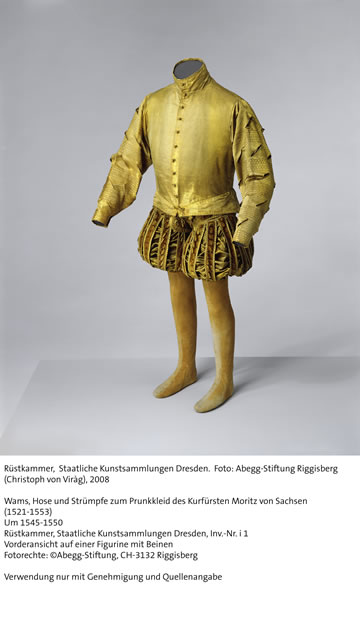
The clothing inventory of Price Moritz of Saxony for 1553 survives, and includes hose of red leather with upperstocks of red velvet. Jutta’s paper on the inventory was published as Jutta Baumel -Der Kleider-Nachlass des Kurfürsten Moritz von Sachsen das Inventar von 1553 und der Dresdener Rustkammer uberlieferten original. In: Waffen- und Kostumkunde 1993 Heft 1 &2, pp65-106. Prince Moritz  parade costume of c.1545-50 in yellow and black also survives, (front view, view from underneath, rear view, without the robe) and was restored by Abegg Shiftung. The book on the restoration work is Das Prunkkleid des Kurfürsten Moritz von Sachsen (1521-1553) in der Dresdner Rüstkammer.  Dokumentation - Restaurierung – Konservierung, by Bettina Niekamp and Agnieszka Wos Jucker and is available for 85 Swiss Francs plus postage.       

The wedding suit of Duke August of Saxony survives from 1548 when he married Anna, Princess of Denmark. This is silver and cloth of gold and was restored in 1988. ( J Baumel - Die Festlichkeiten zur Hochzeit Herzog Augusts von Sachsen mit Anna von Danemark 1548 - Dresdner Hefte, 1990).  It has goatskin leather hose. Jutta had a quarter size copy of one of these leather hose (see photo), the construction of the foot is interesting in that the seam is under the sole of the foot.

As far as knitted stockings are concerned they are first mentioned in 1548. Forty pairs of silk knitted stockings are mentioned in the inventory. A survival has a leather pad inside the toe, presumably to stop wear.

Wednesday, 26 June 2013

Below the knee: pattens, shoes and hose - the MEDATS (Medieval Dress and Textile Society) summer meeting at the British Museum.

Figure 1 - Piece of sprang relaxed
What follows are my notes on what was said for four of the six papers given at the study day. I will write longer notes on the other two papers given; Jutta von Bloh – Refinements in sixteenth century princely legwear: examples from the court of the Duke of Saxony in the Dresden Armoury, and  Lesley O’Connell Edwards – “A Child of 20 yer that knytt gret hose by whom cometh their chiefe lyvinge”: archival and archaeological evidence for hand-knitted hose in Elizabethan England, as they fit better with the period covered by this blog. The notes are my personal interpretation, and depend on how fast I could write and how well I could keep up and understand. Any mistakes and misinterpretations are my own. 

Dagmar Drinkler, Bayerischen Nationalmuseum, Munich – The Reconstruction of tight-fitting textiles in Sprang Technique
Figure 2 Piece of sprang stretched


Dagmar’s thesis was she had been looking at tight garments and especially the highly patterned hose, for example as in the gondoliers in a 1494 painting by Vittorio Carpaccio, and wondering how they were made. She had been experimenting with sprang to see if it were possible to reproduce patterns that appear in medieval illustrations, in order to create a stretch fabric that would produce tight fitting hose. The same piece of sprang, woven in a pattern that copies some of those used in the medieval period is shown in figure 1 relaxed, and in figure 2 stretched to show how much elasticity there is in the fabric. Dagmar recommended Pater Collingwood's The techniques of sprang, 1999, and Carol James Sprang unsprung, 2011.


Timothy Dawson, Independent scholar – Trousers to Trousers in less than a Thousand Years

Tim took us through from the closed hose of the Thorsberg trousers in the 2nd century AD to the closed hose of Ferdinand II of Aragon (d. 1516) via all the two separate leg styles of the Middle Ages. We looked at and discussed the hose of Clement II (d.1047), the hose of St Desiderius (12th C), Hose of Henry III of Germany (c.1056), the hose of Rodrigo Ximenez de Rodo (d. 1247), by this point in time Tim said that point at the rear of the hose where starting to creep up towards the back. Many of the examples Tim used can be seem on this pinterest page on medieval hose. Question of bias or straight cut, and belts and attachments were addressed.


June Swann, formerly of the Northampton Museum – Fourteenth and Fifteenth century poulaines?

June said she added the question mark to the title having recently looked at some surviving complete poulaines. Poulaine is old French for Polish and the style of shoe is also referred to as a Krakow or pike, they are shoes with very long toes, this one was not shown by June but is in the Met Museum. June showed an image from the 1371 tomb of Kasimir the Great as an example of the early style.  The toes on poulaine curve outward, and Pope Urban V (pope 1362-1370) criticized priests for wearing them. The first reference to the word poulaine in England is 1388 and relates to armour, it is a hundred years later but armoured poulaine appear with the c.1485 parade armour of the future Maximilian I. June pointed out that early, 14th century poulaine laced on the inside of the foot, and later 15th century shoe laced on the outside. The cuff turns down all the way around. June had recently examined some surviving poulaine in collections in London, Nuremburg and Antwerp, all of which had entered the collections in the late 19th and early 20th centuries. Having examined them she has some worries regarding them, and suggested people stick to known excavated examples. She did not use this example but here are some in situ photographs of poulaine being excavated in London. June also asked if anyone had actually seen a contemporary illustration of the toes of poulaine being tied up, as she had been unable to find any such illustration.


 Aimee Payton, Ashmolean Museum – Shoes in the community: engaging the public with medieval footwear

Aimee talked about connecting with the public and getting them the write the descriptions to some medieval shoes being put on display as part of an outreach project. The difficulties of getting the descriptions within a 120 word limit were examined.

Friday, 21 June 2013

Pins in the Early Modern Period

Close up of the head of a 16th century gold pin in the
Portable Antiquities Database
The word pin, as in the Oxford English Dictionary definition  “A small, thin, rigid piece of metal with a sharp point at one end and a flattened or rounded head at the other, used to hold objects in place or together, esp. pieces of fabric while they are fitted or sewn,” dates back to Anglo-Saxon times. Research which was done on Anglo-Saxon dress pins by Ross (1991) identified no less than 83 different types with lots of different functions.

The making of pins continued into the medieval period with pinners guilds being set up in major cities such as London and York, and by the time these guilds were formed pins were so important that the 1348 trousseau of Princess Joan included some 12,000 pins. The pinners of London were not recognised as a guild until 1356, but Megson (2009) states that as early as 1278 there was a Walter le Pinnere living in Smithfield; while the ordinances for the pinners’ apprentices in  York were laid down at the “time of the Great Pestilence”, that is about 1349. (Longman, 1911)

What constituted a pin was set out by the 1544 “Acte for the true making of pynnes”, which stated, “oonelie suche as shalbe double headed and have the heads soudered faste to the shanke of the pynne well smothered, the shanke well shaven the pointe well and round fyled cauted and sharped,” could be considered true pins. It also set the price for pins at no more than 6 shillings 8 pence a thousand. (34 & 35 Henry 8 c. 6). The act obvious did not go down well as it was repealed almost straight away (37 Henry 8. c. 13).

The customs rate book for 1550 gives “Pynnes the dossen thousande ii.s.”  (Edwards, 1970). A later chapman’s inventory of 1588 gives, “3000 of pyns 1s 9d.” (Spufford, 1984).  Robert Careles who was Queen Elizabeth’s pinner provided her with vast quantities throughout her reign, a 1563 warrant relating to him shows 16,000 great farthingale pins at 6 shillings the thousand, 20,000 middle farthingale pins at 4 shillings the thousand, 20,000 great velvet pins at 2 shillings 8 pence the thousand and 58,000 small velvet and head pins at 20 pence the thousand. (Arnold, 1988) Harrison (1577) reckoned the value of pins made in England to be £60,000 a year. Interestingly by this point in time the idea of a pin being something of small worth had already entered the language. The Oxford English Dictionary gives, “In fayth, thi felowship set I not at a pyn.” from 1500, “neuer a pinsworthe of pleasure.” from 1562 and “yet he is not worth a pin” from 1577.

Pins that survive from archaeological contexts are normally copper alloy (archaeologist speak for brass). Caple (1991) stated that they formed 99% of those found on high medieval and post medieval sites, and yet Megson (2009) comments that Osmund iron, the basic for a hard steel wire, was being imported into England by the fifteenth century. It may be simply that, because iron rusts, they are underrepresented in the finds, for example one record in the database of the Portable Antiquities Scheme says “cast biconvex head from a pin; ferrous corrosion indicates the loss of an iron or steel shank.” While the bulk of the finds in PAS are copper alloy there are also lead-alloy, silver, silver-gilt and gold pins (Portable Antiquities Scheme), and obviously pins could have highly decorated heads. Massinger’s play the City Madam (1640) speaks of “A silver pin headed with a pearl worth three-pence,” another example of this decorated type is pin is a 16th century gold pin recorded in PAS, the head having flowers made with turquoise. a close up of the head is above.

Caple(1991) has commented on the apparent decline in the length of pins over time, with pins before 1500 having a mean length of over 40mm, pins between 1500 and 1630 having a mean length of 29-35mm and pins between 1630 and 1730 being 25-30mm. To put this in context a standard dress pin purchased today is about 25mm and the longer dress pins, the type with coloured heads, are around 35mm. Pincushions are another subject completely and worth of a separate post.
Bibliography
Arnold, J. ed. 1988. Queen Elizabeth's wardrobe unlock'd. Leeds : Maney, 1988.

Caple, C. 1991. The detection and definition of an industry: the English medieval and post medieval pin industry. Archaeological Journal. 1991, Vol. 148. 241-55
Edwards, J. and Nevinson, J. L. 1970. The rates of the London Custom House in 1550. Costume. 1970, Vol. 4. 3-12

Harrison, William. 1577. Description of England. 1577.
Longman, E and Lock, S. 1911. Pins and pincuhions. London : Longman, 1911.

Megson, Barbara, ed. 2009. The pinners' and wiresellers' book 1462-1511. London : London Record Society, 2009.
Portable Antiquities Scheme. Database. Portable Antiquities Scheme. [Online] British Museum. [Cited: 20 June 2013.] http://finds.org.uk/database.

Ross, Seamus. 1991. Dress Pins from Anglo-Saxon England: Their Production and Typo-chronological Development. s.l. : Oxford University (unpublished PhD thesis), 1991.
Spufford, M. 1984. The great reclothing of rural England: petty chapmen and their wares in the seventeenth century. London : Hambledon Press, 1984.

Wednesday, 5 June 2013

Muckinder or muckender


Katherine Seymour, Countess of Hertford, with her son Edward, c.1563
Muckinder is a wonderful word for what was basically a cloth to clean children’s faces and hands. Recent costume historians have described it variously, it appears in several of Cunnington’s works (1965), (1970), and (1972), as well as in Anne Buck’s work on children’s clothes (1996) and most recently in the Tudor Child. (Huggett, 2013) According to the online Oxford English Dictionary it appears from around 1420 as a mokedour or mokedore, when it seems to indicate simply a handkerchief. The spelling had changed by the early sixteenth century when it becomes more closely associated with children, as in, “mockendar for chyldre.” (Palsgrave, J., Lesclarcissement, 1530)  

In  Peter Erondell’s The French Garden (St. Clare Byrne, 1949) there is a dialogue in the form of a mother speaking to the nurse of a still partially swaddled child. It goes through undressing and dressing the child. After his biggin (cap), band (collar), petticoat, coat, sleeves, and bib are put on the nurse is enjoined, “Let him have his gathered apron with strings, and hang a muckinder to it.”

Huggett and Mikhaila (2013) analysing images of children suggest that boys had muckinders more commonly than girls, probably because the girls continued to wear aprons. Boys ceased to wear aprons by about the age of about three, but still needed something to clean their face and hands. “One must wipe his mouth with a Muckinder.” (Middleton, 1607)

An early depiction of one of these cloths hanging from a boy’s belt appears in the 1504 St Paul’s altarpiece at Augsburg. This is by Hans Holbein the Elder, and the bottom right hand corner of the left portion of the triptych shows two boys, believed to be Holbien’s sons, one of whom clearly has a muckinder hanging from his belt.

A later example shown above right is seen in Katherine Seymour, Countess of Hertford, the younger sister of Lady Jane Grey, with her son Edward. As Edward was born in 1561 the painting is dated to c.1563. The muckinder is again hung from his waist and is of white linen with a border across the bottom, and some form of edging which is difficult to see. The decoration is most likely blackwork, compare it to this handkerchief of 1600-1620 in the Glasgow Museums collection, but woven towels of this period also have borders, as in this example in the Victoria and Albert Museum.

Muckinders continue to be worn in this way until the mid seventeenth century. There is a portrait of William, Lord Petrie at the age of 6, with a lace edged muckinder hanging from his waist, unfortunately I cannot find an online image of it, but in appears, in black and white, in Buck (1996)

Buck, A. 1996. Clothes and the child. Carlton : Ruth Bean, 1996.
Cunnington, C. W. and P. 1970. Handbook of English Costume in the 16th century. London : Faber, 1970.

—. 1972. Handbook of English costume in the seventeenth century. 3rd ed. London : Faber, 1972.
Cunnington, P and Buck, A. 1965. Children's costume in England 1300-1900. London : Black, 1965.

Huggett, J. and Mikhaila, N. 2013. The Tudor Child. Lightwater : Fat Goose, 2013.
Middleton, Thomas. 1607. A trick to catch the old one. 1607.

St. Clare Byrne, M. ed. 1949. The Elizabethan Home Discovered in Two Dialogues by Claudius Hollyband and Peter Erondell. . London : Methuen, 1949.

Wednesday, 22 May 2013

The Calais Museum of Lace and Fashion


Late 16th century lace
I spent last weekend in France and made a visit to the excellent Calais museum on the history of lace, the Cite Internationale de la Dentelle et de la Mode de Calais. Calais is to French lace what Nottingham is to English lace, the place that saw the mechanisation of lace-making; in fact many of the machines in the Calais museum were made in Nottingham.


1630s lace
The museum is extremely well laid out and easy to follow, even if you don’t speak French very well, just remember dentelle a fuseaux is bobbin lace, and dentelle a l’aiguille is needle lace, most labels are in both languages. The museum starts with two short videos, side by side, of the two techniques. The creation of a small leaf motif in needle lace is shown from start to finish, as is the creation of a narrow piece of bobbin lace.
Mid 17th century
There is some beautiful reticella work, and examples of 16th and 17th century bobbin and needle made laces. One thing I particularly liked was the way in which they placed an image of someone wearing lace with original  lace of a similar design, as in the examples I show here.
The museum concentrates on the history of lace in France, so there is much Alencon, Argentan, Chantilly, etc., but there are also Flemish and Italian laces in the collection.
Late 17th century
 
18th century
Later on, when you get into the 18th century, the museum has original garments to add to the display of lace, and by the time you reach the mechanisation of lace in the 19th century they are putting together lace, clothing and illustrations from paintings, fashion magazines and photographs. The Calais lace industry supposedly started after the Napoleonic Wars, when in 1816 a Nottingham lace maker, Robert Webster, supposedly smuggled a lace machine into France.

The twentieth century gallery contains a collection of both underwear, and garments that include lace in their design. The couturiers represented include Paquin, Paco Rabane, Yves St. Laurent, and many others.


Display of bits of the lace making machines
The way in which the machinery that produced the machine made lace is also well displayed, as can be seen in the photo. Upstairs there is a whole floor of machines five of which are in working order, and they use them to demonstrate two or three times a day. The museum is in an old lace warehouse, though you would never know it to look at the outside, which is thoroughly modern.


Finally a very Joseph Wright of Derby style photo of left to right, Ann, Garth, myself and Graham, examining a case of 17th century lace.

Monday, 13 May 2013

Small sewing kits

Figure 1

 Two different terms are sometimes used for small sewing kits. The housewife or hussif is usually seen as a cloth container, a roll with compartments for the various tools. An etui, from the old French word meaning to keep, is by contrast a case containing small articles, not necessarily sewing tools. (OED) The term etui dates back to the seventeenth century, as does huswife. The following definition appears in Florio’s 1611 Italian-English dictionary Queen Anna's New World of Words,   “Astuccio, an estuife, a pocket cace or little sheath with cizers, bodkin, penknife..in it.” Whether this word is meant to be housewife (say estuife out loud) or etui (which is pronounced e’twee) I don’t know. The corruption of housewife to hussif has been charted, Peacock’s Glossary of words [from Lincolnshire] of 1877 has “Hussif, that is house-wife; a roll of flannel with a pin-cushion attached, used for the purpose of holding pins, needles, and thread.”


Nowadays small sewing kits can appear in your hotel room as one of the freebies, together with toiletries and mini shoe cleaning kits, the example in Figure 1 was obtained from a Novotel hotel somewhere. Small kits can also be purchased, and the small blue case in Figure 1 is one I bought, not least because the small scale of the scissors means it is acceptable to airlines. These kits always contain needles, and may contain small scissors, thimble, thread, pins, buttons, and tape measures, depending on the date of the kit and how comprehensive they are trying to be.

Figure 2
In the World Wars housewives were issued to soldiers by the Red Cross and others, and the Imperial War Museum has both fabric examples and leather examples. Unfortunately the Imperial War Museum does not put any dates on their records. An example of a late nineteenth century small sewing kit from my own collection is shown in Figure 2. The yellow case contains a metal needlecase, buttonhook, crochet hook, scissors, bodkins, and a thimble. I think the missing tool may have been a stiletto. Not all these tools may be original.

Like many examples this etui in the Victoria and Albert Museum, which dates from the last decades of the 17th century, survives but unfortunately has no contents. A fairly complete mid 18th century enamel English etui in the Fitzwilliam Museum contains scissors, a button hook, a bodkin, a file, a stiletto and a bodkin case.  In early usage etui could be for all sorts of tools, this mid 18th century shagreen example in the Metropolitan Museum of Art contains drawing instruments, and Figure 3 shows a gold 1570 example in the British Museum, again with drawing implements.


Figure 3 - 17th century kit from the Victoria and Albert Museum.
Click on the link in the text for more information
There is an early sewing kit from the second half of the 17th century, not in a case, which is in the Victoria and Albert Museum, who describe it as a needlecase and scissors. This is very similar to a kit, also in the shape of a small book, described by Taunton (1997) which is even smaller (5.8 x 4.5 x 3.9 cm). It contains scissors, a thimble, a notebook with a dry point writing implement, a mirror and a purse compartment, one side is padded to both contain the thimble and act as a pincushion. The V&A suggest that a skilled needlewoman might have made such a kit for herself or as a gift, but Taunton comments that that she has seen two other compendiums with similar fittings and silver mounts and apparently identical silk brocade, so she suggests some may have been made professionally. Delieb (1967) says he has seen another set which he dated to around 1640.
 
This article has not looked at chatelaines, or other individual articles designed to be hung for waist, perhaps on another day.
Sources and further reading
Delieb, E., 1967. Investing in silver. London: Barrie & Jenkins .
Groves, S. 1968 The history of needlework tools and accessories. London: Hamlyn
Taunton, N., 1997. Antique needlework tools and embroideries. Woodbridge: Antique Collectors Club.


Thursday, 2 May 2013

Edmund Harrison (1591-1667) – the King’s embroiderer


One of Harrison's pictures now in the
National Museums of Scotland
click to see further information from the museum site
There is often a general assumption that embroidery is a domestic, non-professional occupation, but in the sixteenth and seventeenth centuries much work was done by members of the Broderers Guild, which received its first charter in 1561, though it appears to have been around from a considerably earlier date. Edmund Harrison was one of the most important members of the Company which still owns the cup he gave to them, engraved with comment  “The Gift of Edmund Harrison Imbroiderer to our late Soveraigne King James deceased and unto O’Soveraigne Lord King Charles that now is 24 Janry 1628”

 Edmund Harrison was born in London in 1591, the son of a merchant tailor he attended the Merchant Taylors’ School. He may have been trained by two men who were also embroiderers to the King, and his predecessors and/ or contemporaries, William Broderick (died 1620) and John Shipley (or Shepley, died 1631). Harrison continued as a King’s embroiderer until the Civil War. According to Wardle during the interregnum he traded in coal. (Wardle, 2008) Harrison also headed one of the consortiums at the time of the second list. This is the second list drawn up in January 1651 of “about 970 of the said creditors and servants” that is people who were owed money by the late King Charles. Harrison, who at one point is described as a wood monger, sold on about £500 worth of paintings that he had received, including two Titians and a Rubens. (Brotton, 2006) After the Restoration he was reinstated when the Broderers’ Guild wrote to Charles II that he was ‘the ablest worker living’, at that time he was seventy years of age. Charles II granted him £341 yearly for his living, and another £159 12s. for embroidering 250 coats for the yeomen of the chamber, yeomen waiters of the tower, yeomen of the robes and wardrobes, and 42 messengers of the chamber. (Holford, 1910) When he died in 1667 he was worth about £6946 10s, his will and probate inventory are available from the National Archives.

What type of work did Harrison do?

 Ceremonial : Much of Harrison’s work was ceremonial and related to the court, cloths for ceremonies of state and the state barges, banners and standards, for the orders of chivalry, and livery for the heralds, a slightly later herald's tabard is in the Philadelphia Museum of Art, while a tabard from the period, unfortunately without a colour photograph, is in the Victoria and Albert Museum. From 1627, when the Garter Star was introduced, Harrison supplied  stars of the order for cloaks and coats, 34 in 1633-34 and 40 in 1665-66, one of these stars, which may or may not be by Harrison himself, is in the Victoria and Albert Museum. (Wardle, 1995)

 Religious: Harrison is also known to have completed altar frontals and similar both for the King and for private patrons. The Victoria and Albert Museum has in its collection both a pulpit hanging, attributed to Harrison by Wardle with arms of the Sandys of the Vyne family and dated to 1633, and an altar dossal also from the 1630s depicting the Last Supper.

Clothing: Harrison appears quite frequently in the Wardrobe accounts providing clothing for the King. One of the richest suits purchased in 1633/4 cost £226 18s 8½d, part of which went to Harrison for “embroidering the said doublet, hose and cloke, upon watched (i.e. watchet) satin wrought all over verie rich with fine needle gould, and fine twists and flagon cheines and lace purle of fine damaske gold and naple silk at being furnished by him.” (Strong, 1980) Harrison also provided embroidered costume for court masques.

 Embroidered pictures:  The series of embroidered pictures by Harrison, known as the Corby Castle pictures, were split up after a sale in the 1920s. They are dated to 1637 and depict the life of the Virgin. They are in a technique known as or nue, a type of goldwork where the gold threads are couched down with coloured silk threads, the density of the couching threads creating shading in the design. (Synge, 2001)  Two of the pictures are in the National Museums of Scotland; one depicts the Annunciation and the other the Circumcision of Christ .  Another in the series, depicting the Adoration of the Shepherds, is in the Victoria and Albert Museum (unfortunately there is no image attached to the record).

This article is very heavily indebted to Patricia Wardle’s extensive work on Harrison, which should be read for further information on him. (Wardle, 1994) (Wardle, 1995)

Brotton, J., 2006. The sale of the late king's goods.. London: Macmillan.

Holford, C., 1910. A chat about the Broderers' Company. London: Allen.

Strong, R., 1980. Charles I's clothes for the years 1633-1635. Costume, Volume 14.

Synge, L., 2001. Art of embroidery: history of style and technique.. London: Royal School of Needlework.

Wardle, P., 1994. The Kings's Embroiderer: Edmund Harrison (1590-1667), part 1. Textile History, Volume 25, pp. 29-59.

Wardle, P., 1995. The Kings's Embroiderer: Edmund Harrison (1590-1667), part 2. Textile History, Volume 26, pp. 139-184.

Wardle, P., 2008. Harrison, Edmund (bap. 1591, d. 1667), Oxford Dictionary of National Biography, Oxford University Press, 2004; online edn. [Online] Available at: http://www.oxforddnb.com/view/article/40418 [Accessed 1 May 2013].