Showing posts with label study day. Show all posts

Thursday, 1 October 2015

Historic Clothing Day at the Weald & Downland Museum


The gridshell building at Weald & Downland

On Sunday I attended the Weald and Downland Museum’s Historic Clothing Day held in the site’s incredible Gridshell building, see right. For those who do not know the Weald and Downland Museum, it is an open air museum with more than 40 buildings that were in danger of destruction, and which have been rebuilt on a 40 acre site. The buildings run from a 14th century flint cottage, reconstructed from archaeological evidence, to an early 20th century “tin” church. In many of these buildings the museum has costumed interpreters and volunteers, and the project that clothed these people was the subject of the last presentation of the day.

The day started with a presentation on Henry VIII’s clothing from Maria Hayward author of, among other works, Dress at the Court of King Henry VIII (2007), Rich Apparel: Clothing and the Law in Henry VIII's England (2009), and The 1547 Inventory of King Henry VIII: Volume 2: Textiles and Dress (2012). I am still coming to terms with the proposition that it is possible, to an extent, to “let out” a suit of armour when your waist grows. Although this was done for some of Henry’s armour he had many sets and they show his increase in size from a 34 inch waist as a young man to a 51 inch waist in this last years. Maria showed items other than armour associated with Henry including a hawking glove now in the Ashmolean, and clothes similar to those he would have worn, such as the splendid outfit that belonged to Maurice of Saxony. She noted that by the end of his reign he owned many pairs of glasses. 

The second presentation was from Danae Tankard on Fashionable clothing in late seventeenth century Sussex. Danae looked at the clothing choices and purchases of several middling people in Sussex including Samuel Jeake and his wife of Rye. Jeake was a merchant and a dissenter and his correspondence from London to his wife in the provinces, includes fashion comments, for example on a mantua that was to be drawn with India sprigs, presumably indicating that it was to have a pattern drawn on it for her to embroider. Another person was Edward May (1663-86), his father dying when he was young, the payments for his clothes were made by a trustee Walter Roberts, and there are letters between Roberts and a tailor John Heath. 

After a break Grace Evans, curator of the Chertsey Museum, gave a presentation on 18th and early 19th century items from the Olive Matthews bequest that are now in the museum. Grace discussed how Olive Matthews started as a collector of historical dress as young as aged twelve, using her allowance to purchase from the Caledonian Road Market before the Second World War. Grace showed some of the highlights of the collection including an embroidered man’s night cap of c1600-20, and a 1690s collar of point de neige lace. There was also an open robe of 1734-4 silk that had been remake sometime in the 1750s with the addition of two other silks. Frugal indeed.

There was long break for lunch where we could go around the buildings and see some of the demonstrations as in the photograph to the left where the process of creating linen from flax was being presented by a costumed interpreter.

After lunch Vivienne Richmond author of Clothing the poor in 19th century England, spoke on the subject. She talked about the problems of assessing evidence, she regards the painting that is used for the cover of her book as a romanticised image, and queried to what extent photographs of the ragged children of the time might have been sent up by the photographer. She spoke of the concept of Sunday best (something I remember from my own childhood), and quoted from someone reminiscing that, because they did not have Sunday best clothing, their pious mother had taken them to a church some distance from where they lived so they would not be seen attending church in ragged clothes.

The final presentation of the day came from Barbara Painter, who was the clothing consultant for, and heavily
involved in, the
Historic Clothing Project at Weald and Downland. We were treated to a catwalk display of some the garments worn by the interpreters. The garments are matched to the buildings in which they are to be worn, so the Tudor period clothing is worn in the Bayleaf Farmstead which is displayed as it would have been around 1540. Similarly the West Wittering School is presented as it would have been around 1890.

Friday, 21 March 2014

Report on Dressing the little dears – WECS study day 15th March 2014


Had an excellent study day in Bristol, provided by the West of England Costume Society, entitled Dressing the little dears, and covering children’s wear from the sixteenth to the twentieth centuries.

Ninya with the Tudor Tailor display
Our first speakers were Jane Malcolm-Davies and Ninya Mikhaila from the Tudor Tailor, ably assisted by their live model, Ninya’s daughter Minnie Perry. Their presentation Counting cuffs and analysing aprons, was subtitled a statistical approach to children’s dress in the sixteenth century. Much of the information was drawn from their recently published book The Tudor Child. They had, in order to get their information, trawled through nearly 16,000 wills with over 30,000 bequests of clothing, only 357 of which were for children, and vast numbers of images, limited to north west Europe. They spoke about swaddling, and once the babes were a little older, half swaddling, where their arms were free. Lacking a real baby, they are notorious uncooperative, they had a baby sized baby doll you could use to practice swaddling. There was much talk of “slavering clouts” that is bibs. They then moved on to small children, and the problems of guessing the gender of the child, with coats for boys and gowns for girls. Minnie was dressed in an outfit copied in part from a child on the Oglander family monument, with a kirtle on top of her smock, and a russet gown over her kirtle. The book is recommended. (Huggett and Mikhaila, 2013)

Huggett, J. and Mikhaila. N., 2013. The Tudor Child. Lightwater: Fat Goose. £25


Second speaker was Noreen Marshall, who was previously a curator at the Bethnal Green Museum of Childhood. Her talk, What will baby wear, covered the history of baby clothes and started with the sixteenth century. She too spoke about swaddling, noting that the bands were quite deep 2-4 inches, and she had a photograph of a 1575-1600 band from the collection. Noreen talked about chrisoms, the cloth that was used when the child was christened, and how these do not survive. Chrisom children were those who died within the first month. Noreen stated that the ppins used for swaddling were normal open ended pins, and layette pincushions with the pinheads spelling out mottos such as “welcome sweet babe” were common presents for new mothers. Noreen showed a christening set dating to 1650-1700 which consisted of a cap, forehead cloth, bib and mittens, heavily decorated with lace, and a bearing cloth of about the same date, which she described as small tablecloth size. We moved on through 18th and 19th century christening robes to the revolutions of the late 19th and early 20th centuries. Terry for nappies appeared at the end of the 19th century, and we were shown a pilcher (nappy cover) of circa 1909 in oiled silk, creating an early waterproof.  Liberty bodices were introduced in 1908, with a wrapover style by the 1920s. Barracoats made their appearance as open garments in the 19th century but a closed style by the 20th century. Romper suits appear for older children from around 1900, but were being used for babies by 1925.

Examples from Alasdair Peebles collection
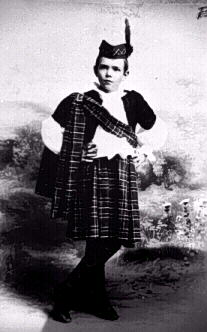
After lunch collector Alasdair Peebles talked about Suitable dress for boys, examining the boy’s suit not only with illustrations, but with examples from his collection and covering from 1770 to the 1940s. He started with photographs of a 1770s suit he had purchased when Brooklyn Museum deaccessioned some of their collection. He then looked at the nankeen skeleton suit of unbleached cotton (far left in the photograph). This style was worn from the 1780s to the 1820s. The breeches button to the jacket. Next a tunic suit (second from left in the photo), these were popular in the 1830s. Next came a suit based on the pattern of the French Zouave uniforms, an original survives in the Chicago History Museum. The outfit Alasdair owns (second from right in the photo), is not as flamboyant as the Chicago example, but is of similar cut. The boy’s sailor suit needs no introduction. The young Prince Albert Edward was famously painted wearing this style in 1848, the original is in the National Maritime Museum.  Alasdair explained how those that have survived are mainly from the 1920s and are of cotton jean, wool versions having succumbed to moth. Alasdair then produced a little kilt suit, which unfortunately I did not photograph. These were popular in the 1880s and 1890s. He wondered why it had little black rosettes on the kilt, but no one was able to offer an explanation. He then moved on to the Norfolk suit, which by 1900 was ubiquitous, but survivals of children’s versions are now incredibly rare. Finally Alasdair looked at the Eton suit, worn in private schools until the 1930s or later, and comprising black coat and waistcoat, striped trousers, stiffened collar and top hat. 


A Ladybird dressing, which someone gave to our speaker.
Our final speaker was social anthropologist Dr. Kaori O’Connor, who some people may have seen recently on the Great British Sewing Bee talking about how Lycra changed fashion. Her talk was entitled The Ladybird, the dressing gown and a golden age of British childhood. Kaori spoke about how the comfortable, safe, secure image of the child’s dressing gown was formed in the inter war years by things like images of listening to radio stories with Uncle Mac, and the Ovaltineys. In 1932 Eric Pasold, whose family had a long running textile manufacturing business on the continent, established the British base in Langley. The firm specialised in machine knit garments and at the beginning was mostly producing underwear. During the war the factory went over to producing parachutes. Kaori pointed out that during the Second World War dressing gowns were an item of clothing that was not produced. After the war Eric decided on a new label for children, Ladybird, and he started with the underwear and with the dressing gown. Eric also produced a book about his family’s story The Legend of the Scarlet Ladybird, and a strip for the comic Swift entitled  The Sign of the Scarlet Ladybird. In the stories Ladybird clothes, such as tee shirts, help to get the children out of trouble or scrapes. When fashions for children stared to change in the 1960s Pasold sold out to Coats Patons, who continued to market the Ladybird range.