Showing posts with label reconstruction. Show all posts

Tuesday, 5 November 2019

The stockings from the Texel Wreck


A selection of the reconstructed stockings
I recently attended the Knitting History Symposium in Leiden. What follows is taken from my notes and therefore may not accurately reflect what was said.

Much of the time was spent looking at the work done by Chrystel Brandenburgh and her group on the Texel stocking finds. There was a lot about the Texel wreck in the newspapers back in 2015-6 when it was discovered. The wreck is off the island of Texel in the Wadden Sea and is designated number BZN17. There was a lot of conjecture at the time about the ship and its contents, and who they belonged to. It now thought to have been an armed Dutch merchant vessel, which sank around 1645-1660.

The project that Chrystel spoke about aimed to use volunteer knitters to produce reconstructions of the silk stockings. So far 27 of these reconstructions have been produced, using different silks, needles and techniques to try and match the originals. 

The wooden board the stockings were stretched on
The original stockings were examined using a high definition microscope. It was discovered that the silk is reeled, not spun. They were knitted in the round with an intricate clock. The knitter participants started off by making test swatches using two sizes of needles, 0.7 mm and 1.0 mm. Three types of silk were used, two of these still had the gum (sericin) attached. The gauge was 83 wales and 100 courses per 10 cm. The stocking was 63 cm long and the foot length is 24 cm.

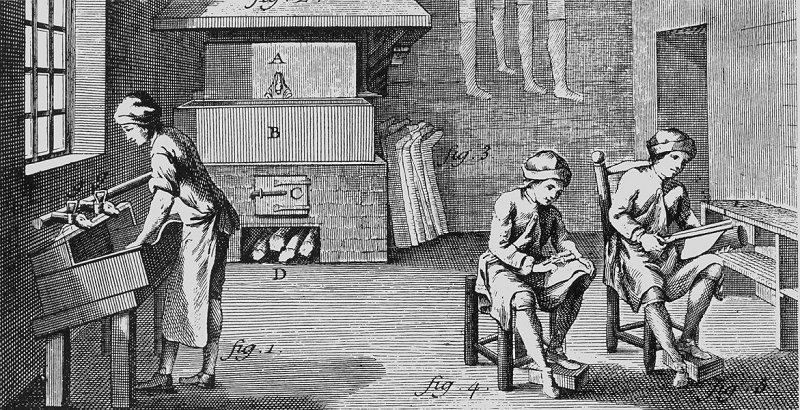
It was discovered that the gummed silk was easier to work than the degummed silk. Degumming involved boiling in salt water. When degummed the stocking was then stretched over a wooden board, this technique existed in the seventeenth century, and they can be seen here in the background of Diderot's entry on stocking knitters, in his Encyclopedie. The degummed knitting then appeared more regular. 

The first reconstruction took around 360 hours to knit a stocking. Experience halved the time taken to knit the stockings, but this was still between 120 and 150 hours work per stocking. A pattern has been produced and is available from Ravelry for €9 at https://www.ravelry.com/patterns/library/17th-century-silk-stockings There also a blog posting from one of the participants at https://www.ravelry.com/projects/buitendijkm/17th-century-silk-stockings

Later on in the day Geeske Krusman talked about wearing the reconstructions. She and another person (Suzanna?, sorry her name is not in my notes) each wore a pair of the reconstructed stockings with reproduction 17th century shoes, one pair with heels and one pair flat. They also used four pairs of garters. One pair of stockings were worn for 139 hours and show no traces of wear, the other pair were washed on three occasions with no damage. Geeske has an Academia page and usually puts up her talks on that. https://independent.academia.edu/GeesKrus

Some of the dyed stockings
Since the stockings were knitted undyed there was also a paper by Art ProaƱo Gaibor on reproducing seventeenth century dye recipes, particularly black, from the Burgundian-Hapsburg Netherlands. These were then tested on some of the reconstructed stockings.


Monday, 21 December 2015

The Gunnister Man Project


 From the Shetland Museums leaflet (3)

Last month I attended the Knitting History Forum conference, and one of the speakers was Dr. Carol Christiansen, Textile Curator at the Shetland Museum and Archives, she spoke on the re-construction of the Gunnister Man clothing. The project to re-construct the clothing was a joint venture involving, among others, Carol Christiansen, Martin Ciszuk, of the School of Textiles, University of BorĆ„s, Sweden, and Lena Hammarlund, craftsperson and textile researcher, from Gƶteborg, Sweden, and was completed in 2009. Some of this was reported at NESAT XI (1) and some at the European Textile Forum. (2)   Also the Shetland museum service has produced a leaflet, which shows the re-created clothing, complete with mends, patches, etc. (3)

Background
A lone burial containing the body of a man, or to be more precise the clothing of a man the body having disappeared, was found at Gunnister in Shetland in 1951. As Carol said most of the report written at that time by Henshall and Maxwell (4) still stands. The body probably dates to the very end of the 17th century, early 18th century. The purse he was carrying contains three coins, one Swedish dated 1683, and two Dutch from 1681 and 1690. Gunnister Voe, itself was one of a number of extremely small ports operating at the end of the Hanseatic League period. It is about two miles distant from the burial, and it traded with Dutch, Swedish and German merchants. The site at Gunnister Voe has been excavated, but very little was found there. (5, 6)

The burial
The bulk of what survived in the burial is the woollen clothing, which is very heavily patched, so that there are 20 different fabrics represented. The non-clothing items were a wooden stick, a small wooden bucket (16.25 cm diameter by 14.5 cm high), two other small pieces of wood, a wooden knife handle, a horn spoon and another piece of horn, a quill (analysis showed that it had ink on it), and the coins.  Non fabric items of clothing were, four pieces of a leather belt with a brass buckle, and a very few fragments where rivlin type shoes would have been.

The clothing
The clothing is with the National Museums of Scotland, but was returned to Shetland for the period of the project and the exhibition that followed. They are now back with the NMS.The garments were all closely examined in order to decide what wools to use, and various wools were tested including Shetland, Herdwick and Gammelnorsk (an old Scandinavian breed). A dye analysis proved inconclusive. One conclusion was that the clothing had been obtained over a considerable period of time, and from many different places. As has already been mentioned the clothing was heavily patched and the feet on the stockings had been completely replaced.
For the reconstruction of the clothing Lena worked on the spinning and weaving of yarn and cloth. Martin worked on the cutting and sewing of the woven items, and Carol and Lena worked on reproducing the knitted items. As Carol was talking mainly about the knitted items some garments were hardly mentioned, however I have linked to the SCRAN – the National Museums of Scotland – database entries for each garment below:

The shirt
This was not mentioned by Carol in her talk. It is of wool and fastens from the waist to neck with ten buttons of wool covered in cloth. (4) All the buttons on the Gunnister clothing were wool covered with cloth.

The jacket and coat
The shorter jacket was being worn over the longer coat. The low decorative pocket slits on the coat were sewn shut, and the turn back cuffs on the coat were rolled down. Carol also mentioned that the stockings appeared to have been sewn to the bottom edge of the coat. She conjectured that these alterations may have been against the cold, and pointed out that the 1690s saw some very bad weather.

The breeches
The breeches had had pocket bags on either side, which had disappeared and therefore were probably made of linen or leather. The waist had been altered by taking in 5 inches. The breeches had a fly front, fastened with only one button at the waist.

The stockings
As mentioned before the stockings appear to have been attached to the lower edge of the coat with thick two ply wool. The stockings had been mended at the knees, but more obviously the feet had been replaced, in one case with the leg of another, finer knit, stocking. Carol said that the knitting on the main stocking legs was 2.9 to 3.2 stitches to the cm, and 4 to 5 rows to the cm. They had a decorative false seam at the back, and the calf shaping was worked every four rows.

The cap with a brim
This was the cap he was wearing. This was white and, according to Carol, the pattern in Henshall is incorrect. The cap was 56 cm in circumference and 17 cm from crown to edge. It was knitted at 3.5 stitches to the cm and 3.75 to 4.5 rows to the cm.

The cap without a brim.
This was the cap that was in a breast pocket of the coat. The shaping, which produces a sort of cross at the crown, is similar to that of a Svabald example. The cap has a boucle effect inside. Testing produced the same boucle effect when a Shetland wool was mixed with primitive Scandinavia wool, and then fulled. This cap was knitted at 3 to 3.25 stitches and 4 to 4.5 rows to the cm.

The purse

The purse is grey-brown with a pattern in white and red. It is 10cm by 13.5cm and was knitted in the round with the bottom being knit together. It has 4.5 stitches and 6 rows to the cm. There is a cast on row, then a knit row, before the 13 loops that carry the drawstring. My attempt at the Gunnister purse, done before I attended the talk, is shown right.

The gloves
The gauge given in Henshall for knitting the gloves is incorrect The gloves were knitted at 3 stitches and 4.5 rows per cm in white wool. They have a decorative design of three lines on the back of the hand. The gauntlet has a decorative design involving rows of garter stitch, stocking stitch and purl stitch. Henshall gives this as “6 rows of garter stitch, 5 of stocking stitch, 5 of garter stitch, 6 of stocking stitch, 3 purl rows separated by 2 plain rows, 8 of stocking stitch, 5 of garter stitch, with decreases along the outer side.”


Bibliography

1.  North European Symposium for Archaeological Textiles, 10-13 May 2011, Esslingen am Neckar, Germany. Carol’s abstract is available from;   http://www.nesat.de/nesat_11_esslingen/abstracts/lecture_christiansen.pdf

2. Ciszuk, M and Hammarlund, L. 2013. Tracing Production Processes and Craft Culture: the reconstruction of the Gunnister Man costume. In: Ancient textiles, modern science : re-creating techniques through experiment : proceedings of the First and Second European Textile Forum 2009 and 2010;  edited by Heather Hopkins. Oxford: Oxbow

3..Shetland Museums and Archives. 2009. Gunnister Man A life reconstructed. (Watch it, because it is designed to fold into a leaflet the first bit is upside down.)

4.  Henshall, A. S. and Maxwell, S.  1952. Clothing and other articles from a late
17th-century grave at Gunnister, Shetland.  Proceedings of the Society of Antiquaries of Scotland, 1951-52, 30-42. Available from: http://archaeologydataservice.ac.uk/archiveDS/archiveDownload?t=arch-352-1/dissemination/pdf/vol_086/86_030_042.pdf link)

5. Queen’s University Belfast. 2010. Gunnister: excavations of a German trading site at Gunnister Voe, Shetland. Available from:

6. Gardiner, M. and Mehler, N. 2010. The Hanseatic trading site at Gunnister Voe, Shetland
Post Medieval Archaeology, 44 (2) 347-349. Available from: https://www.academia.edu/690244/Excavations_at_the_hanseatic_trading_site_at_Gunnister_Shetland._Post-Medieval_Archaeology_44_2_2010_347-349

Wednesday, 27 November 2013

MEDATS (Medieval Dress and Textile Society ) Study Day 23rd Nov 2013


An excellent study day on Saturday with MEDATS, held in the bowels of the British Museum. What follows is my impression of the papers given; any mistakes or misunderstandings are my own.

From the Trachtenbuch, the left
hand outfit has been reproduced
 The first speaker was Jenny Tiramani with the 1530 outfit from Matthaus Schwarz that she produced for the University of Cambridge. For those who haven’t seen this there is an excellent video online at http://www.cam.ac.uk/research/features/the-first-book-of-fashion. There was some discussion about the compromises that had had to be made, partly because of budget constraints. Also the model was a slightly different size and shape from the person it was made for, resulting in comments to the effect that it would never meet in the middle – it did. The comment was also made that, when dressing someone, a lot of time was spent arranging the person so they looked perfect. There were questions about the weight of the aiguillettes, and how this affected how they sat and how they needed to be attached, and how things laced together. The entire Trachtenbuch des Matthaus Schwarz aus Augsburg,1520 – 1560 is available in full online.

 The next speaker was Kathleen O’Neill on Nicolette: Action Transvestite. The second part of the title comes from Eddie Izzard, “I'm an action transvestite! ‘Cause it's running, jumping, climbing trees, you know.” These are the things Nicolette does while dressed as a man. The chantefable of Aucassin and Nicolette was not one I knew, and it was interesting to look at a heroine who not only cross dresses to get her man, but also dyes her skin darker. Kathleen is planning to put this on her blog at http://victorianlibrarian.wordpress.com/ but I don’t think it is there yet.

 The third of the morning speakers was Sarah Thursfield on lacing in fact and fiction. Sarah started with some modern images that come up if you put medieval lacing in Google images, but she spared us the renaissance wench. Modern depictions show lacing that is entirely without function, and it is possible to trace ideas back to early (19th century) costume historians like Planche and Fairholt. Sarah argued that in the medieval period lacing was as ubiquitous and functional as zips used to be, before they became a fashion statement. The use of lacing was traced through the rise of more fitted clothes for both men and women, and the placing of it on the side, front or back of the garment. The Third Temptation of Christ in the Winchester Psalter of c.1150, was examined, where the devil wears lacing. Sarah said that Margaret Scott had commented that the devil's clothes are half male, half female. The side slit and the lacing are from men's wear, and the very long sleeve and skirt are from women's wear.


Book available from the BBC
 After lunch and the AGM Chris Carnie explored the work she had done researching and making Ruth Goodman’s c.1500 outfit for the television series “The Tudor Monastery Farm” Chris based her work on some of the very few depictions of lower class women that exist, especially for England. She showed a woodcut from the Sarum Book of Hours of 1507, an illustration of February from the Grimani Breviary of 1515-20, and material from the Hours of Henry VIII of c1500. Chris created a smock, kirtle, gown, kerchief, filet, rail, apron and cloth stockings that Ruth can be seen wearing in the programme. A book to accompany the series is available. The wear that the outfit received during the filming was discussed.

The final speaker of the day was Johannes Pietsch looking at the Fashionable Silhouette in the Middle Ages. He began his examination of the silhouette with Superbia (pride) on horseback in the Hortus Deliciarum of Herrad of Landsberg, Alsace. The Hortus was started in c.1167 and Johannes worked his way through to the fascinating Erasmus Grasser statues c.1480, of MoriskentƤnzer (morris dancers)  in the Munich City Museum. On the way he took in the garments, which he described as jaque not pourpoint, of Charles de Blois and Charles VI, this lead to a questioning as to whether fashion follows armour, or armour follows fashion.

Friday, 13 July 2012

After Janet Arnold: researching and reconstructing historical clothes in the 21st century, report on a talk by Jenny Tirimani

Last weekend I was at a Costume Society study day in Bath and one of the speakers was Jenny Tirimani, who gave a talk with the title above. Jenny for those who don’t know her was designer at the Globe until 2005, was heavily involved with Patterns of Fashion 4 and edited Seventeenth Century Women’s Dress Patterns, the second volume of which is due out shortly. She is an inspiring speaker with an obvious great love for her subject.

Jenny started by talking about what books are around that have usable patterns taken from surviving clothing, far fewer than you would think. As well as Norah Waugh’s two books on the Cut of Women’s Clothes and the Cut of Men’s Clothes, and Janet Arnold’s four Patterns of Fashion, Jenny mentioned, Sharon Ann Burnston’s Fitting and Proper: 18th century clothing from the collection of the Chester County Historical Society (USA), Linda Baumgarten’s Costume close-up: clothing construction and pattern, 1750-1790 (Williamsburg) and Johannes Piestch’s patterns taken from the Hupsch collection in the Hessischen Landesmuseum Darmstadt  and published by Abegg in 2008 (his PhD thesis on the subject is available online at http://nbn-resolving.de/urn/resolver.pl?urn:nbn:de:bvb:91-diss-20080821-619442-1-9)

Jenny mentioned that she is a director of The School of Historical Dress, which is launching fully in October. The School has access to Janet Arnold’s archive, including probably over half a million slides, and all the material that Janet so sadly left unfinished at her death. Jenny said that there is probably enough material for another two volumes of Patterns of Fashion and showed us a highly detailed unpublished pattern of a c.1620 man’s suit in the Livrustkammaren Stockholm; I think from the description this one .

Jenny spoke about pattern books that were available in the 16th and 17th centuries. The work book of a Milanese tailor dating c.1550-80, here Jenny pointed out that many of the shapes were based on parts of a circle or compounds thereof, and that this was the difference between the tailor and the seamstress.  The Masterbuch von Enns dating to c.1590, I think that is this one. The Libro de geometria (Tailor's pattern book) by Juan de Alcega 1589. The Martin de Anduxar, Geometria y tragus pertinecientes al oficio de sastres, published in Madrid in 1640, and Le Tailleur Sincere of 1671 by Benoist Boullay. I was interested to see that this last book has a pattern for a coat for a poor man. A list of what is available electronically is here.

Jenny was responsible for the fantastic outfits for the Metropolitan Opera’s 2011 production of Anna Bolena, and spoke about the difficulties of researching what was for her a less well known period, most of her work for the Globe being 1590s. She spoke about the 1530s outfit of Maurice, Elector of Saxony, in the Staatlichen Kunstammlungen Dresden, more information is available here, and the Abegg Stiftung publication of their work on the garments is Das Prunkkleid des Kurfürsten Moritz von Sachsen (1521-1553) in der Dresdner Rüstkammer: Dokumentation - Restaurierung – Konservierung, by Bettina Niekamp and Agnieszka Wos Jucker.  Jenny also mentioned some very early Hungarian material, about c1515, which I think is in the Hungarian National Museum, but I cannot find it on their website.

Jenny finished her talk by speaking about the new production of Richard III that she is currently involved with for the Globe, sounds exciting.