 |
| 1870s photo of the Van Dyck portrait |
Everyone is aware of the modern idea of the super-rich woman
being someone who thinks nothing of spending on a handbag, what for most people
is a year’s income. As part of my researches for The Stuart Tailor I have been
looking at the General Account Book of Rachel, Countess of Bath, for 1639-54,
and she counts as mid seventeenth century super-rich, hubby is Charles I’s Lord
Privy Seal. She was also one of the last people to have her portrait painted by
Van Dyck, he returned to England in May of 1641, and was already ill. In her
June 1641 accounts are two payments, “to Sir Anthony Vandick in part for my
picture £10” and “to Sir Anthony Vandick for my picture £10, for the frame £4,
to his man £1.” (1)
Van Dyck died in November 1641. The
whereabouts of this painting are unknown, meaning that it is probably in a
private collection somewhere. The picture on the right is from a 1870s
photograph of the painting.
In some respects it is difficult to compare what Rachel is
spending with the income of an ordinary woman of the time. A 1645 list of the
servants at the Baths’ Tawstock estate shows three female servants being paid
£2 a year. Women who were employed on an annual basis by the gentry Le Strange
family of Hunstanton received between £1 10s and £2 a year, while the two
female servants listed in the 1642 memorandum book of yeoman farmer Henry Best
were paid £1 4s and £1 8s. However as
has been pointed out servants were provided with board, lodging and clothing in
addition to this money. Day labourers also received food and drink as part of
their remuneration and there was a statutory equivalent of the “minimum wage”.
In Suffolk in 1630, for female reapers and binders of corn, this was 4d a day. (2)
 |
| Hollar's Winter 1644 |
So what, for Rachel, was the mid 17th century
equivalent of a modern Hermes Birkin handbag? Here left is Hollar’s Winter from
his 1644 seasons, and this lady is wearing examples of several items that
Rachel buys, a muff, a fur stole, a hood, and shoes roses.
Apart from jewellery, which is discussed at the end, furs
are among her most expensive purchases. In 1650 she pays for “a rich sable muff”
£22, while in 1640 she had purchased “a sable for my neck” for £8 10s 0s.
She buys a large number of hoods ranging in price from 3s
for a black hood in 1639, to 12s in 1640 for a tiffany hood laced. In 1644 she
buys three hoods for a total of 13s, of love, described by the OED as a thin
crape or gauze material, of ducape, described by the OED as a plain-wove stout
silk fabric of softer texture than Gros de Naples, and of sarcenet, which is a fine, soft silk fabric.
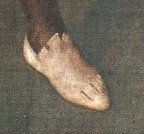
Looking at Winter’s feet the front of her shoe is covered by
a shoe rose. In 1643 Rachel purchases “a pair of roses and 3 yards of pink
coloured ribbon for your Ladyship bought at Mr Gumbletons 5s” The ribbon is
probably for gartering, in 1644 she buys “gartering ribbons 7s”, and in 1650 “3
yards of blue gartering for my Lady 5s.” The shoes on the other hand are a lot
less expensive, in 1644 “for a pair of shoes for your Ladyship 3s 6d”, even
decorated shoes as in 1646 “for a pair of laced shoes for your Ladyship 4s” and
in 1646 her slippers were 2s 6d.
In the winter
engraving you can’t see the stockings, but Rachel’s are usually of silk at
around £1 2s to £1 5s a pair. In 1639 we have “for 3 pair silk stockings £3 15s”
and in 1649 “2 pair of silk stockings 46s,” there are other stockings listed.
These silk
stockings are in the Livrustkammeren in Stockholm and date from 1654.
You can’t tell if
Hollar’s winter is wearing gloves but Rachel buys lots, “paid my glover 6th May
1641 £4 10 0,” and a 1646 bill has “paid for 12 pair of white and 11 pair of
brown gloves Mrs Everatt 19s.” These are
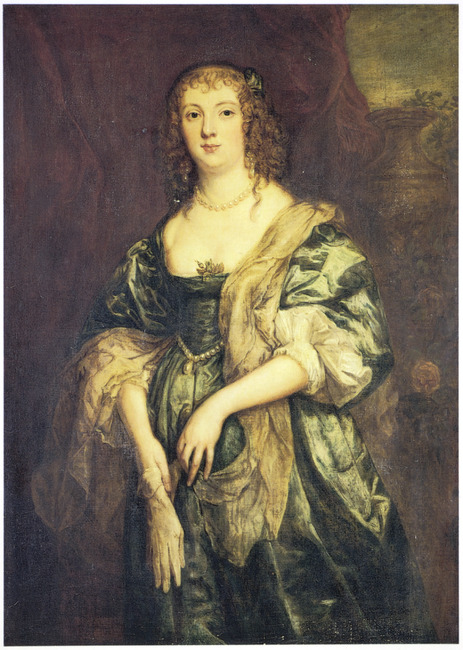
probably the plain elbow length gloves that can be seen in this Van
Dyck portrait of Anne Carr where the glove is shown carried. A slightly
later (c1685-1700) pair, with a little decoration, survives in the Glovers’ Collection.
She buys fans. In 1647 she buys one for 2s and another for
3s. She also buys them with other things, for example “for gloves & a fan
£1 0s 6d,” and in 1647 in a small spending spree, “for a fair laced scarf and
hood & 2 pair of pearl pendants & a screen fan £3.” The assumption is
that a screen fan is a solid fan, as opposed to a folding fan. This folding brise fan
in the collection of the V&A dates to the 1620s.

For her neckwear she has gorgets, these are deep, usually
circular, cape like collars, as can be seen in this rear view from another Hollar
engraving right. In 1640 she pays for a tiffany gorget 10s, in 1641 for making 2
gorgets & tiffany to one of them Miss Antony £1. Tiffany is a kind of thin
transparent silk. Her neckwear wasn’t always of silk, in 1649 we have “for 2
handkerchiefs, cuffs and a gorget of plain Holland £2”
Rachel also purchases a sweet bag in 1640 for the sum of £6
10s. Sweet bags are small purses often given as gifts, and sometimes containing
a scented “sweet powder,” enabling them to be put with clothing in the same way
as lavender bags are used today. Shortly
after buying her sweet bag she spends £1 6s 8d on “silver and gold lace for my
best sweet bag.” The Victoria
and Albert Museum has an excellent collection of examples from the first
half of the 17th century. Jacqui Carey has written a book on the
whole subject of sweet bags. (3)
Finally we have Rachel’s jewellery. Her largest expense is
in 1652 for “for one fair diamond £40,” but she buys a fair number of small,
cheaper items. Some of these items must have been similar to what was found in
the Cheapside Hoard. She buys pendants together with a mask for 10s in 1640,
and in 1642 she spends 14s on “a cornelian ring & crystal pendants.” The
Cheapside Hoard contains several pendants, for example in amethyst
and emerald,
plus a much cruder crystal
pendant. Two pair of pearl pendants
where mentioned above in her 1647 shopping spree, and there is a
pearl and wirework pendant in the Cheapside Hoard. (4) In 1649 she spends £2 5s for “3 great pearls.”
In 1652 she buys “two lockets £4 1s 6d”, and one can speculate as to whether
the lockets might have been of
the type circulating among royalist supporters after Charles’s death. The
final entry for jewellery actually mention her jeweller, and goes into some
detail as to what he is making for her, “£30 to Mr Grumbleton for 4 diamonds
and making two pair of lockets the one 18 diamonds and the other 25 and 17
& a little ring 5s with 5 diamonds.”
Rachel often mentions where she purchases her items, the
Exchange and Paternoster Row in London are mentioned. This engraving of the Royal
Exchange, and with more detail Abraham Bosse’s engraving of one of the
shops in the Galerie
du Palais, show the sort of shop involved. However looking at some of her
purchases, if you didn’t know, you wouldn’t realise, that most of the time
there is a civil war going on. Oh and
the Hermes Birkin equivalent? I think it has to be the sable muff.
Bibliography
1. Gray, Todd. Devon Household Accounts
1627-59. Part 2. Devon and Cornwall Record Society, new series, vol. 39. 1996.
2. Whittle, J. and
Griffiths, E. Consumption and gender in the early seventeenth century
household: the world of Alice Le Strange. Oxford : O.U.P., 2012.
3. Carey, Jacqui.
Sweet bags: an investigation into 16th and 17th century needlework. Ottery
St Mary : Carey Company, 2009.
4. Forsyth, Hazel.
The Cheapside Hoard: London's lost jewels. London : Philip Wilson ,
2013.

.jpg)



.jpg)

.jpg)


