Showing posts with label shirts. Show all posts

Monday, 11 September 2023

One gentleman's 1645-6 list of his linens


On the March 25th 1645 John Willoughby (1571-1658) of Leyhill, in the county of Devon made “a particular note of all my linen.” Two months later he added "More sent unto me first of June 1645.” There were more additions to the list on the 20th November 1645 and the 26th January 1645/6. John Willoughby was travelling at the time he made his note, from Devon, into Somerset and then to Wales, so this is probably not all his linen, just what he took with him. He wrote that he came into Wales on 14th August 1645, and noted that he then sent home some linen, and had had two bands “stolen away” at Weston Bampfydle, a village in south Somerset where one of his three daughters lived. (1)

Willoughby, who was in his seventies, did not take part in the Civil War. He has been described as a moderate royalist, but he was well enough regarded by Parliamentarians for Fairfax, in November 1645, to tell his troops not to plunder Leyhill. This did not stop Willoughby from writing at one point that, “My house is, and hath been, full of soldiers this fortnight, such uncivil drinkers and thirsty souls, that a barrel of beer trembles at the sight of them, and the whole house nothing but a rendezvous of tobacco and spitting.”

The linens listed:-

Shirts

The list has three shirts and then a further two new shirts are added. Because of the amount of neck and wristwear that he owns these are unlikely to be like the shirt that belonged to Colonel Henry Slingsby (1602-1658), which he supposedly wore to his execution, and which has integrated collar and cuffs. They are more likely to be similar to the 1659 example in the Livrustkammaren, which was being worn by Admiral Claes Bielkenstierna when he was shot. An examination of, and pattern for, this shirt is in Pattens of Fashion 4. (2 pp. 26 & 74-5) (figure 1)

1. Admiral Claes Bielkenstierna's shirt, 1659. Livrustkammaren


 Neckwear and wristwear

In the first list Willoughby has seven bands, described as three with lace and four plain, these are accompanied by seven falls. Falls in this case may indicate cuffs, as later listings have the falls as pairs. The June additions include “3 bands and 3 pairs of falls, 2 of them plain and one of them with lace.” The November additions have “2 falling bands and 2 pairs of falls with lace and one plain,” and a further three pairs of falls and three new bands. In January there are three new bands and falls, two with lace and one plain. This means over a period of ten months he receives no less than fifteen bands, with a similar number of pairs of cuffs. He also has three neckcloths. Quite how much lace might be on the seven laced bands that he has is difficult to ascertain. An example in the Victoria and Albert Museum, dating to 1630-40, has a very deep lace edging. The plain bands are likely to resemble the band in the 1645 portrait of Sir Edward Nicholas (1593-1669). (figure 2)

2. Sir Edward Nicholas by William Dobson. 1645. National Portrait Gallery.

Linen caps

Willoughby has five caps, and a further “2 other linen caps within my satin caps and red cloth cap.” The portrait of Sir Edward Nicholas shows him wearing a cap of this type, though in black, so possibly satin and requiring a linen liner. The Victoria and Albert Museum has a plain linen liner, with earflaps, while the Museum of London has a linen liner with a trim of needle-made lace. The V&A example has been examined by Susan North, and a pattern has been produced. (3 pp. 158-61)

3. Linen cap liner, 1600-1640. Museum of London.


 Handkerchiefs

Six handkerchiefs plus one other “wrought handkerchief which MW sent me.” are in the list.  In November he adds one old handkerchief. The wrought handkerchief, wrought means embroidered, might be similar to an example in the Burrell Collection in Glasgow, which has no lace, but does have an embroidered blackwork border. The pattern for the embroidery is available on the museum website.

4. Handkerchief. First half 17th century. Burrell Collection, Glasgow.


Linen leg and foot wear

Willoughby has three pairs of boot hose tops, three pairs of socks and one bootlace. Boot hose tops are quite common, you could have a plain linen hose leg, easily washable, and then a separate embellished top. A pair of boothose belonging to king Gustav Adolphus, which he wore at the 1632 Battle of Lutzen, are in the Livrustkammaren, they are in one piece rather than separated, but they illustrate well how the tops could be embellished. The socks are to protect the foot of a stocking from wear from a shoe, they are the seventeenth century equivalent to trainer socks, and are unseen within a shoe. 

5. Gustav Adolphus's 1632 boothose. Livrustkammaren.


References

 1. Gray, Todd. Devon Household Accounts 1627-59. Part 1. Exeter : Devon and Cornwall Record Society, new series, vol. 38, 1995.

2. Arnold, Janet. Patterns of Fashion 4. London : Macmillan, 2008.

3. Braun, Melanie et al. 17th Century Men's Dress Patterns 1600-1630. London : Thames & Hudson in association with the Victoria and Albert Museum, 2016.

Monday, 21 December 2015

The Gunnister Man Project


 From the Shetland Museums leaflet (3)

Last month I attended the Knitting History Forum conference, and one of the speakers was Dr. Carol Christiansen, Textile Curator at the Shetland Museum and Archives, she spoke on the re-construction of the Gunnister Man clothing. The project to re-construct the clothing was a joint venture involving, among others, Carol Christiansen, Martin Ciszuk, of the School of Textiles, University of BorÃ¥s, Sweden, and Lena Hammarlund, craftsperson and textile researcher, from Göteborg, Sweden, and was completed in 2009. Some of this was reported at NESAT XI (1) and some at the European Textile Forum. (2)   Also the Shetland museum service has produced a leaflet, which shows the re-created clothing, complete with mends, patches, etc. (3)

Background
A lone burial containing the body of a man, or to be more precise the clothing of a man the body having disappeared, was found at Gunnister in Shetland in 1951. As Carol said most of the report written at that time by Henshall and Maxwell (4) still stands. The body probably dates to the very end of the 17th century, early 18th century. The purse he was carrying contains three coins, one Swedish dated 1683, and two Dutch from 1681 and 1690. Gunnister Voe, itself was one of a number of extremely small ports operating at the end of the Hanseatic League period. It is about two miles distant from the burial, and it traded with Dutch, Swedish and German merchants. The site at Gunnister Voe has been excavated, but very little was found there. (5, 6)

The burial
The bulk of what survived in the burial is the woollen clothing, which is very heavily patched, so that there are 20 different fabrics represented. The non-clothing items were a wooden stick, a small wooden bucket (16.25 cm diameter by 14.5 cm high), two other small pieces of wood, a wooden knife handle, a horn spoon and another piece of horn, a quill (analysis showed that it had ink on it), and the coins.  Non fabric items of clothing were, four pieces of a leather belt with a brass buckle, and a very few fragments where rivlin type shoes would have been.

The clothing
The clothing is with the National Museums of Scotland, but was returned to Shetland for the period of the project and the exhibition that followed. They are now back with the NMS.The garments were all closely examined in order to decide what wools to use, and various wools were tested including Shetland, Herdwick and Gammelnorsk (an old Scandinavian breed). A dye analysis proved inconclusive. One conclusion was that the clothing had been obtained over a considerable period of time, and from many different places. As has already been mentioned the clothing was heavily patched and the feet on the stockings had been completely replaced.
For the reconstruction of the clothing Lena worked on the spinning and weaving of yarn and cloth. Martin worked on the cutting and sewing of the woven items, and Carol and Lena worked on reproducing the knitted items. As Carol was talking mainly about the knitted items some garments were hardly mentioned, however I have linked to the SCRAN – the National Museums of Scotland – database entries for each garment below:

The shirt
This was not mentioned by Carol in her talk. It is of wool and fastens from the waist to neck with ten buttons of wool covered in cloth. (4) All the buttons on the Gunnister clothing were wool covered with cloth.

The jacket and coat
The shorter jacket was being worn over the longer coat. The low decorative pocket slits on the coat were sewn shut, and the turn back cuffs on the coat were rolled down. Carol also mentioned that the stockings appeared to have been sewn to the bottom edge of the coat. She conjectured that these alterations may have been against the cold, and pointed out that the 1690s saw some very bad weather.

The breeches
The breeches had had pocket bags on either side, which had disappeared and therefore were probably made of linen or leather. The waist had been altered by taking in 5 inches. The breeches had a fly front, fastened with only one button at the waist.

The stockings
As mentioned before the stockings appear to have been attached to the lower edge of the coat with thick two ply wool. The stockings had been mended at the knees, but more obviously the feet had been replaced, in one case with the leg of another, finer knit, stocking. Carol said that the knitting on the main stocking legs was 2.9 to 3.2 stitches to the cm, and 4 to 5 rows to the cm. They had a decorative false seam at the back, and the calf shaping was worked every four rows.

The cap with a brim
This was the cap he was wearing. This was white and, according to Carol, the pattern in Henshall is incorrect. The cap was 56 cm in circumference and 17 cm from crown to edge. It was knitted at 3.5 stitches to the cm and 3.75 to 4.5 rows to the cm.

The cap without a brim.
This was the cap that was in a breast pocket of the coat. The shaping, which produces a sort of cross at the crown, is similar to that of a Svabald example. The cap has a boucle effect inside. Testing produced the same boucle effect when a Shetland wool was mixed with primitive Scandinavia wool, and then fulled. This cap was knitted at 3 to 3.25 stitches and 4 to 4.5 rows to the cm.

The purse

The purse is grey-brown with a pattern in white and red. It is 10cm by 13.5cm and was knitted in the round with the bottom being knit together. It has 4.5 stitches and 6 rows to the cm. There is a cast on row, then a knit row, before the 13 loops that carry the drawstring. My attempt at the Gunnister purse, done before I attended the talk, is shown right.

The gloves
The gauge given in Henshall for knitting the gloves is incorrect The gloves were knitted at 3 stitches and 4.5 rows per cm in white wool. They have a decorative design of three lines on the back of the hand. The gauntlet has a decorative design involving rows of garter stitch, stocking stitch and purl stitch. Henshall gives this as “6 rows of garter stitch, 5 of stocking stitch, 5 of garter stitch, 6 of stocking stitch, 3 purl rows separated by 2 plain rows, 8 of stocking stitch, 5 of garter stitch, with decreases along the outer side.”


Bibliography

1.  North European Symposium for Archaeological Textiles, 10-13 May 2011, Esslingen am Neckar, Germany. Carol’s abstract is available from;   http://www.nesat.de/nesat_11_esslingen/abstracts/lecture_christiansen.pdf

2. Ciszuk, M and Hammarlund, L. 2013. Tracing Production Processes and Craft Culture: the reconstruction of the Gunnister Man costume. In: Ancient textiles, modern science : re-creating techniques through experiment : proceedings of the First and Second European Textile Forum 2009 and 2010;  edited by Heather Hopkins. Oxford: Oxbow

3..Shetland Museums and Archives. 2009. Gunnister Man A life reconstructed. (Watch it, because it is designed to fold into a leaflet the first bit is upside down.)

4.  Henshall, A. S. and Maxwell, S.  1952. Clothing and other articles from a late
17th-century grave at Gunnister, Shetland.  Proceedings of the Society of Antiquaries of Scotland, 1951-52, 30-42. Available from: http://archaeologydataservice.ac.uk/archiveDS/archiveDownload?t=arch-352-1/dissemination/pdf/vol_086/86_030_042.pdf link)

5. Queen’s University Belfast. 2010. Gunnister: excavations of a German trading site at Gunnister Voe, Shetland. Available from:

6. Gardiner, M. and Mehler, N. 2010. The Hanseatic trading site at Gunnister Voe, Shetland
Post Medieval Archaeology, 44 (2) 347-349. Available from: https://www.academia.edu/690244/Excavations_at_the_hanseatic_trading_site_at_Gunnister_Shetland._Post-Medieval_Archaeology_44_2_2010_347-349

Wednesday, 31 October 2012

Jenny Tirimani – On late 15th and early 16th century linen smock and shirts, evolutions in cut.

This is the last in my series of notes from talks given at:  Well worn weeds: the MEDATS (Medieval Dress and Textile Society) meeting at the British Museum 27th October 2012. Jenny made reference to a lot of illustrations and where I can I have created links to the examples she used. As before any misinterpretations and misspellings are my own. I don’t do shorthand and I don’t write fast enough.

Jenny started by talking about women’s necklines in the early 16th century, and particularly the V in the back of some illustrations. She examined the wide square front neckline with a V back in Holbein’s drawing which shows both, and she speculated on how the smock underneath it may have been made. The construction is problematic because you don’t want the edge on the bias. She showed (and I haven’t been able to work out which painting it was) a c1500 crucifixion scene, so it may have been this one also showing the v back. In another painting, which she said was from a 15th century triptych in Metropolitan Museum of Art, the V neck back of the green dress shows her smock with a centre back seam, indicating that perhaps the edges of the V were on the straight and the seam was on the bias.

Jenny then looked at the extant c.1525 gown of Maria of Hapsburg, in Budapest. Jenny had a pattern from this, I don’t know who made it, which shows the smock back and front are each formed from 3 trapezoids, which of course you could top and tail when cutting to minimise fabric waste. The smock has incredibly fine gathers at neck and is embroidered over the gathers.

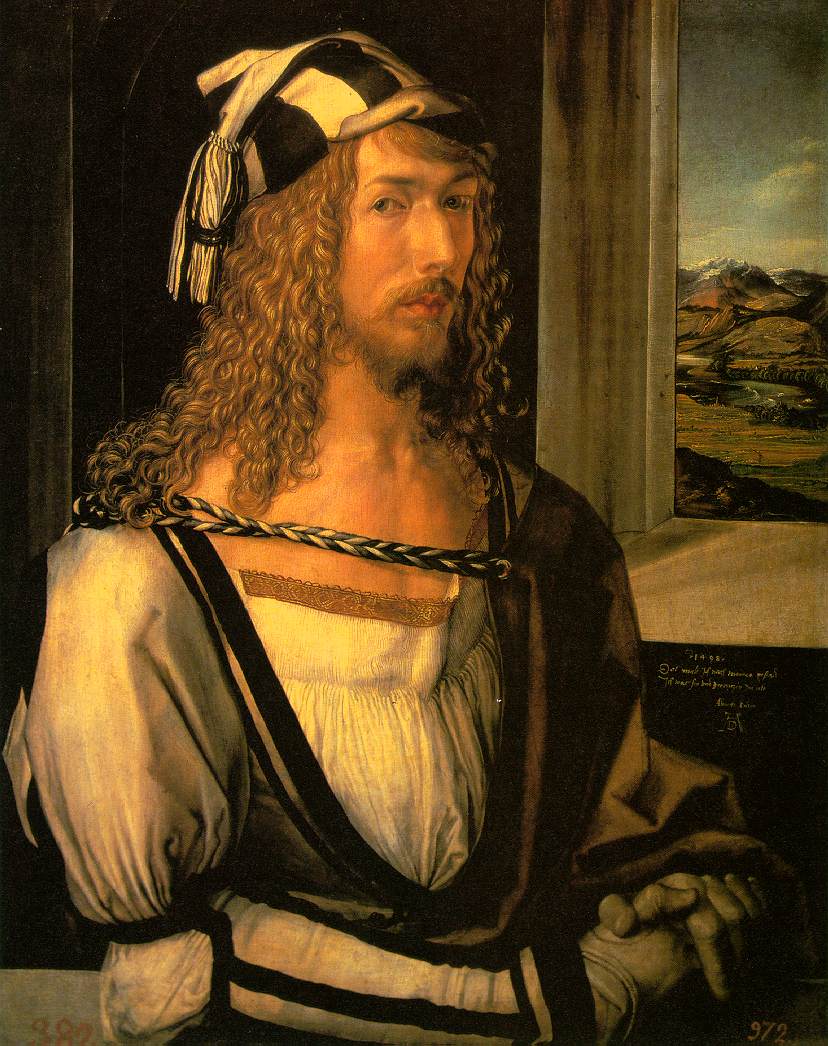
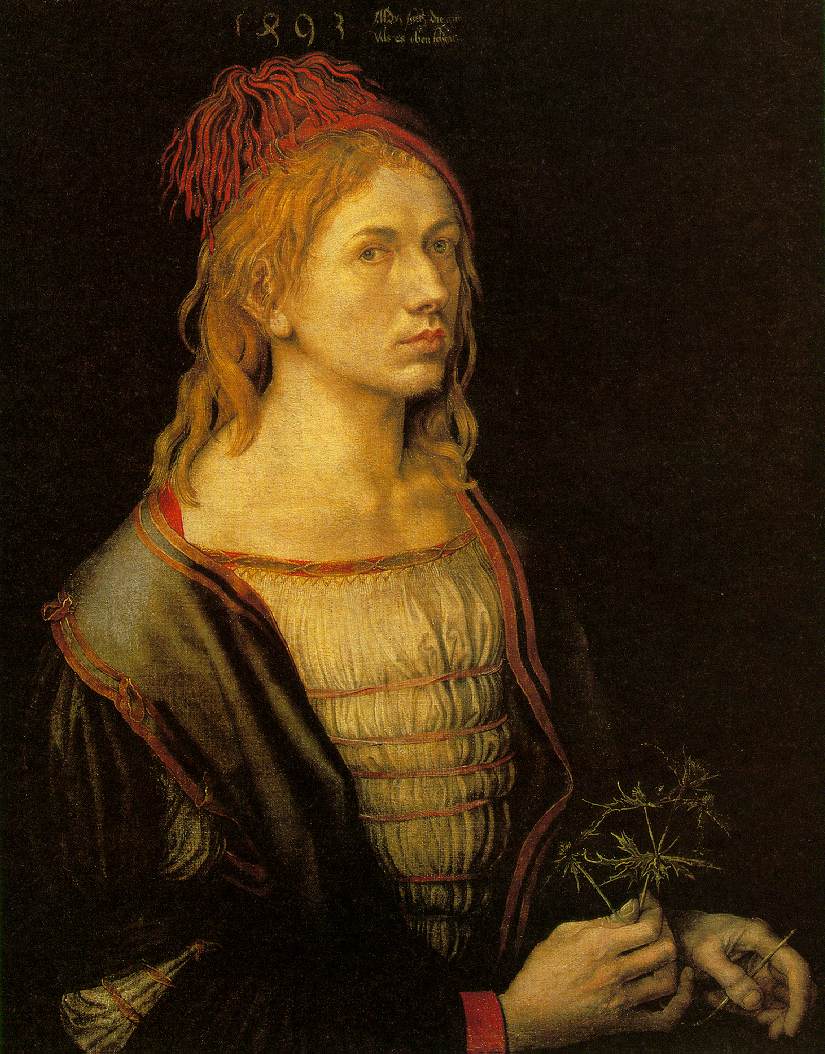
Jenny then looked at two Durer self portraits both showing very tight pleating. The better known of the two is probably this one, and here you can see that the top several inches are fine gathers, and at the very top they are confined by a band of braid. The lesser known one is very similar at the top, though the fine gathers do not go down as far.  Jenny looked at the V&A smock in Cut my Cote (1), which has no shoulder seam, and compared it to one in PoF4 (2) which has a shoulder seam. She posed the question, is this a smock or square necked shirt?

Jenny then showed a Portrait of a Young Man by Holbein c. 1520 National Gallery of Art Washington, pointing out that what we see is not a frill, just top of shirt gathered. Here we have perhaps the early origins of the neck and wrist ruffs.

Jan van Leiden 1536 by Aldegraver
Higher necked shirts were contemporary with lower necked shirts for quite a while. A discussion between Jenny and Jane Bridgeman at the end narrowed the introduction of the higher necked shirt into Italy to German influences around 1515. Jenny then showed a high neck shirt in a 1525 painting by Melzi showing that the neckline has a side opening.

The Jan van Leiden portrait of 1536 by H Aldegrever, shows an even higher necked shirt with a side opening, this time with 3 buttons and loops, and what might be a separate neckband.

Jenny then looked at the Platt Hall shirt, that was the subject of an article by Santina Levy (3), the re-examination of this shirt had dated it to c.1520, with alterations and the addition of seventeenth century lace having been made in the nineteenth century. The neckline of the Platt Hall shirt, is gathered and stitches worked over to produce a chevron design, this cannot be seen in the Platt Hall image of the shirt as it is under the later collar.

This type of chevron design appears again in an Aragon family shirt c1530-50 kept with the Aragon family graves at the Church of San Domenico Maggiore, Naples. There was some conjecture as to whether this could be Italian smocking, but because neck is lined you can’t see the stitching on the inside. Jenny also showed the portrait of a man by Moretto da Brescia 1526, if you use the zoom provided you will see the work around the neckline.

Jenny finished by discussing a reconstruction she is working on of a 1530 illustration, no 102 on page 96, in the Trachtenbuch of Matthaus Schwarz of Augsburg, the whole of the book is available from the hyperlink.  The shirt has really sloped shoulders, and the reconstruction has 3 and a half yards of fabric going into the neck.

1. Burnham, D. Cut my cote. Ontario : Royal Ontario Museum, 1973.

2. Arnold, J. Patterns of Fashion 4 : the cut and construction of linen shirts, smocks, neckwear, headwear and accessories for men and women . London : Macmillan, 2008.

3. Levey, S. The story of a shirt: a cautionary tale with an unexpected ending. Costume. 2010, Vol. 44.