|
| Dutch Sailor's Wife |
Those who study English clothing of the mid 17
th
century are very aware of Hollar’s
Ornatus Muliebris the Habits
[clothing] of Englishwomen, published in 1640. Perhaps less well known are his
engravings of women from across the whole of Europe, and parts of North Africa,
which he published in two series
Theatrum Mulierum and Aula Veneris. The Latin subtitle of the Theatrum
can be translated as, “the variety and differences of the female habits of the
nations of Europe.” The publication history of these two is incredibly complex,
and the plates come in various states, not least because they were being
reprinted until well into the eighteenth century. For those wishing to untangle
the publication, the place to go is Pennington.
(1) The links given
above are to the University of Toronto, Hollar Digital Collection, which has
most, but not all, the prints.
Hollar was well
travelled in Europe. He was born in Prague in 1607, by the late 1620s he was
studying in Frankfurt, by 1630 he had travelled through Strasbourg, Mainz and
Koblenz. His first book was published in
Cologne in 1635 and by 1637, under the patronage of the Earl of Arundel, he was
living in London. Sometime after the Civil War started in 1642, he moved to
Antwerp. He returned to London in 1652 and died there in 1677.
 |
| Woman of Cologne |
Some of his
engravings are of upper class women, but many are of “ordinary” women, tradesmen
and merchants’ wives and daughters, and sometimes countrywomen. They show
regional diversity in the use of garments like huiks, they show how long ruffs
continued to be worn by the middle and lower classes, long after they had gone
out of fashion, and also the ubiquity of other garments, such as the waistcoat.
In the first example
we have a Dutch sailor’s wife, wearing one of those hats that are often teamed
with a huik in Dutch paintings, as seen in this late 16th century
painting by Lucas van Valckenborch. The huik was worn widely in north western
Europe, and Du Mortier has suggested that it may have its origins in Spanish
fashions.(2) In the second image, a woman of Cologne you
again have huik. As Fynes Morison described them, “all women, in generall, when
they goe out of the house, put on a hoyke or vaile which covers their heads and
hangs downe upon their backs to their legges; and this vaile in Holland is of a
light stuffe or kersie, and hath a kind of horne rising over the forehead, not
much unlike to old pummels of our women’s saddles. ... but the women of Brabant
and Flanders wear vailes altogether of some fine light stuffe, and fasten then
about the hinder part and sides of their cap, so as they hang loosely not close
to the body....and these caps are large round and flat to the head....like our
potlids, used to cover pots in the kitchin.” (3) This last is an
excellent description of the sailor’s wife’s hat.
 |
| Woman of Franconia |
The third image is a
woman of Franconia. She wears not a starched ruff, as in the two previous
images, but a ruff which falls to the shoulders. Descriptions of the
construction of surviving ruffs of all types are given in Arnold. (4) The garment
(waistcoat/jacket) she is wearing is buttoned like a male doublet, much like
the garment worn in the monument to Lady Elizabeth Finch, now in the V&A. Similar buttoned garments can be seen in
Hollar’s Woman of Vienna, and several of his women from Augsburg.
In the fourth image is
a woman from Antwerp. She wears a falling collar and, since it appears to be
summer, a straw hat. Her top is patterned, while her skirt is plain.
As a final example
let’s add in Hollar’s English countrywoman. There are lots of differences
between the Englishwoman and the other examples, but some things do carry
across. All five women wear aprons and, as four appear to be marketing, they carry
some form of basket, be it split wood, wicker or rush. All wear some form of
headwear, and in three of the five you can see a coif under the hat. Discarding
the lady from Cologne, whose huik covers too much of her garments, all wear
some type of bodice/waistcoat/jacket which finishes at the hips, and skirts
that finish short of the ground at the ankle bone.
 |
| Woman of Antwerp |
If you go through
the links to explore the collection you will find women from France, Spain,
Italy and Greece. The further afield the subjects of Hollar’s drawings are, the
less likely he is to have seen, or known, what was actually being worn. His Irish woman, for
example, is copied from John
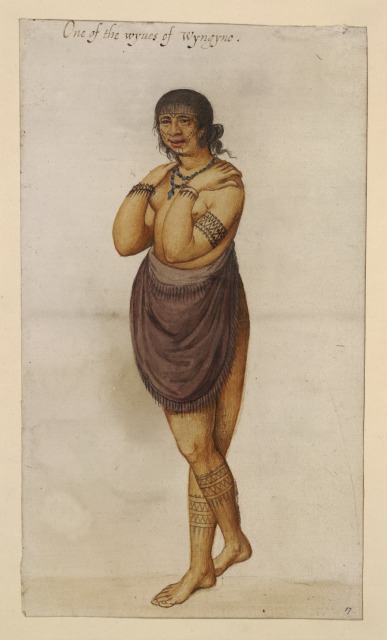
Speed’s map of Ireland , and his “Virginian” is copied from a Theodor de Bry’s
drawing in Thomas Hariot’s A briefe and true report
of the new found land of Virginia. De Bry's drawing is itself based on John White’s originals made when he was with the Roanoke colony.
 |
| English Countrywoman |
1. Pennington, Richard. A descriptive
catalogue of the etched work of Wenceslaus Hollar. . Cambridge : CUP ,
2002.
2. Du Mortier, B.
In search of the origins of the huik. Arte Nuevo : Revista de estudios áureos . 2014, Vol. 1.
3. Moryson, Fynes.
An Itinerary: Containing His Ten Years Travel Through the Twelve Dominions
of Germany, Bohemia, Switzerland, Netherland, Denmark, Poland, Italy, Turkey,
France, England, Scotland and Ireland. London : John Beale, 1617.
4. Arnold, J. Patterns
of Fashion 4 : the cut and construction of linen shirts, smocks, neckwear,
headwear and accessories for men and women . London : Macmillan, 2008.
 The famous engraving by Abraham Bosse (1602-1676) of people shopping
in the Galerie Royale shows three booths. On the left a bookshop, on the right
a booth selling collars, neckerchiefs and lace, and in the centre a booth selling
gloves and fans. In the centre foreground a gentleman, a lady and her maid
servant are admiring a fan. Behind them in the booth a server is taking down a
box labelled Eventails du Bosse [fans by Bosse].
The famous engraving by Abraham Bosse (1602-1676) of people shopping
in the Galerie Royale shows three booths. On the left a bookshop, on the right
a booth selling collars, neckerchiefs and lace, and in the centre a booth selling
gloves and fans. In the centre foreground a gentleman, a lady and her maid
servant are admiring a fan. Behind them in the booth a server is taking down a
box labelled Eventails du Bosse [fans by Bosse]. 


.jpg)