 | ||
| Charles I by Mytens. NPG |
I have been putting Charles I’s clothes as listed in
wardrobe accounts (Strong, 1980) into the Stuart Tailor database, and
here I try to analyse how the terms used in accounts are depicted in portraits.
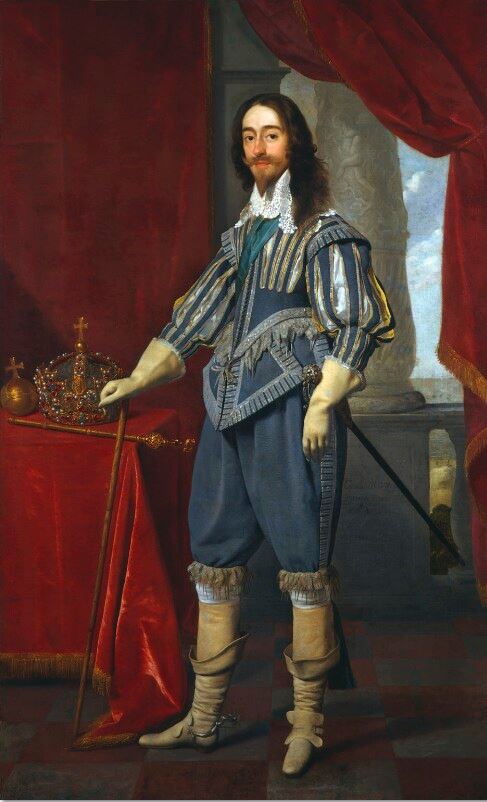
This is Charles
I by Daniel Mytens, the hyperlink is to the high res version of the low res
version to the right. The portrait in the National Portrait Gallery is from
1631, so earlier than the wardrobe accounts I quote here, which are from
1633-5.
The King normally buys suits, these consist of a doublet and hose
(breeches), not always in the same fabric, and usually there is a matching
cloak, for example “a suite the doublett lead cullor tabie the
cloake and hose of cloth”.
The portrait depicts him in grey and there are several grey
suits in 1633-5, as in: “a suit of grey cloth lined with tabie”, “a suite of
lead cullor satin”, “a suite of mist grey drapbery cloth.” The braid that runs
around the edges of the doublet and down the side of the hose is always
referred to as lace, as in: “edged with a gould and silver edging lace,” in
addition each seam has lace, sometimes this is the same as the edging lace,
though in this portrait it would appear to be different. There are other
portraits showing is style of layout of lace, and there is a black wool example
in the Victoria
and Albert Museum, unfortunately the museum website has no photographs. Seam
laces are usually referred to as: “trimmed with two silke laces in a seame”, or
“with two gould and silver laces in a seame”, or similar.
 The doublet seen in the portrait is cut into panes on the
body and sleeves, in the accounts they would say “the doublet cut in panes”, if
the panes were edged with the same lace as the seam lace it would say, “and
laced with the same lace.” To the left is a detail of a paned doublet in the collection of the Gallery of English Costume at Platt Hall, Manchester.
The doublet seen in the portrait is cut into panes on the
body and sleeves, in the accounts they would say “the doublet cut in panes”, if
the panes were edged with the same lace as the seam lace it would say, “and
laced with the same lace.” To the left is a detail of a paned doublet in the collection of the Gallery of English Costume at Platt Hall, Manchester.
It is not the case with the suit shown in the
portrait, but sometimes there would be two layers of fabric, one “cut upon” the
other, so Charles has a suit of grass green tabby “lined with rose cullor tabie,
cutt with and upon rose cullor taffaty”. This effect of this fashion can be
seen in the Cotton
suit of 1618 in the Victoria and Albert Museum, which is described as an “oyster
colour silk satin with an under layer of blue silk.” (Braun, et
al., 2016)
The doublet and hose are tied together with points, these
can be seen at the waist of the doublet in the portrait. Different types of points
appear in the accounts, for example: “flatt points”, “square points” and “round
points.” In addition suites of matching points, garters and shoe roses were
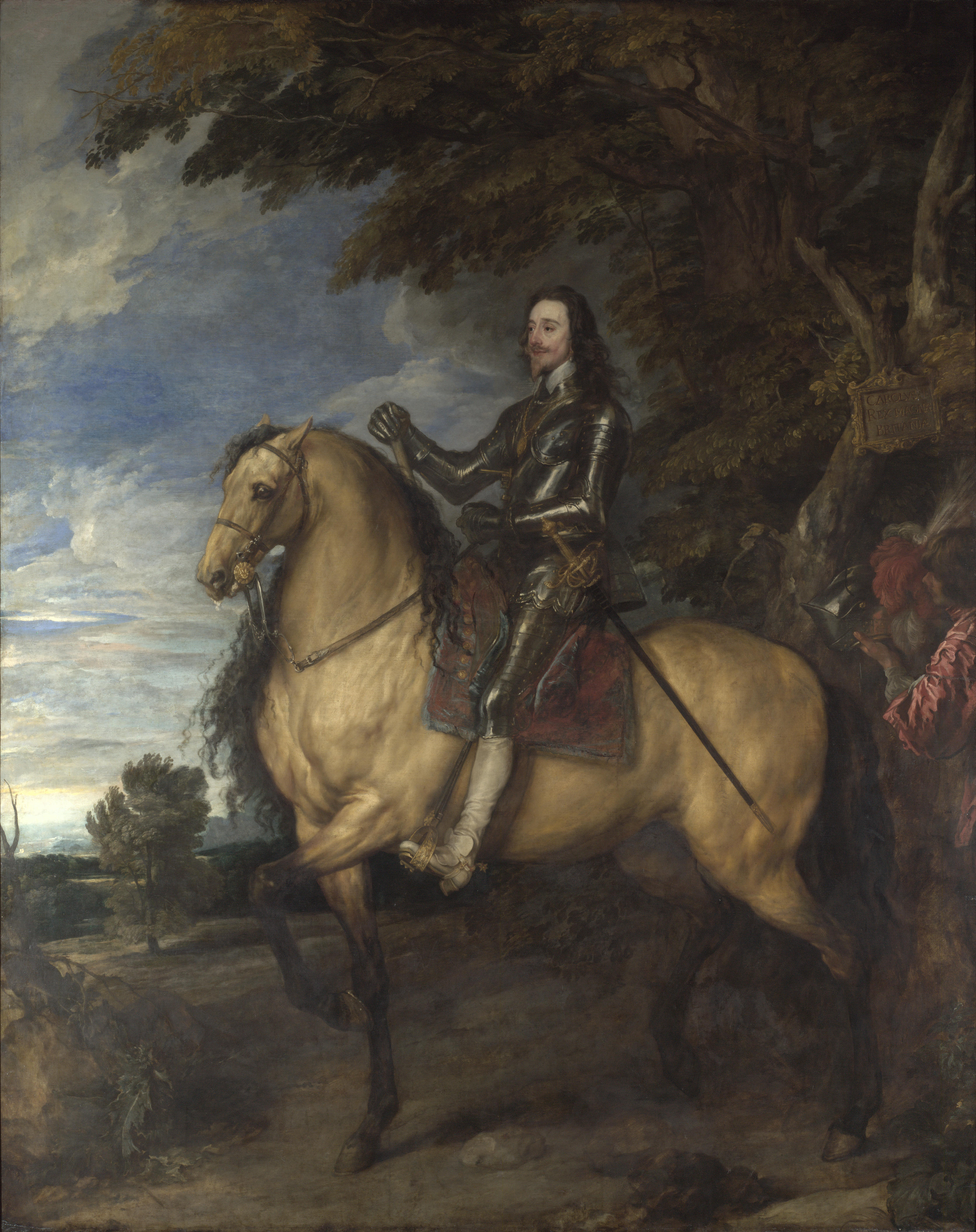
purchased. In the Mytens portrait he is wearing boots, but in this
portrait by Van Dyck his points, garters and shoes roses all appear to be
the same colour.
 |
| Detail of Charles's spur leathers |
He purchases large quantities of accessories. The gloves
seen in the portrait are plain with a simple fringe. Among a vast number of
other gloves, in 1633-4 he buys “2 dozen pairs of thick stags lether gloves
with gould and silver frindges.” His boots are also plain, he buys (in one
year) “24 paires of bootes” and “20 pairs of strong riding bootes”, not to
mention the 189 pairs of shoes. Spurs can also be seen on the boots. These come
in different types, and I don’t know enough about spurs to identify the
differences. We have “hunting spurs”, and “Bramspith spurres.” He also buys
spurleathers, that piece of butterfly shaped leather across the instep of the
boot, and the straps that attach the spur to the boot. These can be seen
clearly in a detail from the equestrian
portrait of Charles I on horseback by Van Dyck. There are references to
“hatching and guilding” spurs and to “trimming” spurs. Worn under the boots you
can see at the knee his boot hose, which he buys “3 dozen pairs” at a time.
His
linens, as in his band (collar) and shirts, do not appear in his wardrobe
accounts.
References
Braun, M, et al. 2016. 17th-century men's dress patterns 1600-1630. London :
Thames & Hudson, 2016. 978 0 500 51905 9.
Strong, Roy. 1980. Charles I's clothes for the years 1633-1635. Costume.
1980, Vol. 14, 73-89