|
1600-25. In LACMA, Los Angeles
|
Nightcaps were caps worn by men informally at home, and
sometimes under a hat. There are a number of portraits in which the sitter
wears a nightcap under their hat. In the late sixteenth and first half of the
seventeenth century survivals are often heavily embroidered, which is why they
have survived. King Charles I matched his nightcaps to his informal wear waistcoats,
having in 1632 “a skie cullor sattin wastcoate with one gold and silver lace in
a seame lined with plush, with a nightcap suitable wrought all over in rich
workes with gold and silver lace, these were incredibly expensive, this set of
waistcoat and nightcap together cost £16 9s 10d. A nightcap with matching
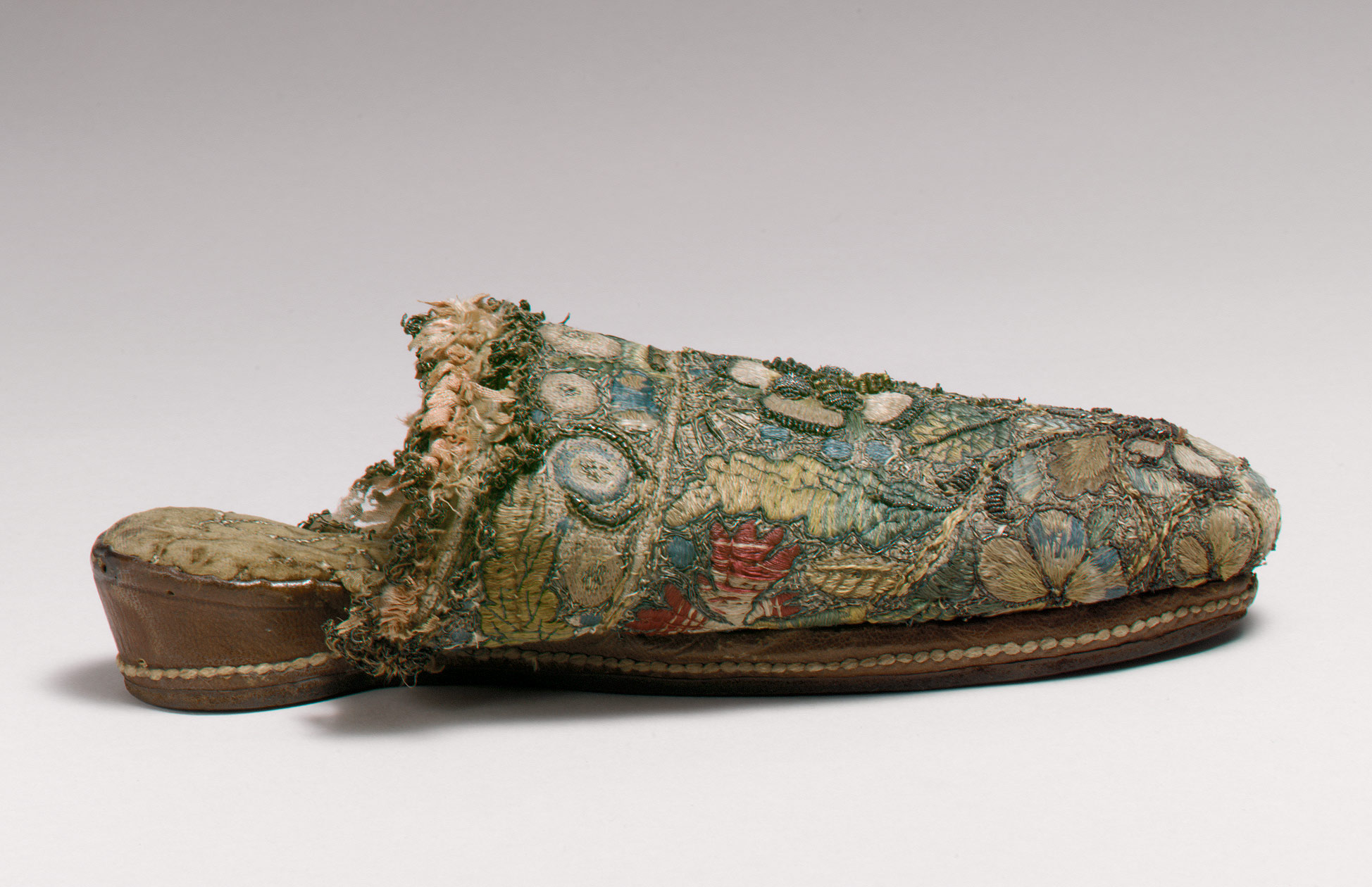
slippers, said to have belonged to Charles II when he was Prince of Wales,
survives in the Burrell Collection in Glasgow. [image below] At the bottom end of the market
they were considerably cheaper, in 1608 Robert Booth Esquire had stolen from
him in Middlesex, “a linen night cappe worth twelve pence,” while in 1610
Thomas Cademan had stolen “a wroughte nightcappe worth ten shillings.”
From the 1650s on they are less likely to be embroidered and
more likely to be quilted or of velvet, the fashion for periwigs resulting in
more shaved heads that required a warm covering. In 1698 Montague Drake, esquire,
in Buckinghamshire owned “four quilted night capps” and nine periwigs. In 1682
Richard Matthew, a vicar in Devon owned 15 nightcaps, and John Dale a yeoman in
Wiltshire owned two.
Links to some surviving nightcaps – organised by date.
1550-1600. Linen with blackwork and metallic
thread embroidery, metallic lace and spangles. Los Angeles County Museum of Art.
https://collections.lacma.org/node/2110101
1570-1600. Linen with polychrome and gold and silver
embroidery. Museum number: T.55-1947. Victoria & Albert Museum. https://collections.vam.ac.uk/item/O359994/nightcap/
1570-1600. Linen
embroidered with blackwork and metal threads. Accession Number: 43.251. Museum of Fine Arts, Boston. https://collections.mfa.org/objects/116887
1570-1630. Linen embroidered with blackwork and metal
threads, and silver gilt bobbin lace trim. Museum number: T.224-1968. Victoria
& Albert Museum. http://collections.vam.ac.uk/item/O359993/nightcap-unknown/
1575-1625. Linen embroidered with blackwork and silver gilt thread.
Museum number: 199-1900. Victoria & Albert Museum. https://collections.vam.ac.uk/item/O357058/cap-headgear/
1575-1625. Linen with polychrome
silks and metallic embroidery. Accession Number: 43.250. Museum of
Fine Arts, Boston. https://collections.mfa.org/objects/116883/mans-cap
1580-1600. Linen with silver thread
embroidery. Cleveland Museum of Art. https://www.clevelandart.org/art/1950.352
1580-1620. Linen with blackwork and metallic thread
embroidery, metallic lace and spangles. Los Angeles County Museum of Art. https://collections.lacma.org/node/2092825
1580-1620. Linen, embroidered in black silk and silver gilt
thread. Accession number: 2003.6. Manchester City Museums. https://manchesterartgallery.org/collections/title/?mag-object-15262
1580-1620. Linen embroidered with blackwork and metal
threads. Museum number: T.140-1929. Victoria & Albert Museum. http://collections.vam.ac.uk/item/O357050/cap-headgear-unknown/
c.1580. Linen with polychrome silk
and metallic thread embroidery, with spangles and trimmed with
metallic-thread lace. Object number: 1987.042.
Museum of Art, Rhode Island School of Design. https://risdmuseum.org/art-design/collection/mans-nightcap-1987042
1590-1600. Linen cap,
embroidered in black and silver-gilt. Accession number: 1959.271. Manchester
City Museums. https://manchesterartgallery.org/collections/title/?mag-object-6642
1600s. Linen cap lining, with cream
silk embroidery and linen lace. Accession Number 1971-50-115. Cooper Hewitt,
New York https://collection.cooperhewitt.org/objects/18474003/
1600s. Linen, embroidered. Museum
reference: A.1889.334. National
Museums of Scotland. No image. https://www.nms.ac.uk/explore-our-collections/collection-search-results/nightcap-mans/350817
c.1600. Linen embroidered with blackwork. Museum number:
T.10-1950. Victoria & Albert Museum. https://collections.vam.ac.uk/item/O357668/nightcap/
c.1600. Silk embroidered in silk and metallic
yarns, in rainbows design. Museum number: 1962-53-11. Cooper Hewitt, New York. https://www.cooperhewitt.org/2014/02/12/a-little-nightcap/
c.1600. Uncut and part blackwork embroidered nightcap.
Museum number: T.9-1950. Victoria & Albert Museum. https://collections.vam.ac.uk/item/O319540/nightcap-panel/
1600-1620. Linen embroidered with black silk and silver-gilt
threads. ID Number: 29.132 Burrell collection, Glasgow Museums. (image right)
http://collections.glasgowmuseums.com/mwebcgi/mweb?request=record;id=37367;type=101
1600-1620. Linen embroidered with polychrome silk and
silver-gilt threads. ID Number: 29.135.
Burrell collection, Glasgow Museums. http://collections.glasgowmuseums.com/mwebcgi/mweb?request=record;id=37485;type=101
1600-1620. Linen embroidered with black silk and silver-gilt
threads. ID Number: 29.136. Burrell collection, Glasgow Museums. http://collections.glasgowmuseums.com/mwebcgi/mweb?request=record;id=36682;type=101
1600-20. Linen worked with silk and metal threads, and
spangles. Accession Number: 64.101.1241. Metropolitan
Museum, New York. https://www.metmuseum.org/art/collection/search/228950?searchField=All&sortBy=Relevance&ft=64.101.1241&offset=0&rpp=20&pos=1
1600-25. Linen embroidered with polychrome silk and
silver-gilt threads. Shakespeare’s Birthplace Trust. http://collections.shakespeare.org.uk/search/museum/strst-sbt-1994-70
1600-25. Linen embroidered with polychrome silk and metallic
threads. Los Angeles County Museum of Art. https://collections.lacma.org/node/250323
1600-25. Linen with polychrome and gold and silver
embroidery of strawberries, with spangles and silver gilt bobbin lace trim.
Museum number: 2016-1899. Victoria & Albert Museum. http://collections.vam.ac.uk/item/O15344/nightcap-unknown/
1600-25. Linen embroidered with blackwork and silver gilt.
Museum number: 198-1900. Victoria & Albert Museum. http://collections.vam.ac.uk/item/O72529/nightcap-unknown/
1600-25. Linen, embroidered with polychrome and silver-gilt
thread with silver-gilt bobbin lace & spangles. Museum number: T.258-1926.
Victoria & Albert Museum. http://collections.vam.ac.uk/item/O73335/nightcap-unknown/
1600-25. Linen, embroidered with silver and silver-gilt
thread with silver-gilt bobbin lace & spangles. Museum number: T.75-1954.
Victoria & Albert Museum. http://collections.vam.ac.uk/item/O357046/cap-unknown/
1600-1625. Linen, embroidered mainly in silver and silver
gilt thread, with pink, green and gold silk thread. Accession number: 1971.50.
Manchester City Museums. https://manchesterartgallery.org/collections/title/?mag-object-7423
1600-1625. Linen, embroidered in black, silk and silver
gilt. Accession number: 1972.113. Manchester City Museums. https://manchesterartgallery.org/collections/title/?mag-object-7435
1600-25. Linen embroidered in plaited braids of silver and
silver-gilt thread, trimmed with silver-gilt bobbin lace, and with spangles. ID
number 42.51. Museum of London. https://collections.museumoflondon.org.uk/online/object/90475.html
1600-25. Linen embroidered in polychrome silks, and silver
and silver-gilt thread. ID number 27.117. Museum of London. https://collections.museumoflondon.org.uk/online/object/90472.html
1600-1630. Linen with wide border of needlepoint lace seamed
to lower edge. Accession number: 2003.85. Manchester City Museums. https://manchesterartgallery.org/collections/title/?mag-object-14672
1600-30 Linen lining, said to have been worn by Charles I,
plain with cutwork or needle-lace trim. ID number: 35.147/3. Museum of London. https://collections.museumoflondon.org.uk/online/object/91437.html
1600-30. Linen embroidered with blackwork. Museum number:
308-1902. Victoria & Albert Museum. http://collections.vam.ac.uk/item/O357057/cap-unknown/
1600-30. Linen embroidered with blackwork. Museum number:
1032-1903. Victoria & Albert Museum. https://collections.vam.ac.uk/item/O357056/cap-headgear/
1600-1630. Linen embroidered with silver and silver-gilt
thread with spangles. Museum number: T15-1925. Victoria & Albert Museum.http://collections.vam.ac.uk/item/O357052/cap-headgear-unknown/
1600-30. Linen, embroidered with polychrome and silver-gilt
thread. Museum number: T.16-1925. Victoria & Albert Museum. https://collections.vam.ac.uk/item/O357051/cap-headgear/
1600-1630. Linen, embroidered with black silk, gold thread
and gilt spangles. Museum number: 814-1891. Victoria & Albert Museum. http://collections.vam.ac.uk/item/O357060/cap-headgear-unknown/
1600-30. Linen, embroidered with black silk (almost
completely missing) and silver-gilt thread. Museum number: 795-1892. Victoria
& Albert Museum. https://collections.vam.ac.uk/item/O357059/cap-headgear/
1600-30. Linen, embroidered with green and yellow silk, gilt
thread, and green ribbon. Museum number:
T.56-1934. Victoria & Albert Museum. https://collections.vam.ac.uk/item/O357047/cap-headgear/
1610-20. Linen, embroidered
with silks, silver metal thread and spangles. Chertsey Museum. https://chertseymuseum.org/search_collection?filter=nightcap&item=14092
1610-20. Linen, polychrome silk and
metal threads. Fashion Museum, Bath. The Fashion Museum does not have an online
search facility. The nightcap is on their Facebook page
c.1620. Uncut and part polychrome embroidered nightcap. Museum
number: T.39-1955.Victoria & Albert Museum. http://collections.vam.ac.uk/item/O357612/nightcap-unknown/
c.1620. Linen, polychrome silk and
metal threads. Sold at Bonhams. https://www.bonhams.com/auctions/24678/lot/139/?category=list
1640-45. Pink silk satin embroidered in silk, silver and silver-gilt
threads, with matching slippers (29.144-145). ID Number: 29.133. Burrell
collection, Glasgow Museums. (shown left)
http://collections.glasgowmuseums.com/mwebcgi/mweb?request=record;id=37208;type=101
1640-60. Red velvet embroidered in metal threads. ID Number:
29.315. Burrell collection, Glasgow Museums. http://collections.glasgowmuseums.com/mwebcgi/mweb?request=record;id=447014;type=101
1650-60. Quilted
white satin. Museum number: 786-1864. Victoria & Albert Museum. https://collections.vam.ac.uk/item/O357061/cap-headgear/
1675–1725. Green silk velvet embroidered with gold-metallic
thread. Accession Number: 38.1298. Museum of Fine Arts, Boston. https://collections.mfa.org/objects/46601/mans-negligee-cap
1675–1725. Light brown silk, embroidered with silks and metallic
thread. Accession Number: 38.1308. Museum of Fine Arts, Boston. https://collections.mfa.org/objects/46615/mans-cap
1675-1700. Linen in the chinoiserie style, embroidered in
black, red, pink and yellow silk, turned up, peaked brim, lined yellow silk and
bound with yellow silk ribbon. Accession number: 1952.123. Manchester City
Museums. https://manchesterartgallery.org/collections/title/?mag-object-5833
1675-1700. Linen in the chinoiserie style, embroidered in
yellow silk, turned up, peaked brim, unlined. Accession number: 2012.82.
Manchester City Museums. https://manchesterartgallery.org/collections/title/?mag-object-5833
1675-1700. Linen, embroidered with
silk (note museum dating of first quarter 17th century is wrong). Accession
Number: 39.145. Metropolitan Museum, New York. https://www.metmuseum.org/art/collection/search/101826?searchField=All&sortBy=Relevance&deptids=62%7c8&when=A.D.+1600-1800&what=Costume&ft=cap&offset=20&rpp=20&pos=22
1680-1700. Quilted linen. Object
number: NT 1348925. National
Trust, Snowshill. http://www.nationaltrustcollections.org.uk/object/1348925
1680-1720. Linen, embroidered over entire surface with
yellow silk and coloured silks, lined with blue silk, blue silk turned-back
brim trimmed with silver bobbin lace. Accession number: 2003.108. Manchester
City Museums. https://manchesterartgallery.org/collections/title/?mag-object-14671
1680-1720. Linen, cotton, with silk
embroidery. Accession Number 1951-105-32. Cooper Hewitt Collection, New York. https://collection.cooperhewitt.org/objects/18386589/
1680-1720. Cream silk embroidered
cross stitch in green silk. Accession Number: 26.231.8. Metropolitan
Museum, New York. https://www.metmuseum.org/art/collection/search/98367?searchField=All&sortBy=Relevance&deptids=62%7c8&when=A.D.+1600-1800&what=Costume&ft=cap&offset=0&rpp=20&pos=2
1690-1700. Scarlet velvet embroidered in silver and silver
gilt, with a spilt point brim. Museum number: T.95-1967. Victoria & Albert
Museum. http://collections.vam.ac.uk/item/O353236/nightcap-unknown/
1700-60. Quilted linen. National
Trust, Snowshill. http://www.nationaltrustcollections.org.uk/object/1348924
1700-50. Green silk embroidered in
silk. Accession Number: C.I.46.9.224. Metropolitan
Museum, New York. (image left) https://www.metmuseum.org/art/collection/search/116700?searchField=All&sortBy=Relevance&deptids=62%7c8&when=A.D.+1600-1800&what=Costume&ft=cap&offset=0&rpp=20&pos=20
1700-50. Silk with embroidery. Accession
Number: 43.311. Museum of
Fine Arts, Boston. https://collections.mfa.org/objects/116815/mans-cap
1700-50. Blue silk embroidered with
straw. Accession Number: 38.1315. Museum of Fine Arts, Boston. https://collections.mfa.org/objects/46627/cap
1700-50. Linen with quilting and
embroidery. Accession Number: 1973.486. Museum of Fine Arts, Boston. https://collections.mfa.org/objects/123621/mans-cap
1700-50. Blue silk with silk and metallic-thread embroidery,
and metallic-thread lace trim. Los Angeles County Museum of Art. https://collections.lacma.org/node/214537
1700-20. Blue silk, embroidered in
silk. Object number: NT 1348924. National Trust, Snowshill http://www.nationaltrustcollections.org.uk/object/1348948
1700-20. Scarlet velvet
embroidered in silver thread. Object number: NT 1348949. National
Trust, Snowshill. http://www.nationaltrustcollections.org.uk/object/1348949
1700-20. Pink silk with metallic
embroidery. Accession Number: 43.307. Museum of Fine Arts, Boston. https://collections.mfa.org/objects/116801/mans-cap
1700-20. White satin silk with
embroidery. Accession Number: 38.1307. Museum of Fine Arts, Boston. https://collections.mfa.org/objects/46613/cap
1700-20. Linen, Italian quilting. Museum
reference: A.1979.19. National Museums of Scotland. No image. https://www.nms.ac.uk/explore-our-collections/collection-search-results/nightcap-mans/350820
1700-1725. Linen,
backed by coarser linen; turned up brim. Embroidered through both layers in
white linen, chiefly in satin stitch, french knots and drawn fabric work.
Accession number: 1948.1. Manchester City Museums. https://manchesterartgallery.org/collections/title/?mag-object-5527
1700-1725. Red silk
velvet, lined with pale blue spotted silk. Museum number:T.44-1918, Victoria and Albert
Museum. http://collections.vam.ac.uk/item/O139654/nightcap-unknown/
1710. Linen with wadded and corded quilting in black. ID Number:29.140. Burrell collection, Glasgow Museums. http://collections.glasgowmuseums.com/mwebcgi/mweb?request=record;id=36131;type=101
c.1720. Cream silk with pink silk brim, embroidered with
silk threads. Accession Number: C.I.39.13.278. Metropolitan
Museum, New York. https://www.metmuseum.org/art/collection/search/112625?searchField=All&sortBy=Relevance&deptids=62%7c8&when=A.D.+1600-1800&what=Costume&ft=cap&offset=0&rpp=20&pos=17
1725-75. Cream silk
with silk and metallic-thread embroidery, and metallic-thread lace trim. Los Angeles
County Museum of Art. https://collections.lacma.org/node/233262
1725-50. Green silk
with silk and metallic-thread embroidery, and metallic-thread lace trim. Los Angeles
County Museum of Art. https://collections.lacma.org/node/246507
c.1730. Green lampas (silk fabric with a brocading
weft). Accession Number 1951-105-31 Cooper Hewitt
Collection, New York. https://collection.cooperhewitt.org/objects/18386587/
1740-60. Leather. Object number: NT
1348951. National Trust, Snowshill. http://www.nationaltrustcollections.org.uk/object/1348951
1740-60. Shot green/yellow silk.
Object number: NT 1348950. National
Trust, Snowshill. http://www.nationaltrustcollections.org.uk/object/1348950
1740-50. Red velvet,
with turned-up brim and a tassel. Museum number: T.43-1918. Victoria &
Albert Museum. https://collections.vam.ac.uk/item/O353241/nightcap/
1740-50. Pale blue silk damask, with turned-up brim and
tassel. Museum number: 294-1906. Victoria & Albert Museum. https://collections.vam.ac.uk/item/O353247/nightcap/
c.1750. Linen, embroidered with silk, and a silver braid edging.
Accession Number: 38.1297. Museum of Fine Arts, Boston. https://collections.mfa.org/objects/46598/mans-negligee-cap
1700s. Orangey-red brocaded silk. Accession
Number 1952-47-2. Cooper Hewitt Collection, New York. https://collection.cooperhewitt.org/objects/18392135/
1700s. Yellow brocaded silk. Accession
Number 1951-105-30. Cooper Hewitt Collection, New York. https://collection.cooperhewitt.org/objects/18386585/
1700s. Linen embroidered with cotton.
Accession Number 1950-19-1. Cooper Hewitt Collection, New York. https://collection.cooperhewitt.org/objects/18392133/
1700s. Yellow embroidered silk, with
metallic lace trim. Accession Number 1952-47-1. Cooper Hewitt Collection, New
York. https://collection.cooperhewitt.org/objects/18384431/
1700s. Linen
embroidered with whitework and with a tassel. Accession Number: 43.1696. Museum of
Fine Arts, Boston. https://collections.mfa.org/objects/120485/nightcap