Sunday, 18 November 2012

West of England Costume Society meeting, November 2012


Next year WECS is 40 so in celebration the society has decided to do a second round of something it did for its 25th. Enter Patterns of Fashion II. The morning meeting was to get together volunteers and divide into 4 (or 5) groups. Each group is going to recreate a garment from Janet Arnold’s Patterns of Fashion. The four garments chosen are:

c.1931-2 Fuschia pink silk chiffon in the Museum of Fashion Bath.

c.1798-1805 Morning dress in white cotton with a small purple pattern in Salisbury Museum
(to go with this they are planning to do a c1800 military uniform)

c 1708-9 sap green brocaded silk mantua in Shrewsbury Museum

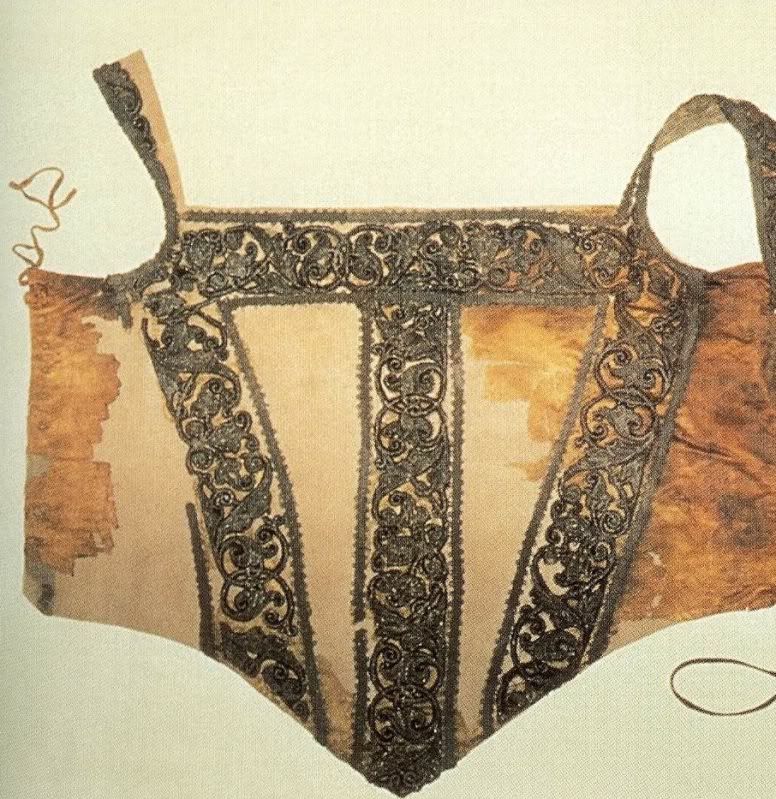
1562 white satin gown and crimson body of Eleanora di Toledo in the Pitti Palace Florence


My group is the Eleanora and two lucky people (not me) are going to Florence to have a look at the original. We have indicated our skills, plain sewing, pattern cutting, embroidery, materials sourcing, etc. We have a goldwork expert who is teaching others how to do the goldwork embroidery, and we have less than a year so it is going to be busy.

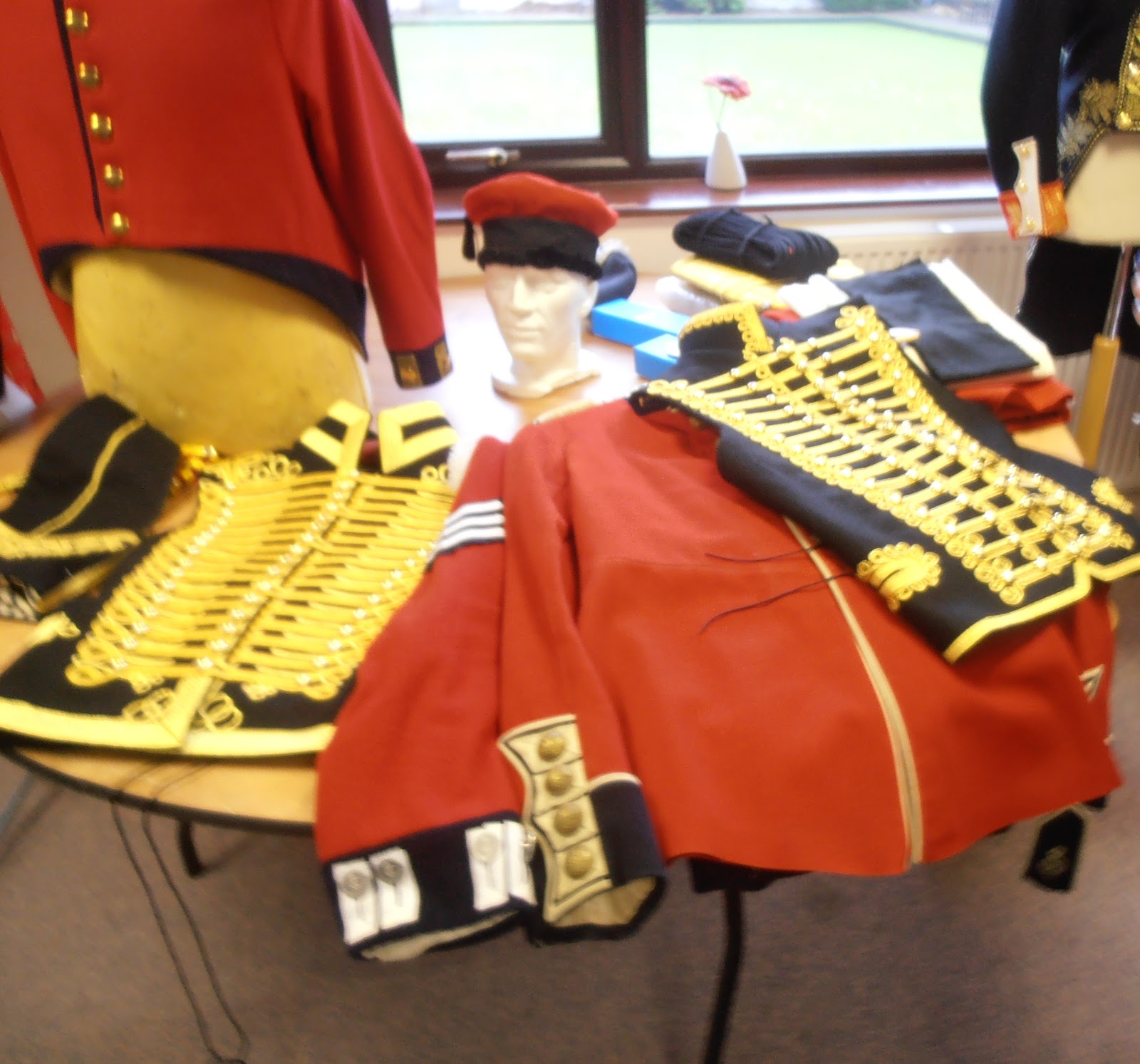
In the afternoon we had a talk by Chris Seals of Farthingales, seen above in his hussar outfit. He makes Napoleonic period military costume, examples of which can also be seen here.

Monday, 12 November 2012

Exhibition review – The Lost Prince, Henry 1594-1612

The book and other related items are available from the
National Portrait Gallery Shop
I recently visited the National Portrait Gallery Exhibition, The Lost Prince: The Life and Death of Henry Stuart (it finishes on the 13th January 2013). For those who cannot get to see the exhibition there is an excellent accompanying book and catalogue by the curator Catherine MacLeod.

For those who are uncertain who this was, Henry Prince of Wales was the elder son of King James VI of Scotland and I of England, and his wife Anne of Denmark. As the exhibition says when James succeeded Elizabeth in 1603 it was the first time in two generations that England had had a “normal” family consisting of the King and Queen and their three children, Henry, Elizabeth and Charles, though the last was considered so sickly he was left behind in Scotland. The exhibition is an assessment of the life of Henry, who died at the age of 18 some 400 years ago this month.
The exhibition is divided into six sections with a wealth of paintings, some of which have not been seen in public before. I have included links to copies of a few of the paintings that are in the exhibition.

The first section deals with the family and includes paintings by John de Critz and Robert Peake who (from 1607 until Peake’s death in 1619) were jointly Serjeant-Painter to James. Here are paintings of all the members of the family, the King and Queen, by de Critz and miniatures of them by Hilliard and Oliver, Princess Elizabeth and Prince Charles by Peake, and several of Henry himself including one of him in his garter robes by Marcus Gheeraerts the Younger. The most poignant item however is a letter from the nine year old Henry to his mother, assuring her he is in good health.

The second section is about the prince in his own household, which was established at the Palace of Nonsuch. There are paintings of the members of the circle who surrounded the Prince at Nonsuch, and a well known portrait of Henry with a young Earl of Essex (who later commanded the Parlimentary army against his brother King Charles in the Civil War. There has been much argument, based on the image I have linked to, as to whether the collars have a blue starch. The collars on the painting, as seen in the gallery, are white with a very slight caste of green from the doublets underneath. It is an object lesson in not taking the colours that appear in online sources as true.

 The third section is on festivals, masques and tournaments and includes several sketches for masque costume, as well as a very strange portrait of Henry leading Old Father Time by the forelock, two sets of Henry’s armour and several miniatures of Henry in armour.

The fourth section is on Henry’s collecting, and made me wonder if Henry’s collection of paintings and renaissance bronzes influenced his brother’s collecting habit, which has been explored in Jerry Brotton’s book The sale of the late king’s goods.

Henry did not leave the UK, but the fifth section explores his links to the wider world, and his interest in ships. The painting by Adam Willaerts of the Embarkation of the Elector Palatine 1613 is interesting for its depiction of ordinary people standing on the foreshore in the bottom right hand corner. The section also has portraits of his extended family, his uncle Christian IV of Denmark, his brother in law to be Frederick Elector Palatine, his godfather Henri IV of France, and Maurice of Nassau.

The final section deals with Henry’s death on the 6th November 1612, from an illness now recognised to have been typhus. It includes post mortem notes, and a well known portrait of Queen Anne in mourning, but most poignant are the scant remains of the wooden effigy of Henry that was created and dressed in his robes as Prince of Wales and placed on his hearse.

One is inclined to ask what if Henry hadn’t died? What if Charles hadn’t succeeded James I as Charles I? Would we still have had a Civil War? it is a very good exhibition, and if you can’t get to it the book is excellent.

Wednesday, 31 October 2012

Jenny Tirimani – On late 15th and early 16th century linen smock and shirts, evolutions in cut.

This is the last in my series of notes from talks given at:  Well worn weeds: the MEDATS (Medieval Dress and Textile Society) meeting at the British Museum 27th October 2012. Jenny made reference to a lot of illustrations and where I can I have created links to the examples she used. As before any misinterpretations and misspellings are my own. I don’t do shorthand and I don’t write fast enough.

Jenny started by talking about women’s necklines in the early 16th century, and particularly the V in the back of some illustrations. She examined the wide square front neckline with a V back in Holbein’s drawing which shows both, and she speculated on how the smock underneath it may have been made. The construction is problematic because you don’t want the edge on the bias. She showed (and I haven’t been able to work out which painting it was) a c1500 crucifixion scene, so it may have been this one also showing the v back. In another painting, which she said was from a 15th century triptych in Metropolitan Museum of Art, the V neck back of the green dress shows her smock with a centre back seam, indicating that perhaps the edges of the V were on the straight and the seam was on the bias.

Jenny then looked at the extant c.1525 gown of Maria of Hapsburg, in Budapest. Jenny had a pattern from this, I don’t know who made it, which shows the smock back and front are each formed from 3 trapezoids, which of course you could top and tail when cutting to minimise fabric waste. The smock has incredibly fine gathers at neck and is embroidered over the gathers.

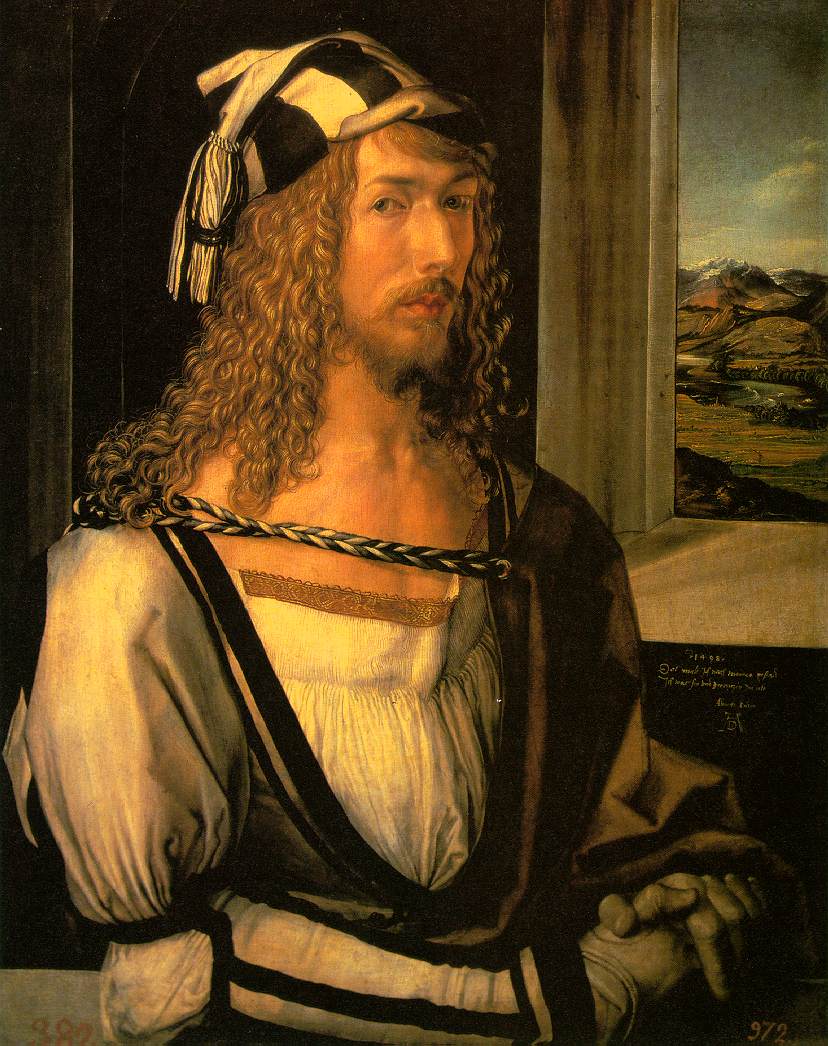
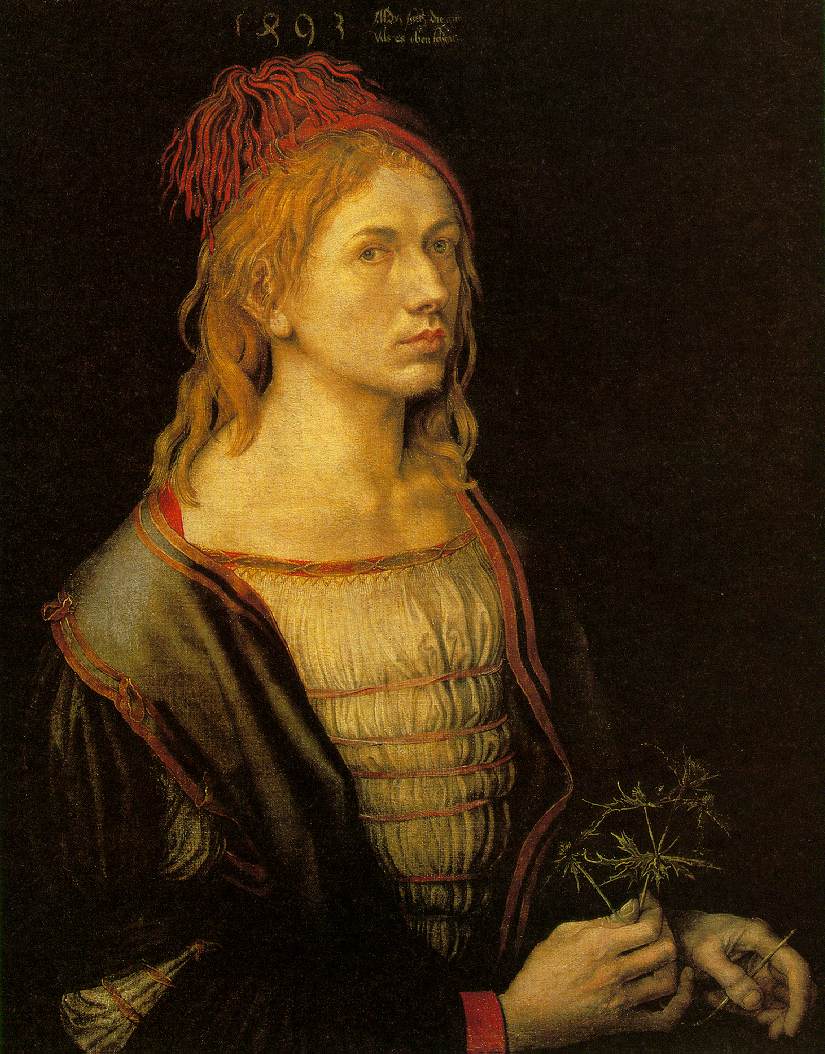
Jenny then looked at two Durer self portraits both showing very tight pleating. The better known of the two is probably this one, and here you can see that the top several inches are fine gathers, and at the very top they are confined by a band of braid. The lesser known one is very similar at the top, though the fine gathers do not go down as far.  Jenny looked at the V&A smock in Cut my Cote (1), which has no shoulder seam, and compared it to one in PoF4 (2) which has a shoulder seam. She posed the question, is this a smock or square necked shirt?

Jenny then showed a Portrait of a Young Man by Holbein c. 1520 National Gallery of Art Washington, pointing out that what we see is not a frill, just top of shirt gathered. Here we have perhaps the early origins of the neck and wrist ruffs.

Jan van Leiden 1536 by Aldegraver
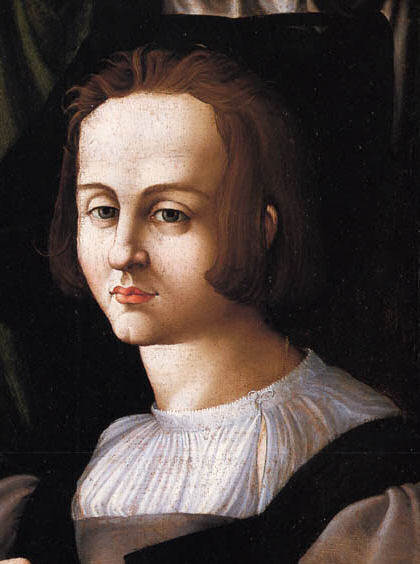
Higher necked shirts were contemporary with lower necked shirts for quite a while. A discussion between Jenny and Jane Bridgeman at the end narrowed the introduction of the higher necked shirt into Italy to German influences around 1515. Jenny then showed a high neck shirt in a 1525 painting by Melzi showing that the neckline has a side opening.

The Jan van Leiden portrait of 1536 by H Aldegrever, shows an even higher necked shirt with a side opening, this time with 3 buttons and loops, and what might be a separate neckband.

Jenny then looked at the Platt Hall shirt, that was the subject of an article by Santina Levy (3), the re-examination of this shirt had dated it to c.1520, with alterations and the addition of seventeenth century lace having been made in the nineteenth century. The neckline of the Platt Hall shirt, is gathered and stitches worked over to produce a chevron design, this cannot be seen in the Platt Hall image of the shirt as it is under the later collar.

This type of chevron design appears again in an Aragon family shirt c1530-50 kept with the Aragon family graves at the Church of San Domenico Maggiore, Naples. There was some conjecture as to whether this could be Italian smocking, but because neck is lined you can’t see the stitching on the inside. Jenny also showed the portrait of a man by Moretto da Brescia 1526, if you use the zoom provided you will see the work around the neckline.

Jenny finished by discussing a reconstruction she is working on of a 1530 illustration, no 102 on page 96, in the Trachtenbuch of Matthaus Schwarz of Augsburg, the whole of the book is available from the hyperlink.  The shirt has really sloped shoulders, and the reconstruction has 3 and a half yards of fabric going into the neck.

1. Burnham, D. Cut my cote. Ontario : Royal Ontario Museum, 1973.

2. Arnold, J. Patterns of Fashion 4 : the cut and construction of linen shirts, smocks, neckwear, headwear and accessories for men and women . London : Macmillan, 2008.

3. Levey, S. The story of a shirt: a cautionary tale with an unexpected ending. Costume. 2010, Vol. 44.

Monday, 29 October 2012

Susan North - The necessity of clean linen

Susan started by saying that there is a profound insistence that the past was dirty, and that one needs to throw out modern judgmental comments. She says she traced some of this back to the Cunningtons. She gave a quote from the Cunningtons, which I didn’t write down, but may well have been this one “Bodily cleanliness was scarcely thought important until less that 200 years ago.” (History of Underclothes, 1951, p15). Susan talked about the visible qualities of linen, you knew your linen was clean because it was white, and it smelt sweet, and anything that smelt clean (as opposed to perfumed) therefore was clean.

Susan talked a lot about references to the necessity of clean linen in conduct literature, and had quotes from John Russell’s Boke of nuture (1460), Erasmus on the Education of Children (1530), The mirror of good manners of Dominicus Mancinus (fl. 1478-1491), French schoole maister by Claudius Hollyband (1573), George Whetstone’s Heptameron of Civil Discourses (1582), and Giovanni della Casa’s Il Galateo (1558). Finally she had some wonderful quotes from Thomas Reynalde’s The birth of mankind (1560), I particularly liked the idea of the “rank savour of the armhole.”

She talked about ideas on clothing and the transmission of the plague, commenting on the 14th century Moorish doctor Ibn Khatimah who was convinced that linens could transmit the plague. Advice on the plague also appeared in England, and in 1578 (reissued 1592) it was set down in Advise set down upon Her Majesties express commandment.

There was a discussion at the end about soap making. That three types of soap were imported and provided to laundries at the time of the Black Book of Edward IV. That there was soap making in London in the early 16th century. And that bucking using lye was common.

These are my notes on the talk given at:  Well worn weeds: underclothes, linens and vegetable fibres worn next to the body. The MEDATS (Medieval Dress and Textile Society) meeting at the British Museum 27th October 2012.

Sunday, 28 October 2012

Beatrix Nutz – All indecent!: 15th century linen underwear from Lengberg castle, East Tyrol, Austria (Updated)


I said when I first published this that it was taken from my notes of Beatrix Nutz talk. Beatrix has been kind enough to feed back to me that there were some things wrong with my comments, and therefore I have altered them so that, hopefully, you now have the correct information.

We have all seen the newspaper reports about these finds, for example by Hilary Davidson (of the Museum of London) in the Guardian, and perhaps read the article by Beatrix in BBC History, and certainly they have created a lot of discussions on various web groups.

Beatrix started by talking about the castle itself. Between 1480 and 1507 it was owned by Virgil von Graben, who decided to extend the castle by adding a second floor. The room on the second floor, under whose floorboards the finds were found, is in the same wing as the chapel which was consecrated on the 13th October 1485, so presumably the work was finished by then. The room, on the first floor, was vaulted so that putting a flat floor above it created considerable voids which were then filled with this mainly organic material. Beatrix speculated that because they were adding a new floor they may just have dumped everything that was in the attics in there.

The finds consisted of 2,700 single fragments of linen and to a lesser extent wool. These included fragments representing 17 shirts, textile buttons, linen linings from dresses, one with fragments of the blue wool outer attached, a non ferrous metal dress hook, some baby clothes, a coif, a straw hat, fragments of finger loop braiding, a complete pair of underpants and the now famous “bras.” There were also between 800 and 1,000 fragments of shoes, and 12 complete shoes.

I think partly because of the controversy many of the pieces have been carbon dated. This gave a series of dates the earliest possible date being 1390 and the latest 1590. When carbon dating each item is given a range, so one item was 1410 to 1520, and another 1440 to 1590, however we know the floor was in place by 1485 so this gives us a probable terminus ante quem.

I actually found the coif quite interesting as there has been much discussion of coifs in 17th century circles. This coif was simply a rectangle of fabric with two corners tied in a knot at the back; the knot was still in place. I experimented with this at home in the three photos below, I think I made my rectangle too long, but you get the general idea. Beatrix has now informed me that I do indeed have it too large, the original is 47cm long and about 25 cm wide. The width has had to be estimated because of the knot.

Other things Beatrix pointed out. There was a fragment of clothing with eyelet holes and along the outer edge, to stop the eyelets tearing out, a piece of braid. There was a piece of fingerloop braid, 15 cm long with the loops still at both ends, and three patterns along its length, so obviously a practice piece. The underpants were also discussed, the linen was 11-12 threads per cm, but it was also patched with three patches, two with 12-14 threads per cm and the other 18 threads per cm. Beatrix said it had also been tested for DNA to see if it had been used by a man or a woman, but unfortunately the only DNA on it was her own.

Now to the bras. Beatrix has obviously been researching the use of these as she had found several quotes which I wasn’t quick enough to take down. There was one from the 13th century Roman de la Rose, one from Henri de Mondeville’s Cyrugia of c.1306-1320, one from Eustache Deschamps (c1346-1406) Balade sur les femmes qui troussent leur tetins (ballad on women who truss their breasts) and, one I did manage to get down, from Konrad Stolle’s Chronicle of Thuringia and Erfurt of 1480, which gave the title to the paper. “..and their shirts had bags into which they put their breasts – all indecent.”

If you follow the link above to the BBC article you will find photographs of the “long line style” with eyelet holes at the side for lacing, this and the underpants also appear in photographs in Beatrix’s project notes on the University of Innsbruck site.   The BBC site also has a photograph of the bra with needlelace in the shoulder straps, and a sprang insert between the cups. The sprang was worked on  120 warp threads, and there is evidence of a least one repair.

Beatrix has an article coming out in the next issue of Archaeological Textiles Review, and is going to write her own short report on the MEDATS meeting
These are my notes on her talk which was given at :
Well worn weeds: underclothes, linens and vegetable fibres worn next to the body. The MEDATS (Medieval Dress and Textile Society) meeting at the British Museum 27th October 2012.
Many thanks again to Beatrix for being kind enough to correct my errors



Jane Bridgeman – Machiavelli’s Linens: some linens in 15th century Florence


Ghirlandaio - Lucrezia Tornabuoni
This was a talk based on a diary/account book kept by Niccolo Machiavelli’s father Bernado around 1474. As well as a palazzo in Florence the Machiavellis owed a house in Sant’ Andrea in Percussina, an area which in those days grew a large amount of flax. The account book says nothing about the processing of the flax, but it does talk about it being sent away to be woven, what weight was sent, what length came back, and what it was used for. Much was woven into household linens.

The measurements in the account book are given in braccia, a Florentine braccia was equivalent to 58.4 cm. So having sent out so much weight of yarn, he might get back say 36 metres of 1.45 metre wide fabric. Some of the fabric that came back was fustian, with a linen warp and a cotton weft. Jane said that more cotton was imported than one might think, from places like Syria and Cyprus. It could take 3 months from the yard being sent to the finished, bleached cloth being returned. Though it depended on the weather the average time for bleaching was 2 months, in 1479 30 metres went for bleaching and took a month. There was a quote, not from Machiavelli but from a lady trying to make shirts to send to her sons, that “the linen for the shirts is not yet white.”

Examples given of uses:  11½ kilo weight of cloth (?) being 18½m. long, was to be used for two quilt covers, there is a reference elsewhere in the book to a quilt filled with chicken feathers. 36 metres was to be used for long linen towels, each 3 metres long. Jane commented that there is a problem with definitions here, as to what is a towel, for example 29 metres for use as a towel?  There were handkerchiefs that were a braccia (58 cm) square, and there was 4½ braccia (2.6 metres) for aprons. Some of the linen was made with a black or blue stripe, and some of this was for head coverings, though some was for napkins/towels. Jane mentioned examples in the V&A collection and this one. This type of striped linen can also be seen in illustrations of this period, for example as a table cloth in a wedding banquet, as a towel hanging over an arm in an illustration of Bathsheba bathing, and in the Melrode altarpiece, and as a sort of apron in the Birth of the Virgin Mary.  Jane did show illustration of the striped cloth being used as a headcloth, but I have not made a note of which examples she use, so here is Ghirlandaio’s Lucrezia Tornabuoni.
 
My notes made at a talk given by Jane Bridgeman at:  


Well worn weeds: underclothes, linens and vegetable fibres worn next to the body: The MEDATS (Medieval Dress and Textile Society) meeting at the British Museum 27th October 2012.


Well worn weeds: underclothes, linens and vegetable fibres worn next to the body.

The MEDATS (Medieval Dress and Textile Society) meeting at the British Museum 27th October 2012.

This will be a series of blog posts based on my notes taken at this fantastic study day, any misinterpretations and misspellings are my own. I don’t do shorthand and I certainly don’t write fast enough. The four blog posts will cover the four talks we were given.

Jane Bridgeman – Machiavelli’s Linens: based on the c1474 account book of Bernado Machiavelli of Florence

Beatrix Nutz – All indecent!: 15th century linen underwear from Lengberg castle, East Tyrol, Austria

Susan North - The necessity of clean linen: on attitudes to cleanliness in the 15th and 16th centuries

Jenny Tirimani – On late 15th and early 16th century linen smock and shirts, evolutions in cut. In which she looked at the origins of neck and wrist ruffs.