Boothose
One of the things about the seventeenth century fashion for turned over tops to boots was that people had boothose. Boothose, as a practical garment to protect finer stockings from the wear caused by the boot, had been around since the mid sixteenth century. They appear several times in the Wardrobe accounts of Henry VIII between 1521 and 1545. (1 p. 96) A late sixteenth century painting where lace edged boothose can be seen is Isaac Oliver’s Young Man Seated Under a Tree [Figure 1]
 |
| Figure 1: Isaac Oliver. Young Man Seated Under a Tree. c.1590. Royal Collection. |
By 1583 the original grumpy old man, Philip Stubbs, was complaining that, “They have also bootehose, which are to be wondered at, for they be of the fynest cloth, that may be got, … yet this is bad inough to weare next their greasie boots. And … they must be wrought all over, from the gartering place upward, with nedle worke, clogged with silk of all colors, with birds, foules, beasts, and antiques portrayed all over in comlie sorte. … besides this, they are made so wyde to draw over all, and so longe, to reach up to the waste that as litle or lesse clothe would make one a reasonable large shurte.” (2) This may well be an exaggeration but there are examples of embroidered boothose which survive, as can be seen in a pair that belonged to Gustavus Adolfus of Sweden [Figure 2] They could also be heavily decorated with both textile [as in Figure 1] or metal laces. The wardrobe account of Richard, 3rd Earl of Dorset in 1617 includes, “one paire of lynnen boothose the tops laced with eight laces of silver and gold.” (3 p. 49) In 1659 Lord Killman owned “one paire of scollopp lynnen knee cuffs worth three pounds” (4 pp. 276-82) Scallop indicates lace with a scalloped edge, as can be seen in a portrait of Henry, Earl of Holland.
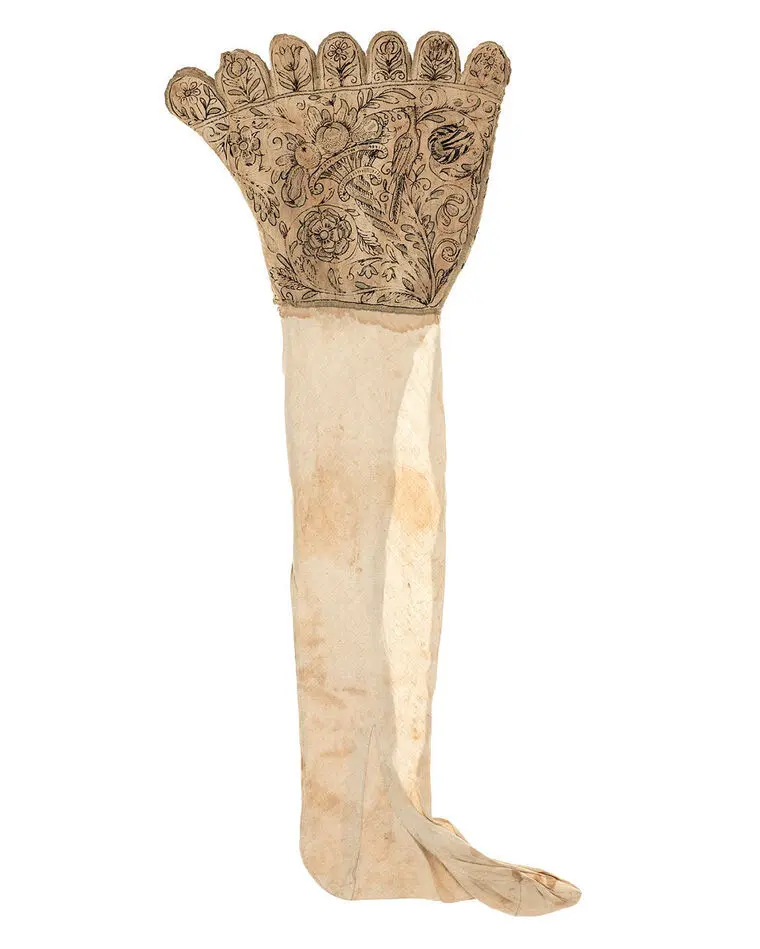 | ||||
| Figure 2: Boot hose worn by Gustavus Adolfus. Livrustkammaren |
Boothose tops (and canons)
Boothose tops, were just the tops without the legs, to fit in or over the top of the boots to make a fashionable display. A pair can be seen in this photograph of two 1650s outfits belonging to Charles X of Sweden, Figure 3. Having just the tops could be cheaper, in 1632 a pair of boothose tops belonging to Ralph Wells was sold for 9d. (5 pp. 119-25) However this also meant that the tops could be heavily decorated, or have expensive lace attached, while the boot hose itself could be plain and more easily laundered. James Master between 1646 and 1651 bought at least twenty-seven pairs of boothose tops. (6)
Boothose tops can sometime be referred to as canons. In the early part of the century the term canon referred to a tighter to the leg extension to fuller breeches, as in Cotgrave’s description, “round breeches with strait cannions” (7), but by the second half of the century it could refer to separate tops to stockings or boothose, especially worn with wide petticoat breeches, but not necessarily with boots. Samuel Pepys wrote in 1660 that he “made myself as fine as I could, with the Linning stockings on and wide canons that I bought the other day.” (8 p. 24th May) He does not say whether he is wearing boots with them. Giles quotes a c.1664 bill, “For making a dove-color'd and silk brocade coat, Rhingrave breeches and cannons.” (9 p. 56) So the canons were made to match the coat and breeches, not the stockings.
 |
| Figure 3: Two 1650s suits of Charlex X of Sweden. Livrustkammaren. |
Boothose and tops: materials, colours, and costs
Many were made of linen, and some state that they are the better quality holland linen. In 1651 James Master paid out for even finer cambric, “for a band, cuffs and boothose tops of cambrick 11s.” (6 p. 198) Charles I purchased his boothose by the dozen, for example, “2 dozen fine linen boothose with welted tops,” these cost sixteen shillings a pair in 1635 (10 p. 89) Welted in this sense means to add a border or strip of something to a garment, as in “In making of velvet breeches, where there is required silke lace,..and such costly stuffe, to welt, …, edge, face, and draw out.” (11) The lace added to the boothose could be expensive, in 1641 the Hertford accounts have “for 4 yardes of bonelace for three paire of boothose for my Lord Henry at 7s.” (12 p. 32) Lower down the social scale boothose tops could be purchased from grocer James Kennard in 1637 for 1s 6d a pair. (13)
Linen was not the only fabric used, nor was white the only colour. In 1626 Tollemache of Helmingham Hall had “iiij deroy coloured paire of bootehoose topps, three of cloathe, one of bayes on paire with a broade lace.” (14 p. 82) Deroy is a debatable colour, as Cotgrave said in 1611, “Couleur de Roy, was in old time Purple; but now is the bright Tawnie, which wee also tearme, Colour de Roy.” (7) Cloth is usually used to indicate a wool based fabric, and bays (baize) is also wool based. In 1653 James Master purchased a “pa of black taffeta boothose 13s.” and in 1650 “a pa of scarlet worsted tops 4s” (6 p. 208 & 191) Charles I in 1635 purchased “40 paires of grey boothose.” (10 p. 88)

Figure 4: Knitted boot hose. Victoria and Albert Museum.
Boot hose could be knitted, and figure 4 shows a pair of knitted woollen boothose in the collection of the Victoria and Albert Museum. In 1663 that Samuel Pepys purchased “silk tops for my legs” and four weeks later wore his best black cloth suit "with my black silk knit canons I bought a month ago"
Who owned boothose
Most records are from the nobility and gentry, but just as boots are owned lower down the social scale, so are boothose. In 1612 Isaac Lowden, who was both a vicar and a schoolmaster, had as his linen, “a shirt, two bandes, two payre of custes [cuffs], a payre of boote hose & an handkercher 4s.” (15 pp. 122-3) In 1626 a yeoman in Hampshire, Richard Perrin, owned “three shirts, one pair of boothose, … another old pair of boothose.” (16) They appear in the stock of grocers, mercers, etc., in 1668 George Johnson in Kent had in stock 57 pairs of men’s woollen stockings at just over one shilling a pair, but just three pairs of boot hose at 1s 8d a pair. (17 pp. 76-7)
References
1. Hayward, Maria. Dress at the Court of King Henry VIII. Leeds : Maney, 2007.
2. Stubbes, Philip. Anatomie of Abuses. London : Richard Jones, 1583. https://www.bl.uk/collection-items/the-anatomy-of-abuses-by-philip-stubbes-1583.
3. MacTaggart, Peter and MacTaggart, Ann. The Rich Wearing Apparel of Richard, 3rd Earl of Dorset. Costume. 1980, Vol. 14.
4. Middlesex Sessions Rolls. Middlesex County Records: Volume 3, 1625-67. London : Middlesex County Record Society, 1888.
5. Briggs, J. and McGhee, R. Sunderland Wills and Inventories, 1601-1650. Publications of the Surtees Society. 2010, Vol. 214.
6. Robertson, S. The expense Book of James Master 1646-1676 [Part 1, 1646-1655], transcribed by Mrs Dallison. Archaeologia Cantiana. 1883, Vol. 15, 152-216, pp. 152-216.
7. Cotgrave, Randle. A Dictionarie of the French and English Tongues. London : Printed by Adam Islip, 1611.
8. Pepys, Samuel. Diary. [Online] https://www.pepysdiary.com/diary.
9. Giles, Edward. The history of the art of cutting in England. London : Prewett, 1887.
10. Strong, Roy. Charles I's clothes for the years 1633-1635. Costume. 1980, Vol. 14, pp. 73-89.
11. Greene, Robert. A Quip for Vpstart Courtier: or, A Quaint Dispute Between Veluet Breeches and Clothbreeches . London : John Wolfe, 1592.
12. Morgan, F. C. Private Purse Accounts of the Marquis of Hertford, Michaelmas 1641-2. Antiquaries Journal. 1945, Vols. 25, 12-42, pp. 12-42.
13. Kent Archaeological Society. Kentish Documents c1530-1810. Inventory of James Kennard 1637 (PRC11/2/62). [Online] [Cited: November 20, 2025.] https://www.kentarchaeology.org.uk/13/01/52.pdf.
14. Coleman, Moira. Household Inventories of Helmingham Hall 1597-1741. Woodbridge : Boydell Press for The Suffolk Records Society, 2018.
15. Atkinson, J A., et al eds. Darlington wills and inventories 1600-1625. Publications of the Surtees Society. 1993, Vol. 201, p.111-114.
16. Hampshire County Record Office. Probate inventory of Richard Perrin. Hants.RO 1626A/094. 1626.
17. Lansberry, H. C. F. ed. Sevenoaks wills and inventories in the reign of Charles II. Maidstone : Kent Archaeological Society., 1988.


No comments:
Post a Comment
Note: only a member of this blog may post a comment.