Friday, 10 August 2012

The rise and fall of the shoe rose (1580-1660)

In the second half of the 16th century shoes started to be closed again using a latchet. Latchet is an old term for a thong or similar used to fasten a shoe (1). By the early 1600s, for the upper classes, royalty, nobility and gentry, the bows these latchets were tied into had disappeared behind huge shoe roses. They were still in place in 1640, but by 1660 they seem to have disappeared. This is an essay in details from paintings showing the rise and fall of the shoe rose. The links take you to an online version of the full painting.
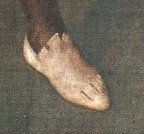
1577

So we start with Martin Frobisher’s shoe painted in 1577, in a style that had been around for some time. Are the the sort of “white leather pumps, 14d,” that the Petrie Accounts for 1569 list? (2)
1597

Next we have a 1597 pair of shoes belonging to Robert Devereux, Earl of Essex with latchets tied in a small bow.
1606

1606 and King James I and VI has got the beginnings of these roses, but still very small.
By 1613 his son, Prince Charles,  has definitely got them. Somewhere about this time Ben Jonson wrote in his play Epicœne, or The silent woman (staged 1609, published 1616) “All the yellow doublets, and great roses i' the towne will bee there.”
1613
1611
Just to prove that women also wore them, though they were usually hidden under their skirts, here are the shoes of Frances Howard, Countess of Hertford in 1611. These items could be very expensive, as Peacham commented, “and shoo-tyes that goe under the name of roses, from thirty shillings, to three, foure and five pounds the pair.” (3)


1613

Back to 1613 and Richard Sackville, Earl of Dorset. Now here we are lucky as an inventory of the Earl’s clothing dated 1617 exists, and the items appearing in this portrait have been tentatively identified. (3)  Item 42 in the inventory is “Item one paire of roses of black ribban laced with gold and siluer lace. This is matched with Item 43 “one paire of white silke stockings embroadered  with gold and siluer.”

1636
King Charles is still wearing them with his robes of state in 1636, and his purchases in his Wardrobe accounts for 1633-35 show that roses were being matched with the garters and points, for example Thomas Robinson is paid for among others “One paire of rich needlework garters cinnamond cullour with roses and points suitable to them” (4)

Portraits from the Civil War show most frequently men in boots, but the shoe rose survived and can be seen in Peter Nason’s 1651 portrait of Walter Strickland.

The rose however did not survive the restoration. Charles II chose to be painted in the coronation portrait wearing shoes fastened with buckles, it was the beginning of the end. Although ordinary people had worn shoes with simple latchet ties for the whole period, and continued to do so until the end of the century, buckles were swiftly taking over. As Pepys said on the 22nd January 1660 “This day I began to put on buckles to my shoes, which I have bought yesterday of Mr. Wotton.”

1. OED. Oxford English Dictionary online version June 2012. [Online] 2012. [Cited: 10 August 2012.] http://www.oed.com/view/Entry/106043.

2. Cunnington, C. W. and P. Handbook of English Costume in the 16th century. London : Faber, 1970.

3. Peacham, H. The truth of our times. . London : s.n., 1618.

4. MacTaggart, P. and A. The rich wearing apparel of Richard, 3rd Earl of Dorset. Costume. 1980, Vol. 14.

5. Strong, R. Charles I's clothes for the years 1633-1635. Costume. 1980, Vol. 14.

Saturday, 4 August 2012

Jane Lambard's Mantle

Jane Lambarde by Marcus Gheerhaerts
A portrait of Jane Lambarde painted by Marcus Gheerhaerts, and now in the collection of the Drapers’ Company in London. It dates from about 1620, and is of interest to the lovers of embroidered jackets and petticoats, however the real thing about the painting is that the mantle/cloak she is wearing survives and is also in the Drapers’ Collection . This is so rare at this date, one thinks of Margaret Layton’s jacket and Sir Richard Cotton’s suit, but that is about it. Janet Arnold (1980) wrote an article on the painting and the mantle, putting them in the context of a series of paintings of women wearing mantles which date from the 1590s to 1630s, such as the portrait of Francis Howard, Countess of Hertford, 1611 by the same painter,  Isabella Rich by William Larkin (below) or a lady, thought to be Elizabeth, wife of Sir William Pope (1596-1624)

The mantle itself is made from two pieces of crimson velvet to create a rectangle 53 by 45 inches. It is according to Arnold interlined with cream linen and “lined” with silk shag, in a slightly lighter red,  which is cut larger than the velvet and then turned back to form a edge 2½ inches wide on the front. Shag, (OED)is a material with a long pile used for linings and often of worsted or, as here, silk. There is then a band of plaited bobbin lace in gold and silver thread, 2½ inches wide. This lace is very similar to some of the plaited lace patterns that appear in Le Pompe (Levey, 1983)

Isabella Rich by William Larkin
The mantle is often worn tied, or held together with a brooch over one shoulder.  Arnold has speculated that most are tied of the left shoulder because most people are right handed. The Stowe Inventory of Queen Elizabeth's wardrobe has 94 mantles and veils. (Arnold, 1988)

Arnold, J., 1980. Jane Lambarde's mantle. Costume, Volume 14, pp. 56-72.
Arnold, J., 1988. Queen Elizabeth's Wardrobe Unlock'd. Leeds: Maney
Levey, S. and Payne, P. (eds), 1983. Pompe, 1559: Patterns for Venetian Bobbin Lace. s.l.:Ruth Bean.

OED. Oxford English Dictionary Online.

Tuesday, 31 July 2012

Banyans or Nightgowns

Vermeer - The astronomer, 1668.
The name

The Oxford English Dictionary defines a banyan as “A loose gown, jacket, or shirt of flannel, worn in India.”  Many costume historians over the years have conflated it with a nightgown, and just to stop any confusion, in this sense a nightgown is not what you wear in bed, it is a loose gown worn informally at home. These loose gowns appear all over Western Europe in later part of the seventeenth century, as Lemire (2009) has commented in each country they are known by a different name. In France, where the influence of the Armenian trading community was important they are known as a robe d’Armenien, or a robe de chambre, as in this 1676 example. The Dutch called them Cambay, a name derived from the Indian port of Khambhat in Gujarat, or more commonly,  because of their trade with Japan, Japanese robes (japonsche rok) as worn by Vermeer’s Astronomer (pictured above right) and Geographer (Hollander, 2011). The English also used a Gujarati term for these loose garments, a banyan (or banian),  indicating a Hindu trader, but the first use the OED has for banyan as an article of clothing is 1725. (Oxford English Dictionary), and interestingly the term does not appear in Dr Johnson’s Dictionary (1755)

The types

Green banyan in the LACMA collection
The Cunningtons (1972) write of a banyan or (as they say) an Indian nightgown as “a loose coat ending just above or below the knees and having a short back vent to the skirt. It wrapped over in front being fastened by a clasp, or was buttoned or hooked down the front,” as in this superb example in LACMA (left), but they do not say how they came by this description. Anne Buck describes two types of nightgown the looser longer garment and the shorter more fitted version described by the Cunningtons, saying that the term banyan is also used for this second type. (Buck, 1979)

Who wore them?

The banyan/nightgown was an informal garment usually worn around the house with a shirt and breeches, though Steele in 1711 wrote of those who “come in their nightgowns to saunter away their time” in coffee houses. As Fortune (2002)has pointed out it usually those who are, or wish to appear, studious, who are painted in nightgowns, for example the 1695 portrait of John Dryden by James Maubert,  the 1712 portrait of Isaac Newton by James Thornhill , and the 1745 portrait of Maurice Greene, professor of music, in a nightgown, and his friend John Hoadley, a clergyman and poet, in a suit

Surviving examples

The Metropolitan Museum has several banyans/nightgowns dating from throughout the eighteenth century. LACMA has several as well as the one shown above.  The example in the Museum of London has an outer fabric of Spitafields silk that was originally a different garment and was remade as a banyan in the mid 18th century. The V&A example is cotton chintz rather than silk.  Platt Hall at Manchester has four examples from the eighteenth century.

Buck, A., 1979. Dress in eighteenth century England. London: Batsford.
Cunnington, C. W. and P., 1972. Handbook of English costume in the eighteenth century.. Rev. ed. London: Faber.

Fortune, B., 2002. "Studious men are always painted in gowns": Charles Wilson Peale's Benjamin Rush and the question of banyans in the 18th century. Dress, Volume 29, pp. 27-40.

Hollander, M., 2011. Vermeer's Robe: Costume, Commerce, and Fantasy in the Early Modern Netherlands. Dutch Crossing: Journal of Low Countries Studies, 35(2), pp. 177-195.

Johnson, S., 1755. Dictionary. [Online] Available at: http://johnsonsdictionaryonline.com/ [Accessed 20 July 2012].
Lemire, B., 2009. Fashioning global trade: Indian textiles, gender meanings and European consumers 1500-1800. In: G. Riello, ed. How India clothed the world: the world of south Asian textiles 1500-1800. Boston, MA: Brill, pp. 365-389.

Oxford English Dictionary. Banian. [Online] Available at: www.oed.com/ [Accessed 5 July 2012].

Friday, 13 July 2012

After Janet Arnold: researching and reconstructing historical clothes in the 21st century, report on a talk by Jenny Tirimani

Last weekend I was at a Costume Society study day in Bath and one of the speakers was Jenny Tirimani, who gave a talk with the title above. Jenny for those who don’t know her was designer at the Globe until 2005, was heavily involved with Patterns of Fashion 4 and edited Seventeenth Century Women’s Dress Patterns, the second volume of which is due out shortly. She is an inspiring speaker with an obvious great love for her subject.

Jenny started by talking about what books are around that have usable patterns taken from surviving clothing, far fewer than you would think. As well as Norah Waugh’s two books on the Cut of Women’s Clothes and the Cut of Men’s Clothes, and Janet Arnold’s four Patterns of Fashion, Jenny mentioned, Sharon Ann Burnston’s Fitting and Proper: 18th century clothing from the collection of the Chester County Historical Society (USA), Linda Baumgarten’s Costume close-up: clothing construction and pattern, 1750-1790 (Williamsburg) and Johannes Piestch’s patterns taken from the Hupsch collection in the Hessischen Landesmuseum Darmstadt  and published by Abegg in 2008 (his PhD thesis on the subject is available online at http://nbn-resolving.de/urn/resolver.pl?urn:nbn:de:bvb:91-diss-20080821-619442-1-9)

Jenny mentioned that she is a director of The School of Historical Dress, which is launching fully in October. The School has access to Janet Arnold’s archive, including probably over half a million slides, and all the material that Janet so sadly left unfinished at her death. Jenny said that there is probably enough material for another two volumes of Patterns of Fashion and showed us a highly detailed unpublished pattern of a c.1620 man’s suit in the Livrustkammaren Stockholm; I think from the description this one .

Jenny spoke about pattern books that were available in the 16th and 17th centuries. The work book of a Milanese tailor dating c.1550-80, here Jenny pointed out that many of the shapes were based on parts of a circle or compounds thereof, and that this was the difference between the tailor and the seamstress.  The Masterbuch von Enns dating to c.1590, I think that is this one. The Libro de geometria (Tailor's pattern book) by Juan de Alcega 1589. The Martin de Anduxar, Geometria y tragus pertinecientes al oficio de sastres, published in Madrid in 1640, and Le Tailleur Sincere of 1671 by Benoist Boullay. I was interested to see that this last book has a pattern for a coat for a poor man. A list of what is available electronically is here.

Jenny was responsible for the fantastic outfits for the Metropolitan Opera’s 2011 production of Anna Bolena, and spoke about the difficulties of researching what was for her a less well known period, most of her work for the Globe being 1590s. She spoke about the 1530s outfit of Maurice, Elector of Saxony, in the Staatlichen Kunstammlungen Dresden, more information is available here, and the Abegg Stiftung publication of their work on the garments is Das Prunkkleid des Kurfürsten Moritz von Sachsen (1521-1553) in der Dresdner Rüstkammer: Dokumentation - Restaurierung – Konservierung, by Bettina Niekamp and Agnieszka Wos Jucker.  Jenny also mentioned some very early Hungarian material, about c1515, which I think is in the Hungarian National Museum, but I cannot find it on their website.

Jenny finished her talk by speaking about the new production of Richard III that she is currently involved with for the Globe, sounds exciting.

Tuesday, 10 July 2012

Fashioning the Early Modern Final Conference 2012

Fashioning the Early Modern Final Conference 2012
14-15 September 2012, Victoria and Albert Museum, London

The HERA funded 'Fashioning the Early Modern: Creativity and Innovation in Early
Modern Europe, 1500-1800' project will be holding its final conference on Friday
14 and Saturday 15 September at the Victoria and Albert Museum.

The two-day “Fashioning the Early Modern: Creativity and Innovation in 1500-1800
Europe” conference will be organised around three themes: Innovation,
Dissemination and Reputation. The following key profile speakers have been
invited to speak: Lesley Miller (Victoria and Albert Museum), John Styles
(University of Hertfordshire) and Evelyn Welch (University of Queen Mary,
University of London).

Registration is open to all those interested to attend. For a Conference Programme and online registration, go
to:
http://www.vam.ac.uk/whatson/event/1818/fashioning-the-early-modern-creativity-and-innovation-in-europe-2990/

Monday, 11 June 2012

The Judith Hayle Samplers


Back in 2001 I went to an exhibition of embroideries at Dorchester Museum, it was called The point of the Needle. They had a series of talks, and one of the speakers was Edwina Ehrman of the Museum of London. Her talk was fascinating; she had been researching Judith Hayle, and her daughter Rebecca Thomson, who taught needlework in Ipswich at the end of the seventeenth century, beginning of the eighteenth century. I didn’t realise until recently that in 2007 Edwina published a book, “The Judith Hayle Samplers.” (ISBN 978 0 9552086 0 7)

Why is Judith Hayle so interesting? First, she is the first teacher to be named on a sampler. Elizabeth Meadow’s 1691 sampler says, “Elizabeth Meadows is my name and with my needle I wrought the same and Juda Hayle was my dame.” Secondly a lot, fifteen or sixteen, samplers produced by pupils of her and her daughter survive. Finally Edwina has been able to find out a vast amount about both Judith and Rebecca and their pupils.

Judith Hayle was born in Ipswich in 1649, married in 1669, and was left a widow with six or seven children in 1685. Edwina does not know when she started teaching, but the first samplers with her name were produced in 1691. When she died in 1706 she left a will, and the inventory indicates that at that time she was running a shop and from the contents, “bone lace- head rowle & wyers & musling & forms, Lynnen horses & other odd nifles,” she was producing headdresses.  Her pupils were, for the most part, not the offspring of gentry, they were the children of mercers, drapers, weavers, malsters and yeomen, the emerging middle classes.

The book is 91 pages long, well illustrated with lots of colour photographs, and has a fascinating story to tell. Well worth it. The story continues for in 2010 an unknown Judith Hayle sampler, dated 1696, was sold at auction. Further information on the book is at http://www.needleprint.com/books.html


Sunday, 10 June 2012

Tuppenny lace (for non lace makers)


As several people have asked how to make the simplest lace attached to Elizabeth Isham’s letter to her father, here are my instructions based on the assumption that you know nothing about lace making. Apologies to those who do know how to make lace.

First thing to say is that most early bobbin lace (does not apply to needlemade lace) is not made with a ground as modern lace tends to be. If you go to learn lace – assuming you are British rather than European -  you will probably start with torchon, then learn Beds (Bedfordshire), Bucks (Buckinghamshire) and last (because it requires a different type of bobbin) Honiton. This is how I learnt about 30 years ago. I gave up when the children were little and developed a disconcerting habit of turning my pillow upside down.
Starting point

The tuppenny lace requires four pairs of bobbins. Two pairs for the footside – the side you attach to fabric – and two pairs of workers that weave through. This photo hopefully not to blurred, shows ready for a pattern repeat. Before I started writing this I thought how hard can it be. Now I think this is something you learn by “sitting next to Nellie”.
Adding the first twists


Close over the pin with a whole stitch, that is weave the worker pair through the footside pair, this is not lace terminology but it is aimed at people who don’t know. Put in two twists, that is for each pair put the right hand bobbin over the left hand bobbin twice. Put two twists in the inner footside pair, then whole stitch (weave) the worker pair through the inner footside pair, and put in a pin. Bring in the second worker pair. With the two worker pairs work a three half stitch plait. Put up a pin, close round the pin. Put in two twists. With the right hand thread make a picot. Put in two twists. Put up a pin. With the two worker pairs work a three half stitch plait. Put up a pin. Whole stitch one pair of workers through the inner footside. Put up a pin. Put in two twists. Whole stitch the pair of workers through the outer footside. You are back where you started.
Whole stitch


Half stitch
The photographs of stitches I have taken from my 1931 copy of Margaret Maidment’s A manual of handmade bobbin lace work.  I afraid I am not very good with a camera, so everything is blurry. 

Half stitch plait
Picot


Suzanne wedding bouquet of lace
The best piece of lacemaking I was ever involved with was my tutor's wedding bouquet. This is entirely made of lace. It won the John Bull trophy, everyone Suzanne taught was involved, and she carried it on her wedding day. I made a few stephanotis leaves.